
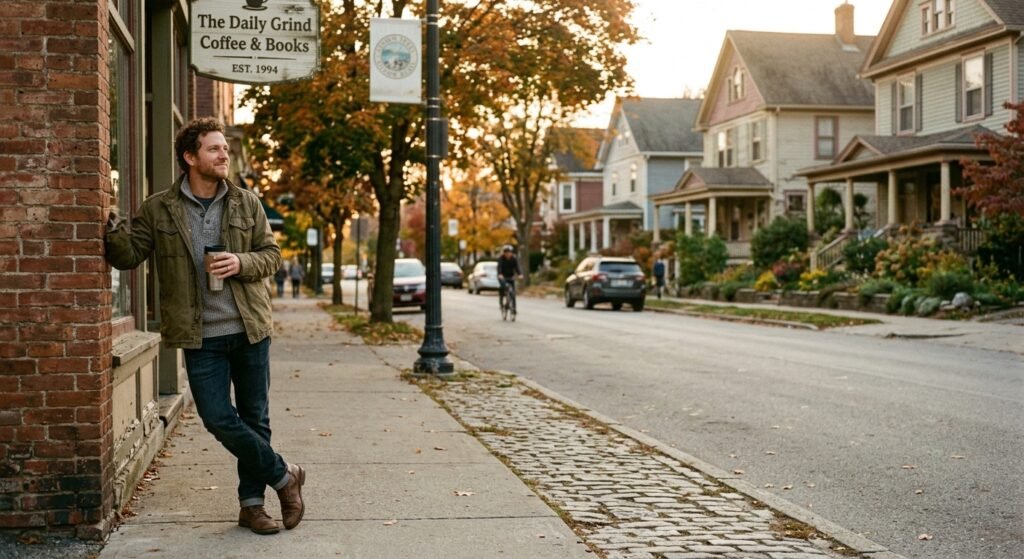
The drive back always begins with a strange sense of comfort. You turn off the highway, pass the welcome sign you’ve seen a thousand times, and find yourself on roads you could navigate with your eyes closed. There is the diner where you spent Friday nights in high school, the grocery store where you ran errands with your mother, and the quiet streets where you first learned to drive. Everything looks exactly as it always has, but as you pull into the driveway, a quiet, unsettling realization settles in. You are here, but you aren’t really home anymore.
It’s a difficult feeling to name because it doesn’t arrive with a dramatic event. Nothing terrible happened to drive you away, and the town itself hasn’t fallen apart. The streets are still there, the people you grew up with are still living their lives, and the local coffee shop still smells like burnt espresso and cinnamon. Yet, as you walk through the rooms of your childhood house or run into an old acquaintance at the supermarket, the space feels smaller than you remember. It’s like trying to wear a favorite jacket from middle school. You still love the color and remember how warm it kept you, but the seams are pulling, and you can’t quite move your arms.
Many of us experience this quiet grief during life transitions, especially when we return to the places that raised us. We expect to feel an immediate rush of belonging, a return to safety. Instead, we’re met with a strange disconnect. You might find yourself sitting in your old bedroom, looking at posters of bands you haven’t listened to in a decade, feeling like an intruder in your own history. You aren’t unhappy to be there, but you’re intensely aware of the distance between the person who used to sleep in that room and the person sitting there now.
This disconnect often makes us feel guilty. We worry that our discomfort means we’ve become snobbish or that we’re turning our backs on our roots. We worry that by finding our hometown quiet or limiting, we’re somehow criticizing the people who chose to stay. But this isn’t about superiority. It’s about growth. When we outgrow a place, we aren’t rejecting it; we’re simply recognizing that the container no longer holds the life we are trying to build.
The Comfort of the Familiar Trap
Our brains are wired to love familiarity because it represents safety. In psychological terms, our attachment to places is deeply connected to our identity formation. When we are young, our environment tells us who we are. The school we attend, the neighborhoods we wander, and the local social rules provide a steady framework for our daily existence. We don’t have to think about where we fit because the town has already decided our place for us.
But as we step out into a larger world, we start building our own framework. We encounter different perspectives, choose new career paths, and form relationships based on shared values rather than shared zip codes. We develop new habits and realize we care about things our hometown never quite had room for. This personal expansion is a natural part of adulthood, but it comes with an unspoken cost. When you return to the place where your identity was first formed, you often feel pressured to shrink back into the old version of yourself just to make everyone else comfortable.
You might notice this during family dinners or when catching up with childhood friends. The conversation naturally drifts toward the past, repeating the same old stories, the same high school jokes, and the same familiar narratives. It’s pleasant for an hour or two, but eventually, you realize that nobody is asking about who you are today. They’re interacting with the memory of you. And keeping that memory alive requires you to hold back the parts of yourself that have grown since you left.
The Grief of No Longer Fitting
What makes this transition so complicated is that we rarely give ourselves permission to grieve places. We understand mourning a relationship or a lost job, but mourning a town feels dramatic. After all, the town is still there. You can buy a ticket or drive back whenever you want. But the thing you’re actually mourning isn’t a geographical location. It’s a specific chapter of your life, and more importantly, the version of you that lived it.
There is a profound sadness in realizing that the safety of your past can no longer protect you in the present. When you were younger, you might have believed that no matter how difficult the world became, you could always go back. Hometowns live in our minds as ultimate fallback plans, permanent sanctuaries where time stands still. But when you finally return and realize the sanctuary no longer fits, you lose that comforting illusion. You realize that you’re entirely responsible for creating your own sense of safety now, wherever you happen to be.
This realization often brings a sense of loneliness. You walk down streets that once felt massive and realize they’re actually quite narrow. You look at the local landmarks and realize they don’t hold the same magic they used to. It’s a quiet acknowledgment that you have crossed a threshold, and there is no going back to the simpler, smaller world you once navigated so easily.
Honoring the Ground We Grew On
It’s easy to mistake this feeling for a mistake, to think that if returning home hurts, we must have made a wrong turn somewhere in our lives. We might wonder if we should have stayed, if life would have been simpler, warmer, and more grounded if we had never left. We see the people who stayed behind, building houses down the road from their parents, and we sometimes envy the uncomplicated clarity of their lives. But we can’t undo the expansion we’ve experienced. You can’t force yourself to forget the world you’ve seen or the person you’ve become.
Perhaps the secret is changing how we look at our hometowns. They aren’t meant to be permanent museums of our lives, nor are they places we must reject to prove we’ve succeeded. Instead, we can think of them as the soil that allowed us to grow. A plant doesn’t hate the dirt it started in just because its roots have outgrown the pot. It simply needed more space to bloom.
Outgrowing your hometown doesn’t mean the place wasn’t important, and it doesn’t mean your memories there are any less real. Maybe the quiet grief of returning home isn’t a sign that you’ve made a mistake or lost your way. Maybe it’s the ultimate proof that your hometown did exactly what it was supposed to do. It gave you a safe enough place to start so that you would eventually have the courage to leave.