
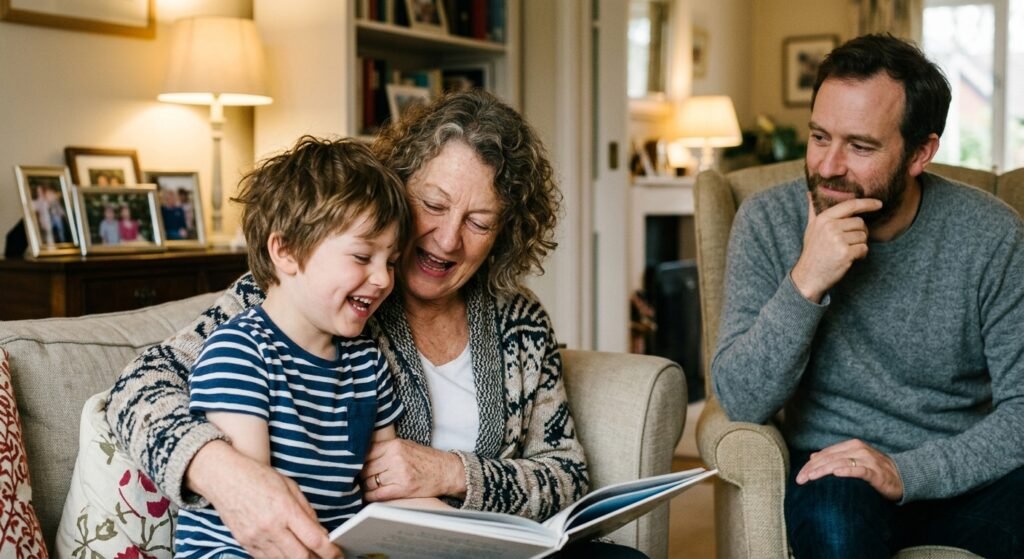
You’re standing in the kitchen, holding a partially washed glass, looking out the window into the backyard. Your child is sitting on the grass, head tilted back in genuine laughter. Next to them is the one person you’ve spent the last decade quietly, carefully keeping at arm’s length. Maybe it’s a sibling whose unpredictable choices made you retreat, an in-law whose sharp comments left you bruised, or a cousin whose presence always brought a quiet tension to family dinners. You’ve perfected the art of the polite nod, the brief phone call, and the comfortable distance. Yet, there they are, sitting together in the afternoon sun, sharing a moment that looks effortless.
It’s a sight that can make your chest tighten in a very specific, complicated way. You don’t feel anger, exactly, but rather a profound sense of surprise. For years, you built those emotional boundaries to keep yourself and your household safe from friction. You assumed those boundaries would naturally stretch over your children like a protective canopy. Seeing your child step outside that shelter to grasp the hand of someone you’ve spent years keeping on the other side of the fence is disorienting. It forces you to watch two entirely different realities exist in the same yard.
To you, this person represents a library of old disagreements, unsaid frustrations, and years of carefully managed disappointment. You remember the exact holiday dinner where everything changed, or the specific phone call that made you decide to pull back. But to your child, none of that history exists. They don’t have an archive of past offenses or a mental list of reasons to be cautious. They simply see someone who is willing to help them build a cardboard castle, someone who listens to their long, winding stories about recess, or someone who treats them like the most important person in the room.
The Clean Slate of Childhood
We often forget that children possess a remarkable ability to see people without the burden of their past mistakes. Developmental researchers often talk about how young minds form relationships based almost entirely on immediate, present moment safety and play. They aren’t tracking consistency over a long timeline. They’re looking at who is willing to sit on the floor with them right now. For a child, a person is simply the sum of how they show up in the room in this very second. It’s a beautifully simple way of moving through the world, even if it feels deeply complicated for the parent watching from the kitchen window.
This simplicity allows children to build bridges over chasms we’ve spent half of a lifetime constructing. They don’t feel the tension that lingers in the air when a room goes quiet. They don’t decode the indirect hostility in a casual remark. They just hear a voice asking about their favorite color, and they answer with complete honesty. In doing so, they unknowingly invite us to witness a version of that difficult person we never got to see, a version that might actually be capable of warmth, playfulness, and patience when the demands of adult relationships are removed.
When People Show Up Differently
It’s entirely possible that the person you’ve kept your distance from is genuinely different with your child than they ever were with you. Adult relationships are fraught with expectations, shared histories, financial pressures, and personality clashes. Sometimes, two people simply cannot find a way to exist in the same space without friction. But a child doesn’t ask for emotional maturity, shared values, or an apology for something that happened five years ago. A child only asks for presence. Free from the strain of adult dynamics, that difficult person might finally find the space to be their gentlest, kindest self.
This realization can bring its own quiet sting. It’s natural to feel a pinch of resentment when you see someone offering your child the very warmth, consistency, or attention they always withheld from you. You might find yourself wondering why you couldn’t have had that version of them, or why it took a child’s presence to unlock their kindness. Those feelings are valid, and they’re a natural part of navigating family dynamics. But if you watch closely, you might also find a strange sort of comfort in seeing that the capacity for goodness was always there, even if it couldn’t reach you.
Writing Their Own Stories
As parents, we often think our job is to hand down our wisdom, our values, and even our caution. We want to protect our kids from the disappointments we’ve experienced, so we try to guide them toward the safe relationships and away from the complicated ones. But children aren’t just continuations of our own lives. They’re entirely separate individuals with their own social pathways to walk, their own lessons to learn, and their own stories to write. They don’t inherit our emotional archives unless we force them to carry them.
Allowing your child to love someone you’ve struggled to love is a quiet act of courage. It means choosing not to recruit them into old family rivalries or quiet standoffs. It means standing back and letting them form their own opinions, even when it feels uncomfortable to watch. You don’t have to tear down your own boundaries to let this happen. You can keep your distance while still leaving a doorway open for your child to walk through. Your peace doesn’t have to be compromised for their connection to flourish.
Perhaps that’s the ultimate realization that comes from watching that effortless laughter on the grass. Our children are not here to fight our battles or validate our past hurts. They’re here to remind us that relationships can be rebuilt, simplified, and experienced in entirely new ways. By letting them write their own stories with the people we couldn’t figure out how to love, we aren’t losing anything. We’re simply giving them the freedom to see the world with clearer eyes than our own, and perhaps, in the process, we’re letting ourselves heal just a little bit too.