
The Silence in the Driveway
Imagine sitting in your car with the engine off, staring at the garage door for just a few extra seconds before you walk inside. You’ve had a day that felt like a marathon, the kind where your neck is tight and your mind is still spinning with unfinished tasks. You take a deep, deliberate breath, roll your shoulders back, and consciously decide to leave the stress of the day right there in the front seat. You plaster on a pleasant face because you don’t want your family to carry the burden of your demanding day. You walk through the front door, call out a cheerful greeting, and head into the kitchen.
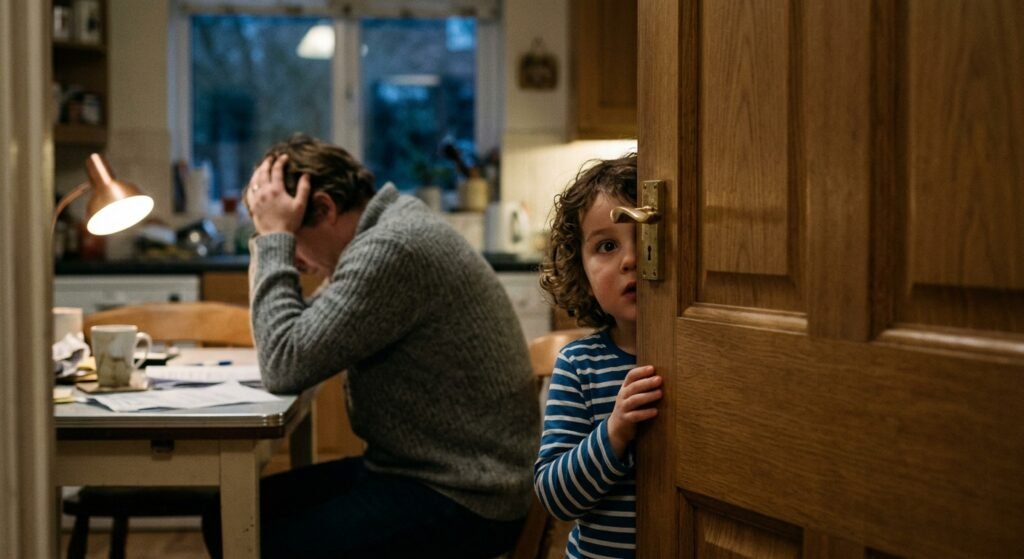
On the surface, you’ve done everything right. You didn’t yell, you didn’t complain, and you kept your worries to yourself. Yet, across the room, your young child quietly stops playing with their blocks. They don’t say anything, but their eyes follow you as you set your keys on the counter. They might ask if you’re mad, or they might suddenly become unusually cooperative, offering to help with dinner without being asked. They don’t know the specifics of your budget meetings or your difficult conversations, but they’ve already received the signal. Without a single word being spoken, they’ve felt the change in the air.
The Silent Translators of Our Tension
We often think of parenting as a series of instructions, conversations, and deliberate choices. We assume that if we don’t speak our anxieties aloud, our children remain safely insulated from them. It’s a beautiful, protective instinct. We want childhood to be a place of warmth and simplicity, untouched by the adult world of bills, deadlines, and personal doubts. So we tuck our worries away, believing we’ve hidden them behind closed bedroom doors or quiet sighs.
But children are remarkably perceptive observers. Long before they understand the vocabulary of adult anxiety, they are masters of reading our nonverbal cues. They notice the exact sharpness with which we close a cabinet door. They recognize the slight tightness in our voice when we say everything is fine. They feel the lack of presence when we’re looking directly at them but our minds are miles away. To a child, a parent is their entire world, which means they must become experts in reading that world’s emotional atmosphere.
The Rhythm of Shared Feelings
This isn’t just an observation; it’s deeply rooted in how we’re built to connect. People who study family dynamics have found that families operate much like a single orchestra. When one instrument is out of tune, the rest of the players instinctively adjust. Studies tracking parent and child interactions show that our physical systems are remarkably synchronized. When a parent’s heart rate rises during a stressful task, their child’s heart rate often climbs right along with it, even if the parent is actively trying to hide their frustration.
Our bodies are constantly sending signals to one another. When we try to mask our tension, we often send conflicting messages. A child sees a smile, but they feel the rigid posture. This mismatch can actually feel more confusing to them than the stress itself. When the emotional climate doesn’t match what they’re seeing, their internal alarm system quietly activates. They start watching us more closely, trying to solve the puzzle of what’s wrong, because in their mind, an unpredictable environment is an unsafe one.
The Roles They Play to Restore the Peace
When a child senses this unspoken tension, they often find ways to manage it. Some children become peacekeepers, turning into exceptionally helpful, quiet helpers who try to minimize their own needs so they don’t add to your burden. They might clean their rooms without prompting, or quietly retreat to their corners, trying to remain as small as possible. They think that if they are perfect, perhaps the invisible storm will pass.
Other children react by releasing the tension they’ve absorbed. They might pick a fight over a juice cup, throw a tantrum over homework, or become unusually clingy. It’s easy to view this as misbehavior, but often it’s simply a young person trying to process an emotional static they don’t know how to name. They feel the pressure in the house, and because they can’t sit with the unresolved silence, they create a distraction that forces us to engage. In a strange way, a loud tantrum can feel safer to them than a quiet, simmering resentment.
Letting Go of the Perfect Shield
It is remarkably easy to feel guilty when we realize how much our children absorb. We live in a culture that tells us we must be steady, joyful, and endlessly patient guides at all times. We treat our own stress as a personal failure, a crack in our armor that we must patch up before anyone notices. But this expectation places an impossible demand on us, and ironically, the pressure to look perfect only makes us more anxious.
Perhaps the realization we need is that our children don’t actually need us to be perfectly happy all the time. They don’t need us to be emotional superheroes who never feel overwhelmed or tired. What they actually need is honesty. When we pretend everything is wonderful when it clearly isn’t, we teach them to doubt their own instincts. We teach them that what they feel in their gut isn’t real.
When you walk through the door after a demanding day, it’s okay to say that you had a very long day, and your brain is a little tired right now. You can tell them that it has nothing to do with them, and that you’re so happy to be home, but you might need a few minutes of quiet before you play. This simple act of speaking the truth changes everything. It validates what they are already feeling, takes away the mystery, and relieves them of the job of trying to fix your mood. They don’t have to wonder if they did something wrong. They can turn off their internal alarm system, step down from the lookout tower, and simply go back to being kids.