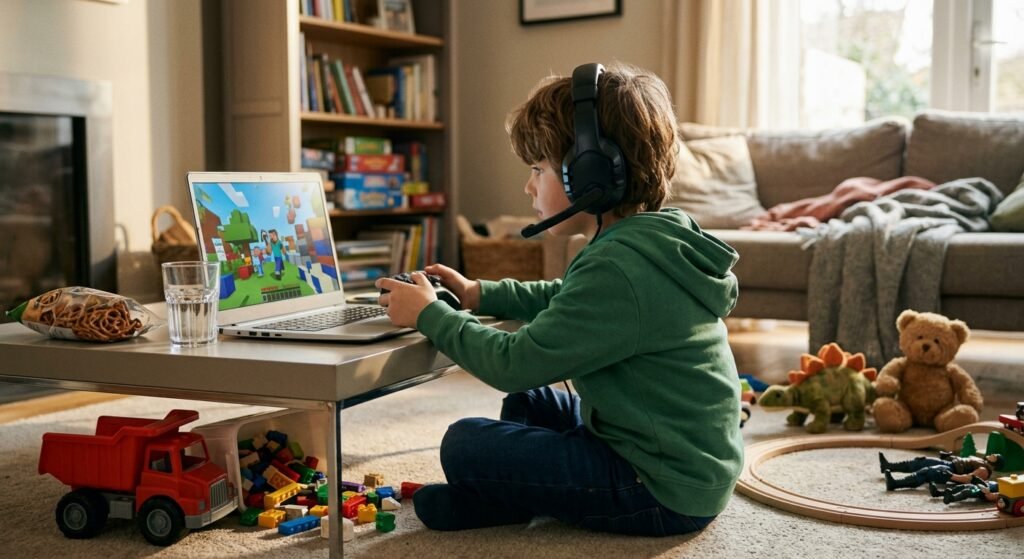
Imagine spending weeks searching for the perfect birthday gift for your child. You find something beautifully made, something tactile that you can wrap in bright paper and tie with a bow. You imagine the look on their face when they unwrap it. But when the moment arrives, they tear through the paper, give the toy a polite smile, and set it aside.
Ten minutes later, they’re practically begging you for a ten dollar digital gift card to buy a virtual outfit for an online avatar. It’s a confusing moment, and if you’re a parent, you’ve probably felt that quiet pang of worry. You look at the screen, then at the discarded toy on the floor, and you wonder if something is going wrong. It’s easy to feel like we’re losing our children to a world we don’t fully understand. We worry that they’re trading the real world for pixels.
The Changing Language of Belonging
When we look at a digital item, we see nothing. We see a collection of code that can disappear with a power outage. But when your child looks at that same digital item, they’re seeing something else entirely. They’re seeing their neighborhood playground, their school cafeteria, and their after school hangout spot all rolled into one. For children growing up today, these digital spaces aren’t just games they play when they’re bored. They’re the actual spaces where friendships are formed, tested, and maintained. The virtual outfit or the digital companion isn’t just a toy. It’s the clothes they wear to school. It’s the conversation starter at recess.
The Need Behind the Screen
Psychologists who study childhood development have long pointed out that children have always projected deep emotional meaning onto objects. Whether it’s a worn out security blanket, a collection of smooth stones from the garden, or a plastic action figure, we’ve always used physical items to help us navigate our feelings and express our identity. Researchers note that these objects act as extensions of ourselves. They help us feel secure when we’re away from home, and they help us show others who we are. Today, that exact process is simply happening on a screen. The tool has changed, but the underlying emotional need remains exactly the same.
Every Generation Has Its Own Treasures
If you look back at your own childhood, you can probably remember loving things that drove your own parents crazy. Maybe you spent your allowance on cardboard baseball cards, plastic colorful rings, or stuffed animals that you were convinced would be worth a fortune someday. To your parents, those things were useless clutter taking up space in your bedroom. To you, however, those items were priceless. They were the ticket into the group conversation. Having the right card or the right sticker meant you belonged. You were part of the club.
The only real difference now is that our children’s treasures don’t collect dust on a bedroom shelf. Instead, they live in cloud storage. But the feeling of holding something that makes you feel connected to your peers is a timeless experience. Our children aren’t a strange new species. They’re just doing what young people have always done: finding ways to fit in.
Understanding the Realization
It’s easy to wish things were simpler. We want our children to climb trees, build forts, and feel the dirt between their fingers. There is still so much beauty in those physical experiences, and it’s natural to protect them. But perhaps we can find some peace when we change the way we look at their digital attachments.
Maybe the digital item was never actually what your child was chasing. Maybe they’re just looking for a way to say, “I’m here, and I want to play too.” When we stop focusing on the screen and start looking at the relationships behind it, the worry begins to soften. We realize that our children aren’t losing their ability to connect. They’re just doing it in a world we didn’t build for them. And in the end, wanting to belong is the most real, comforting thing there is.