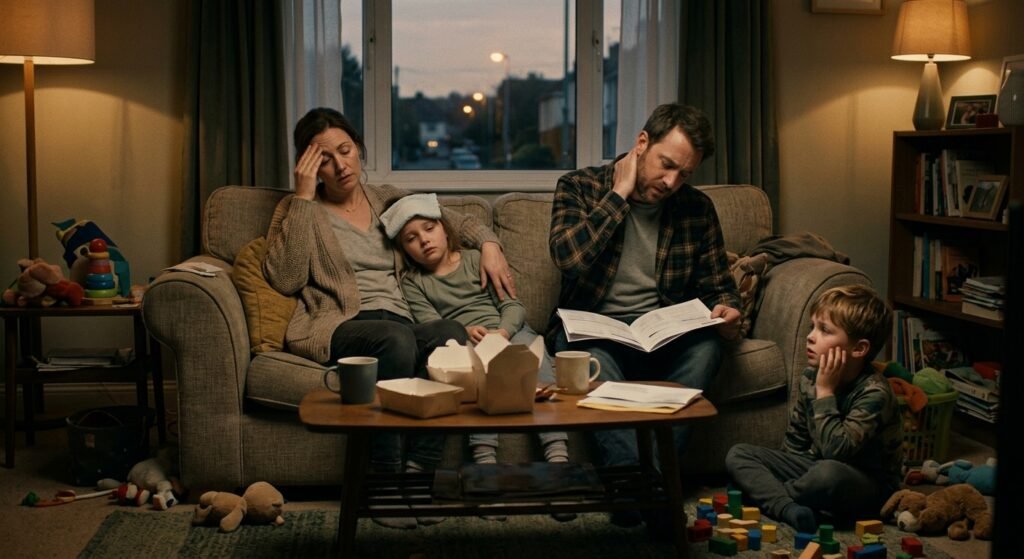
You Can Feel The Morning Before You Even Walk Into The Kitchen
You know the feeling before your feet even touch the bottom of the stairs. You haven’t heard a single argument yet, and nobody has said a word out loud, but the air in the house already feels different. It’s in the way a cupboard door closes just a little too hard, or the sharp click of a cereal bowl meeting the counter. Without thinking, you adjust your own steps. You take a quiet breath, step into the kitchen, and instantly begin assessing the room.
One of your children is sitting at the island, shoulders slightly rounded, staring into a toast plate with an intensity that promises trouble if anyone asks the wrong question. Across the table, their sibling is making themselves as small and quiet as possible, eating quickly as if trying to clear out before the spark catches the dry grass. You catch your partner’s eye over the coffee pot. No words pass between you, just that brief, shared look that says the same thing you’re both thinking: okay, here we go.
It’s remarkable how fast one person’s internal storm can fill an entire house. You can spend an hour carefully setting a calm, easy tone for the day, only for it to evaporate in ten seconds because one child woke up overwhelmed, frustrated, or simply out of alignment with the world. Before breakfast is even finished, the entire household is orbiting around a single emotional center, walking carefully around the edges of a mood nobody else created.
The Silent Work Of Reading The Room
When this happens, the most tiring part usually isn’t the mood itself. It’s the silent management that follows. You find yourself constantly calculating every interaction in real time. You carefully phrase simple requests so they don’t sound like demands. You step in to soften conversations between siblings before they turn into full battles. You monitor tone, voice volume, and body language like someone managing a delicate experiment.
It creates a very specific kind of exhaustion because it asks you to stay on high alert during the most ordinary moments of your day. Making lunches or finding missing shoes becomes a high-stakes effort to keep the peace. You aren’t just parenting the child who’s struggling; you’re trying to protect the emotional space for everyone else in the home at the exact same time.
And quietly, beneath all that management, there’s often a lingering sting of frustration. You might catch yourself thinking how unfair it feels that one person’s hard morning gets to dictate everyone else’s morning. You want the rest of the house to have a smooth day, too. You want your other children to feel heard, and you want to drink your own coffee without feeling like you’re standing near an open flame.
Why One Person’s Mood Takes Over The Space
Family researchers and clinicians have talked for decades about how deeply linked family dynamics really are. In a household, people don’t experience emotions in isolation. Instead, families function like interconnected networks where emotional energy moves naturally from one person to the next. When one person’s nervous system enters a state of distress, it sends out quiet signals that everyone else automatically picks up on.
Psychologists call this emotional contagion, and it isn’t something we choose to do. It’s a natural social mechanism. Our brains are hardwired to notice distress in the people we love because, deep down, we’re built to stay connected to our group. When a child is struggling, their emotional distress acts like a loud noise in a quiet room. It commands attention because it demands to be resolved.
What makes parenting so tricky is that children don’t yet possess the tools to hold their own big feelings inside a tidy container. When they feel overwhelmed, that feeling spills over into the room. They don’t just express their mood; they broadcast it. And because you care so deeply about their well-being, your own system absorbs that energy whether you want it to or not.
The Quiet Adjustments Everyone Else Makes
Over time, a household living with frequent emotional storms develops subtle survival habits. The siblings often learn how to read the house faster than adult guests ever could. They know when to ask for help and when to wait. They know when it’s safe to tell a story about their day and when it’s better to keep things quiet and head to their room.
Sometimes, those other children take on the role of the helper, trying to bring light into the room to offset the dark cloud. Other times, they simply withdraw, learning to ask for less so they don’t add to the load you’re already carrying. As a parent, watching that happen can feel heartbreaking. You worry about the space they aren’t getting, and you wonder if they feel lost in the shuffle while so much energy goes toward keeping the peace.
It’s easy to judge yourself during these seasons. You worry that you’re letting one child take over the home, or that you aren’t strong enough to keep the atmosphere calm and safe for everyone. You wonder why other families seem to glide through their routines while yours feels like it’s constantly balancing on a edge.
It Isn’t A Failure Of Love
The truth is that an emotionally reactive house isn’t a broken house. It’s simply a house where people are deeply connected to one another. The very reason one child’s bad mood can alter the temperature of the kitchen is the same reason a child’s sudden belly laugh can light up the entire living room in an instant. The wires are connected. The energy moves through everyone because nobody is living behind locked doors.
You don’t have to fix every hard morning before the school bus arrives, and you don’t have to pretend that walking on eggshells doesn’t wear you out. It’s completely normal to feel tired by the effort it takes to keep a family balanced when the ground keeps shifting under your feet.
Maybe the goal was never to create a home where bad moods never spill over into the hallway. Maybe the work is simply remembering that a hard morning isn’t the whole story of your family. It’s just a single chapter in a long, noisy, deeply connected life together. And on the days when one person’s storm fills every corner of the house, it isn’t a sign that you’re failing. It’s just proof of how closely you’re all holding onto each other.