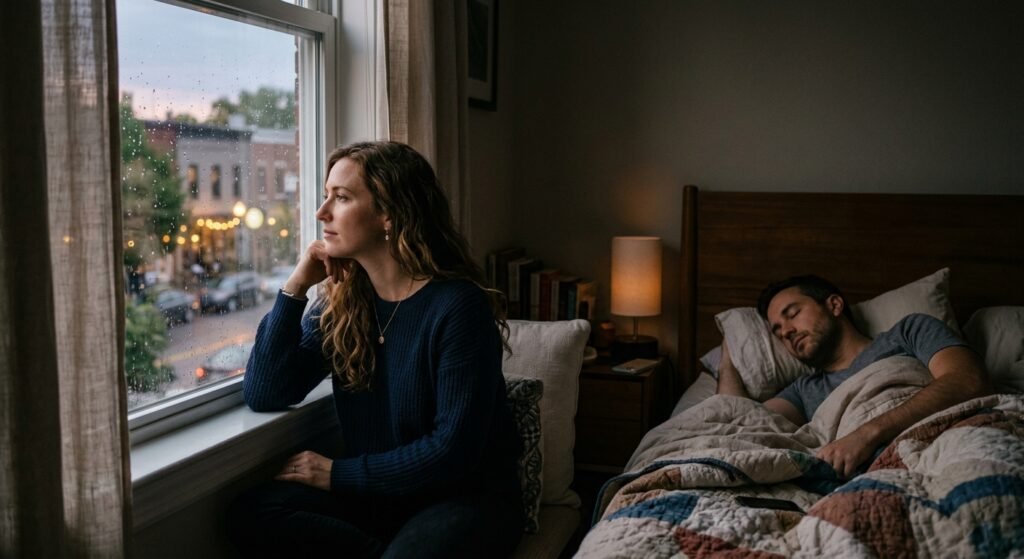
You’re sitting across from someone you’ve loved for years, listening to them tell a story you’ve heard a dozen times before. In the past, this predictability felt like a warm blanket. It was the rhythm of a shared life, a comfortable language only the two of you spoke. But tonight, as the words wash over you, you feel a strange, quiet distance. You realize you’re nodding along out of habit rather than interest, and a cold realization settles in: the version of you who used to love this story, and this relationship, isn’t there anymore.
It’s a bittersweet experience that rarely arrives with a crash. It doesn’t come because of a massive argument, a betrayal, or a sudden, dramatic falling out. Instead, it shows up in the quiet spaces. It’s the book you read that you know they wouldn’t understand, the new goal you’re excited about that they meet with a blank stare, or the way you find yourself editing your thoughts before you speak to keep the peace. You aren’t angry with them. If anything, you still care about them deeply. But you’re starting to notice that the coat you’ve worn for so long is suddenly pinching at the shoulders.
We often talk about relationships ending because something went wrong. We look for villains and victims, for mistakes and betrayals, because those things are easy to categorize. It’s much more difficult to sit with the reality that two people can do everything right, love each other sincerely, and still find themselves standing on opposite sides of a widening chasm. When you grow, your perspective turns, and sometimes that growth alters the very foundation of what you need from a partner.
The Silent Distance of Quiet Transitions
When we enter a relationship, we enter it as the person we are in that specific season of life. We have certain fears, specific dreams, and a unique set of emotional needs. For a long time, the relationship works because it meets those needs perfectly. But people aren’t museums; we aren’t meant to remain unchanged. As you navigate careers, loss, successes, and the slow maturation of adulthood, your inner landscape changes. You might find yourself valuing stability more than excitement, or perhaps you begin to crave deep, emotional vulnerability where casual companionship used to be enough.
When the Unspoken Contract Frays
This is where the friction begins. Relationship experts who study long-term attachment often point out that a partnership is essentially an unspoken contract between two specific versions of two people. When one person begins to alter their values, goals, or emotional capacity, that contract starts to fray. It’s not a sign of selfishness. It’s simply the natural result of personal evolution. The challenge is that we are taught to view constancy as the ultimate goal of love, which makes our own growth feel like a betrayal of the life we’ve built.
You might find yourself trying to shrink to fit back into the old mold. You try to care about the things you used to care about, or you suppress the new parts of yourself that feel inconvenient to the relationship. You tell yourself that you’re just going through a phase, or that you’re being ungrateful. After all, they’re still the same kind, dependable person they’ve always been. But trying to force yourself backward only breeds a quiet resentment that eventually poisons the affection that remains.
The Grief of Doing Nothing Wrong
There is a unique kind of grief that comes with outgrowing a relationship because there is nowhere to place the blame. You can’t point to a single moment and say, “That’s where it broke.” You can’t be angry, because they haven’t done anything to deserve your anger. They’re simply continuing to be who they’ve always been. In fact, that’s often the hardest part: they’re exactly the same, but you are different.
The Loneliness of Being Fully Known But Unseen
In these moments, you might look at your partner and feel a profound sense of isolation. It’s the loneliness of being fully known by someone who no longer understands who you are. They know your favorite coffee order, your childhood stories, and the way you look when you’re tired, but they don’t know the quiet thoughts keeping you awake at night or the new dreams you’re too hesitant to share. You’re sharing a home, a bed, or a routine, but you’re no longer sharing an inner world.
It helps to understand that this distance isn’t a personal failure. Developmental psychologists often note that our twenties, thirties, and even forties are marked by periods of identity reconstruction. We are constantly gathering new information about ourselves and the world. Sometimes, two people navigate these transitions in parallel, matching each other’s pace and direction. Other times, one person takes a turn while the other remains on the path they’ve always preferred. Neither choice is incorrect, but they do lead to different destinations.
Reimagining the Meaning of Forever
We are raised on stories that tell us love is only successful if it lasts forever. We measure the quality of a relationship by its longevity, assuming that a bond that ends after five years is somehow less valuable than one that lasts fifty. This mindset places an immense burden on our personal growth. It forces us to choose between our own development and our loyalty to those we love, as if the two are fundamentally incompatible.
But what if we looked at it differently? What if a relationship doesn’t have to last forever to be considered a beautiful success? Perhaps some partnerships are meant to be chapters rather than the whole book. They are the safe harbors where we heal, the mirrors that help us see ourselves clearly, and the environments where we learn how to love and be loved. When you look back at the person you were when the relationship began, you can appreciate how much that connection helped you become the person you are today.
Acknowledging that you’ve outgrown a relationship isn’t an act of cruelty. It is a painful, honest recognition of reality. It means admitting that the space you once occupied together has become too small for the person you have become. And while letting go of that comfort is deeply difficult, it also opens up the possibility for both of you to find connections that align with who you are now, rather than who you used to be.
In the end, maybe outgrowing a relationship isn’t a failure of love. Maybe it’s just the natural result of two people who were brave enough to grow, even when it meant growing apart. You’re not a bad person for wanting more, or for wanting something different. You’re just a person who is continuing to unfold, and sometimes, the most loving thing we can do is to honor that growth, even when it leads us in a different direction.