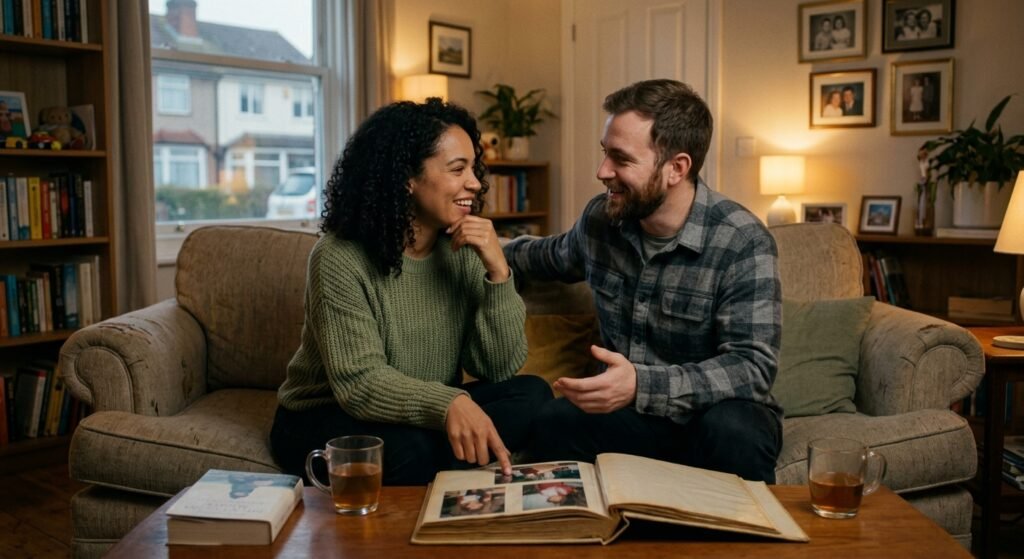
You’re standing in the kitchen, wiping down the counter, when your partner asks a simple question about whether you remembered to pay the electricity bill. It’s an ordinary moment, the kind that happens a dozen times a week. But instead of answering calmly, you feel a sudden surge of irritation flare up inside you, or maybe you do the exact opposite, you quietly close yourself off, offer a brief reply, and walk out of the room. In the silence that follows, a strange and familiar feeling settles in. You realize that the tone of your voice, the defensive posture of your shoulders, or the cold wall of your silence didn’t actually originate with you. You’ve seen this exact exchange before, decades ago, while standing in the hallway of your childhood home, watching your parents.
It’s one of the most disquieting realizations of adulthood. We spend years trying to build our own lives, carving out paths we believe are entirely our own, only to find ourselves speaking with the exact inflections of the people who raised us. We promise ourselves we’ll do things differently. We tell ourselves we’ll communicate better, listen more, and react with more patience. Yet, in moments of stress or vulnerability, the old scripts we watched during our formative years have a way of playing out anyway.
This doesn’t mean you’re failing, and it doesn’t mean your relationship is doomed to repeat every mistake of the past. It simply means that long before you ever held anyone’s hand or navigated a shared household budget, you were sitting in the front row of a masterclass on how relationships work. You watched how conflicts were resolved, or how they were swept under the rug. You absorbed the quiet ways affection was given, and the subtle ways it was withdrawn.
The Silent Curriculum of Childhood
Children are remarkable observers. Long before we have the words to describe concepts like emotional security or conflict resolution, we’re registering how the adults around us handle their differences. We notice when a door gets slammed, when someone sleeps on the couch, or when an icy silence stretches across the dinner table for days at a time. We also notice the warm things, like a gentle hand on a shoulder while making coffee, or the way one parent laughs at the other’s jokes even when they’ve heard them a hundred times.
Those who study family systems often point out that we don’t just inherit our physical features from our family tree; we also inherit their emotional patterns. Research suggests that the ways our families communicated when we were small can become deeply ingrained in our nervous systems, acting as a default setting that we return to during times of stress. It’s why our adult partnerships can sometimes feel like a reenactment of our childhood homes, even when we’ve spent years trying to build something entirely different.
Consider the way you react when your partner is upset. If you grew up in a household where conflict was loud and explosive, you might feel an intense urge to pacify your partner at all costs, even if it means sacrificing your own feelings. Alternatively, if your family handled disagreements through emotional withdrawal, you might find yourself shutting down and retreating into a protective space whenever tension arises. We learn these coping mechanisms because, when we were young, they were the tools that helped us navigate the emotional temperature of our homes.
The Comfort of the Familiar
What’s truly fascinating, and sometimes frustrating, is how easily we gravitate toward what’s familiar, even when that familiarity is painful. Relationship experts often note that we’re naturally drawn to patterns that mirror our early experiences. If you grew up feeling like you had to earn love and approval from an emotionally distant parent, you might find yourself repeatedly drawn to partners who are difficult to reach, unconsciously hoping that this time you can finally win them over.
It isn’t that we want to suffer. Rather, our minds are wired to recognize familiar landscapes. A partner who is consistent, predictable, and emotionally available can sometimes feel boring or even unsettling to someone who grew up in an environment where love was volatile and unpredictable. We mistake the anxiety of chasing someone for the feeling of passion, simply because that chase is the rhythm we grew up understanding.
This explains why we often recreate the very dynamics we vowed to avoid. We’re not doing it because we lack willpower or intelligence. We’re doing it because the mind thrives on predictability. There’s a strange, quiet comfort in knowing how the story ends, even if it’s a difficult ending, because at least we know how to play our part in it.
Unpacking the Legacy
Recognizing these patterns isn’t about placing blame on our parents. Most parents do the best they can with the emotional tools they have at the time, often carrying their own unexamined blueprints from the generation before them. Instead, looking backward is about understanding why we react the way we do today. It’s about realizing that our most intense reactions in our partnerships are rarely just about the present moment.
When you find yourself arguing over the dishes or the way your partner parked the car, and the emotional reaction feels out of proportion to the event, it’s usually because the argument is touching an old wound. It isn’t just about the dishes. It’s about the ancient fear of being ignored, or the childhood anxiety of walking on eggshells around someone else’s unpredictable mood.
When we begin to see these connections, something remarkable happens. The intensity of the moment begins to soften. We can look at our anger or our urge to withdraw and realize that it doesn’t belong entirely to the person standing in front of us. It’s an echo from the past, trying to protect us from a danger that no longer exists.
Choosing a New Way Forward
The beauty of becoming aware of our relationship inheritance is that awareness creates a pause. In that small pause, between the moment we feel triggered and the moment we respond, lies our freedom. We can notice the urge to shut down or lash out, acknowledge where it came from, and make a conscious choice to do something different.
This isn’t easy work, and it doesn’t happen overnight. It’s a slow process of learning to parent ourselves through the moments that trigger our oldest fears. It requires us to have immense compassion for ourselves and our partners as we both try to navigate the quiet memories that populate our living rooms.
Perhaps the most comforting realization of all is that our past doesn’t have to be our destiny. We’re not destined to repeat every mistake we witnessed, nor are we required to discard everything we were given. Awareness gives us the chance to keep what helps and change what hurts. We can honor the warmth we inherited while gently setting down the patterns that were never ours to carry in the first place.