
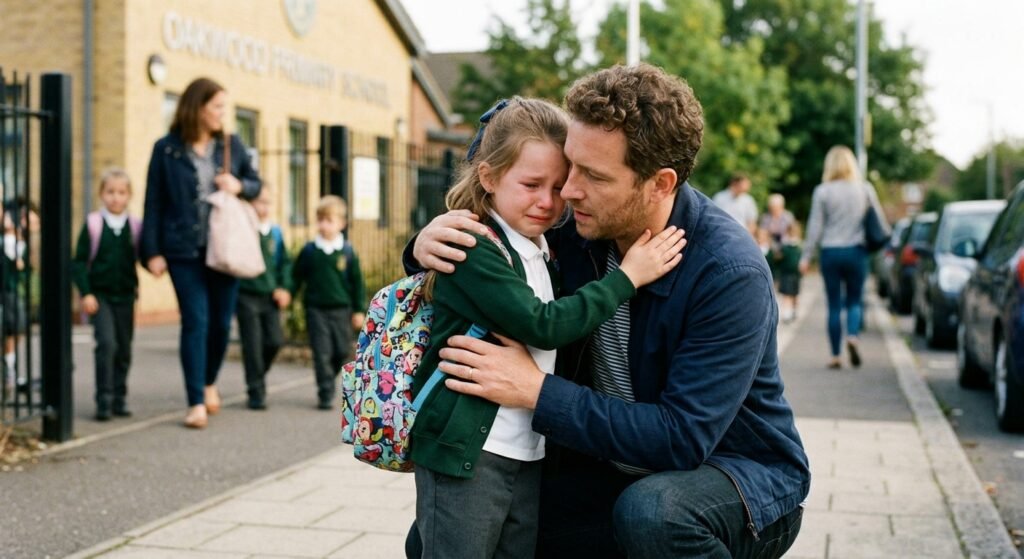
You stand in the school hallway, listening to the teacher praise your child. She smiles, telling you how helpful, quiet, and cooperative they were all afternoon. You feel a quiet swell of pride, thanking her before taking your little one by the hand. But the moment you walk through the front door of your house, or sometimes even before you’ve fully backed out of the school parking lot, the atmosphere changes completely. A dropped toy, a misplaced shoe, or a simple question about what they want for a snack triggers a massive, tearful meltdown. They’re screaming, sobbing, or throwing themselves onto the living room rug, completely inconsolable.
You find yourself standing there in absolute bewilderment. You wonder how the cooperative child the teacher just described could turn into this storm of raw emotion in a matter of minutes. It’s a deeply disorienting experience that many parents quietly worry about behind closed doors. You start to ask yourself if you’re doing something wrong. You wonder if your parenting is too soft, or if there’s something about you that invites this chaos. It feels like a personal failure when they seem to behave beautifully for everyone else, only to reserve their most difficult moments for you.
The Hidden Strain of the Outside World
There is a beautiful, comforting reason for this, and it has nothing to do with bad behavior or poor parenting. Psychologists often refer to this pattern as after-school restraint collapse. To understand why it happens, it helps to imagine wearing a pair of shoes that are just a little too tight. You can keep them on for a few hours, smiling and walking politely because you’re out in public and you have to. But the very second you step through your front door, those shoes are flying off, and you’re letting out a sigh of relief.
For a child, navigating the classroom, the playground, or even a playdate requires an immense amount of effort. Throughout the day, they’re constantly regulating their impulses. They have to sit still when they want to run, listen quietly when they want to speak, share toys they want to keep, and navigate complex social rules with their peers. It takes every bit of their energy to keep the lid on. They do it because they want to fit in, because they want to please the adults around them, and because they know the outside world demands it.
But that capacity for self-regulation isn’t limitless. It’s like a battery that slowly drains with every transition, every instruction, and every social interaction. By the time the school day ends, that battery is completely empty. They’ve spent hours holding themselves together, and they simply don’t have any strength left to keep doing it.
The Relief of the Safe Space
When they finally see your face or cross the threshold of your home, they aren’t just changing locations. They are returning to their ultimate safe space. They know, at a deep, instinctual level, that your love for them is unconditional. They don’t have to perform for you. They don’t have to keep their shoes tied, wait their turn, or hide their frustrations to keep you happy. With you, they can finally drop the exhausting act of being perfect and let all that stored-up tension escape.
Child development research suggests that children actually monitor their emotional boundaries based on the proximity of their primary caregivers. When they’re away from you, their natural defenses stay high to keep them protected. But once they’re back in your presence, their nervous system registers that they’ve arrived in a place where they’re safe enough to let their guard down. The meltdown isn’t a sign that they are broken, nor is it a sign that you are doing a poor job. It’s actually a sign that your home is working exactly the way a home should.
It’s their way of saying they’ve had a long day, and they finally feel secure enough to let you see how tired they really are. They save their hardest feelings for you because they trust you to hold those feelings without walking away.
Rethinking the Storm
Recognizing this doesn’t make the meltdowns disappear, nor does it make them easy to handle. It’s still exhausting to navigate a tantrum when you’ve had a long day of your own. But reframing the situation can change how you experience it. Instead of seeing the collapse as a behavioral problem to be corrected, you can start to see it as a physical release of pressure. They aren’t trying to give you a hard time; they’re having a hard time.
When we look at it this way, our response can change from frustration to quiet presence. We don’t need to fix the broken cracker, and we don’t need to lecture them on manners in the middle of their distress. Often, the best thing we can offer is simply a quiet space to let the storm pass. We can sit with them on the floor, offer a silent hug, or just let them cry without trying to force them back into the quiet, polite box they’ve been sitting in all day.
It’s a realization that changes how we view our role as parents. Perhaps our children aren’t failing to behave when they fall apart at home. Maybe home is the only place where they feel safe enough to stop holding themselves together, and being the person they trust with their worst moments is actually one of the greatest privileges we have.