
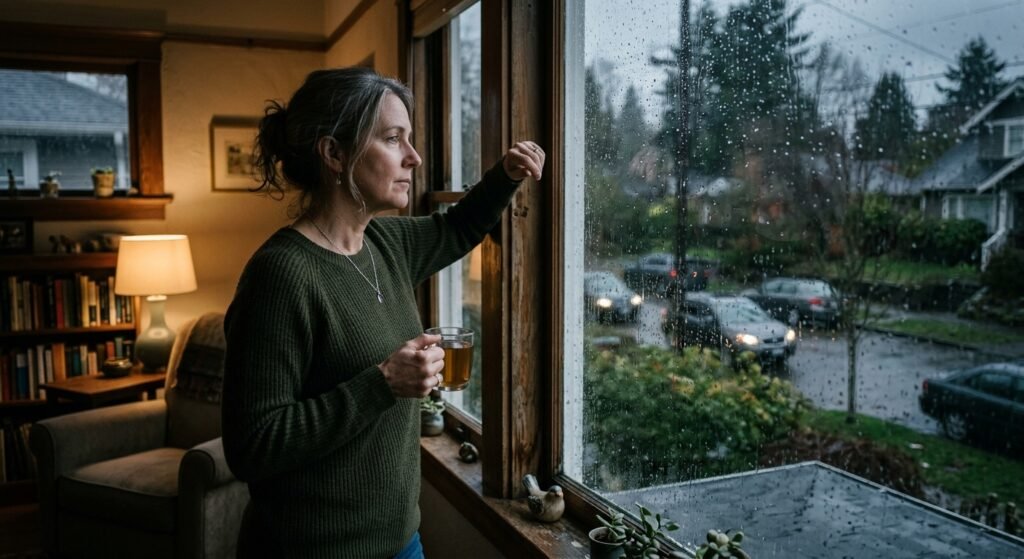
Imagine a perfectly ordinary Tuesday evening. You’re sitting on your couch, the living room is quiet, and for the first time in weeks, there’s absolutely nothing on your to-do list. Your bills are paid, your loved ones are safe, and the day has unfolded without a single crisis. By all accounts, this is the exact kind of moment you’ve been working so hard to achieve.
But instead of sinking into the cushions and breathing a sigh of relief, you feel a familiar, subtle tightening in your chest. Your mind starts scanning the horizon, looking for things to worry about. You check your phone just in case you missed an urgent message. You replay a conversation from earlier in the day, wondering if you accidentally offended a colleague. You find yourself waiting for the phone to ring with bad news.
If you’ve ever felt this way, you know how exhausting it is to live in a state of constant anticipation. It’s the persistent feeling that peace is actually a trap, and that letting yourself enjoy a good moment is simply making you vulnerable to the blow you assume is coming next. We call it waiting for the other shoe to drop, and it’s one of the most quietly draining ways a person can live.
Why Quiet Moments Feel So Threatening
Let’s explore why this happens. When you’ve spent years dealing with unpredictable situations, your mind develops a highly efficient survival strategy. Whether you grew up in a household where the emotional temperature changed without warning, navigated a volatile relationship, or spent years in a high-stress workplace where mistakes were treated as disasters, you learned something very specific. You learned that the only way to stay safe was to stay ready.
In those chaotic seasons, being caught off guard was painful. So, your mind built a habit of constant scanning. You became an expert at reading the room, noticing the slightest changes in someone’s tone of voice, and preparing for the worst-case scenario before it could catch you by surprise. Back then, this readiness was a gift. It protected you. It helped you get through difficult times because you were always two steps ahead of the trouble.
The problem is that our bodies don’t automatically come with an off-switch once the trouble ends. When your life finally becomes stable, safe, and quiet, your protective instincts don’t get the memo. Instead of recognizing quiet as a sign of safety, your mind interprets the lack of drama as a silence that must be filled with preparation. To an analytical mind that’s used to solving problems, a day with no problems feels deeply suspicious.
The Science Behind the Constant Guard
People who study stress patterns find that our brains can become conditioned to expect chaos. When we experience prolonged stress, the part of the brain responsible for spotting danger becomes highly sensitive. It starts working overtime, treating everyday uncertainties as major threats. When things are calm, the brain feels like it’s missing critical information, so it manufactures worry to keep you alert. It’s almost as if the mind mistakes quietness for the eerie pause that happens right before a storm.
This is why you can’t simply think your way out of feeling anxious during peaceful moments. It isn’t a logical failing; it’s a physical response. Your body is still trying to protect you from a past version of your life. When you try to force yourself to relax, your nervous system interprets that relaxation as letting down your guard, which feels dangerous.
It’s a strange paradox. We work so hard to build a life of stability, yet when we finally reach it, we find ourselves unable to inhabit it. We treat happiness not as a state of being, but as a countdown. We tell ourselves that we can relax after the next project is done, after the family obligations ease up, or after we reach a certain milestone. But when those moments arrive, the goalpost simply moves, and the waiting continues.
Learning to Trust the Calm
If you’re tired of waiting for the storm, the first step isn’t to force yourself to stop worrying. That usually just creates more frustration. Instead, it helps to offer yourself a bit of understanding. The part of you that’s scanning the horizon isn’t trying to ruin your day. It’s simply a loyal protector that doesn’t realize the danger has passed.
When you feel that familiar tightening in your chest during a quiet moment, you don’t have to fight it. You can simply acknowledge it. You can tell yourself that it makes sense that you’re waiting for trouble, because for a long time, trouble was exactly what arrived next. By recognizing that your vigilance is just an old habit trying to keep you safe, you take away some of its power.
Peace doesn’t require you to be completely certain that nothing bad will ever happen again. Life will always have its challenges, and there will undoubtedly be difficult days ahead. But constantly bracing for them doesn’t make those difficult days any easier when they arrive. It only robs you of the good days you have right now.
You Are Allowed to Put Your Guard Down
Perhaps the real work of adulthood isn’t preventing bad things from happening, but learning to trust that we can handle them if they do. You don’t need to spend your beautiful, quiet afternoons rehearsing for tragedies that may never arrive. You’ve already survived every difficult day you’ve ever faced, and you did so without needing to spend your entire life in a state of high alert beforehand.
It takes time to convince your body that the quiet is safe. It happens in tiny increments. It happens when you allow yourself to take one deep breath on a Tuesday evening, look around your peaceful room, and decide to stay right there, even if just for a minute.
You aren’t dropping your guard because you are naive. You are dropping your guard because you deserve to experience the peace you worked so hard to build. And maybe, just maybe, the other shoe isn’t going to drop after all. Maybe this is just what a good day feels like.