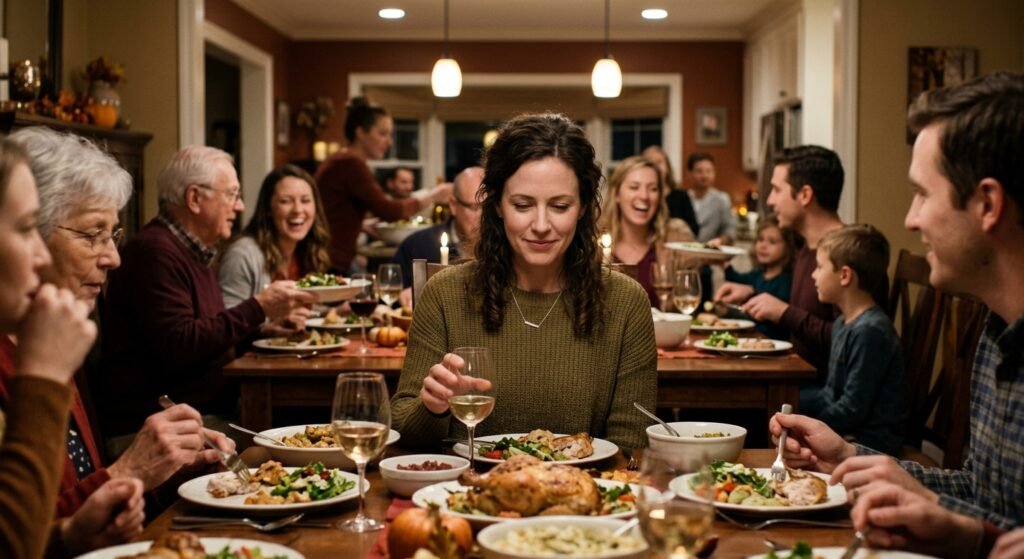
You are sitting on a comfortable sofa, holding a glass of water, watching a room full of people laugh at a story you’ve never heard before. It’s your partner’s family. You know the names of their childhood pets, you’ve heard about the legendary road trip of 2012, and you’ve spent weeks picking out the perfect holiday gifts. Yet, as the laughter echoes around the living room, you find yourself wearing a polite, frozen smile, realizing that you are completely, undeniably alone.
It’s a quiet sort of loneliness that is hard to explain to anyone else, especially to the person sitting next to you. On paper, there’s absolutely nothing wrong. You were invited. Your coat was hung up with care. There is a plate set for you at the table, and someone even remembered that you prefer oat milk in your coffee. But as you watch the effortless shorthand of their interactions, you realize that being included is not the same thing as being accepted.
The Difference Between an Invitation and Belonging
When we enter a long-term relationship, we often assume that loving someone means eventually absorbing their world, and them absorbing ours. We imagine a seamless blending of lives. But families are not just groups of individuals who happen to share DNA. They are tiny ecosystems with their own rules, histories, and invisible boundaries. They have decades of practice being themselves around one another, and that means they have a shared rhythm that is almost impossible for an outsider to match.
Think about the last time you spent an evening with your partner’s relatives. You might have noticed how conversations move seamlessly from one topic to another, guided by unspoken cues you can’t quite read. A look between siblings, a sudden silence when a certain topic is raised, or a joke that makes everyone laugh but leaves you searching for the punchline. You’re there, but you’re operating on a delay, constantly trying to translate a foreign language in real-time.
This is where the quiet exhaustion sets in. When you are constantly trying to fit into a space that wasn’t designed for you, you have to monitor your posture, your words, and your reactions. You worry that being too quiet makes you seem cold, while being too talkative might feel intrusive. You’re performing a version of yourself that you hope is likable, but in the process, you lose the ease of simply existing.
The Invisible Manual of Family Systems
Psychologists who study family dynamics often talk about families as closed systems. Every system has a set of rules that keep it functioning. Some families are highly expressive, showing love through loud teasing and constant debate. Others are reserved, offering care through quiet gestures and structured routines. When you step into your partner’s family, you are essentially trying to play a game where everyone else has been practicing for thirty years, and nobody thought to hand you the rulebook.
Research in family science shows that families develop what is called inner-circle cohesion. It’s a natural protective barrier that helps a family group maintain its identity over time. While this cohesion is wonderful for the people inside, it can make it remarkably difficult for a newcomer to feel like anything more than a permanent guest. The barrier isn’t necessarily kept there out of malice. Often, it’s just that the family doesn’t know how to open the circle without changing the dynamic they’ve spent a lifetime building.
And that’s why it’s so painful when you try to discuss this with your partner. When you head home in the car and gently mention that you felt a bit like an outsider, they might look at you with genuine confusion. They might say, “But my mom made your favorite dessert!” or “My brother talked to you about football for an hour!” To your partner, those actions are proof of love. They see the effort, but they can’t feel the emotional distance that still remains.
The Burden of the Permanent Guest
When you are treated as a permanent guest, you are always on your best behavior. You can’t just wander into the kitchen to make toast in your pajamas. You can’t sit in silence without someone asking if you’re okay. You are surrounded by kindness, perhaps, but it is a formal sort of kindness that keeps you at arm’s length. It’s the difference between being welcomed into a home and being allowed to live there.
This dynamic can create a subtle strain in your relationship. You might find yourself dreading holidays or family gatherings, which then makes you feel guilty. You start to wonder if there is something wrong with you, or if you’re simply not trying hard enough. You might try to ask better questions, help more with the dishes, or share more about your own life, only to find that the invisible wall remains exactly where it was before.
But the truth is, you can’t force your way into a history you didn’t live. You can’t quickly manufacture the deep, messy, complicated roots that hold a family together. And trying to do so only leaves you feeling more exhausted and more isolated.
Finding Peace on the Edge of the Circle
Maybe the realization that changes everything is that you don’t need to be written into their old family history to build a beautiful life with your partner. We often put a tremendous amount of pressure on ourselves to become an honorary child or sibling in our partner’s family, believing that anything less is a sign of failure. But perhaps real acceptance isn’t about erasing the differences between you and them.
When you stop trying to force yourself into the center of their circle, you give yourself permission to step back and observe. You can appreciate their warmth without needing it to validate your worth. You can accept their hospitality for what it is—a kind gesture from people who love your partner—rather than a test you need to pass.
The family you are building with your partner is the one where you truly belong. That is where your rules are written, where your shorthand is created, and where you never have to worry about being a guest. By letting go of the need to be fully absorbed into their past, you free up the energy to focus on the future you’re creating together. And sometimes, looking at a family from the edge of the circle is the most peaceful place to be.