The Yoga Pose That No One Can Hold
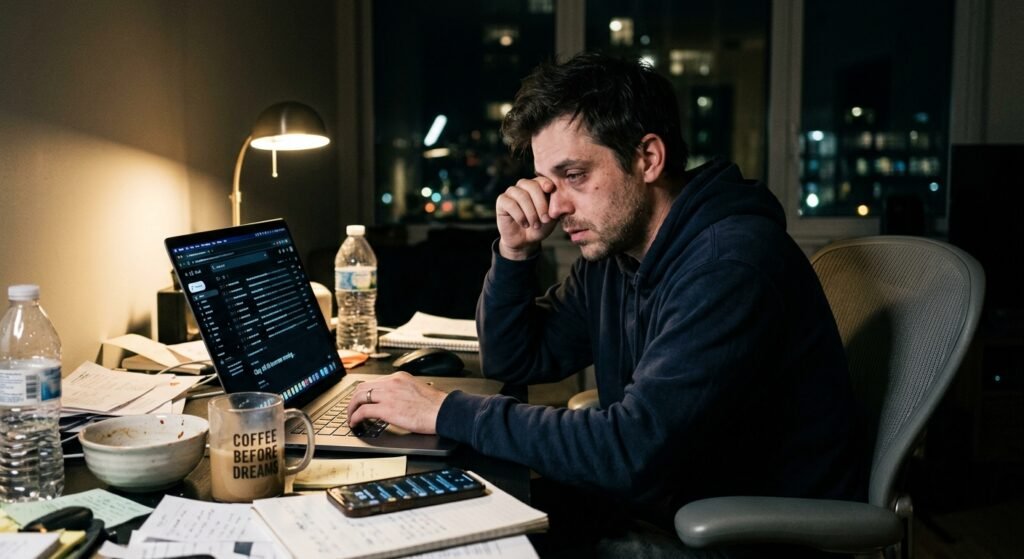
You are sitting on your sofa on a Tuesday evening, watching the cursor blink on a half-finished email while a plate of cold dinner sits on the coffee table. In your inbox lies a newsletter from your company’s HR department, cheerfully offering five tips for achieving work-life balance. There is a stock photo of a smiling person doing yoga next to a laptop, looking entirely serene. You look at the photo, look at your laptop, and feel a familiar, cold wave of frustration. It is a scene playing out in living rooms everywhere, a quiet moment of feeling like you are failing at the very thing that is supposed to keep you sane.
We have been sold a beautiful promise that we can somehow keep our careers and our personal lives in perfect equilibrium. We are told that if we just manage our schedules better, download the right wellness app, or participate in Friday morning meditation, the scale will balance itself. But the scale never seems to balance, and we are left wondering what we are doing wrong. The truth is that you aren’t doing anything wrong. The promise of work-life balance, as it is presented to us today, was never designed to be achieved. It was designed to make you feel like your exhaustion is a personal time-management failure rather than a natural response to impossible expectations.
It is a brilliant marketing concept because it places the entire burden of systemic overwork onto your shoulders. By framing balance as an individual achievement, the modern workplace quietly excuses itself from the conversation. If you are stressed, it isn’t because the workload is unsustainable; it is because you haven’t mastered your boundaries. This subtle framing turns a structural issue into a personal shortcoming, leaving you to chase an ideal that doesn’t exist in reality.
The Invention of an Impossible Standard
To understand why this concept feels so frustrating, we have to look at how we got here. The phrase first gained traction in the late twentieth century as technology began blurring the boundaries between the office and the home. Suddenly, the physical separation between work and rest disappeared, and companies realized that employees were burning out at alarming rates. The solution, however, wasn’t to reduce workloads or change expectations. Instead, the solution was to brand a new lifestyle goal that employees could strive for on their own time.
Finding equilibrium became another task on your to-do list, right next to preparing quarterly reports and buying groceries. Experts who study workplace culture have noted that this framing creates a double burden. Not only are you expected to perform at a highly demanding level at work, but you are also expected to master the art of relaxation and self-care in your limited free time. You must be productive by day and perfectly peaceful by night, transitioning between the two with seamless grace.
When you cannot manage to do both, the corporate narrative suggests that you simply haven’t tried hard enough. You didn’t set enough boundaries, or you didn’t meditate correctly, or you didn’t organize your calendar efficiently. The structure remains blameless, while you lie awake at midnight wondering why you feel so thoroughly depleted despite your best efforts to find that elusive middle ground.
Why the Scale Was Never Meant to Be Still
Think about the word itself: balance. It evokes an image of a gymnast standing perfectly still on a narrow beam, holding a flawless pose. It is an image of complete control, stillness, and perfection. But your life is not a still image. It is messy, unpredictable, and constantly in motion. Expecting your career and your personal life to sit in a peaceful fifty-fifty split is like asking the ocean to stop waving.
On any given week, your child might get sick, a project at work might experience an emergency, a close friend might need your support, or you might simply need to sleep for twelve hours. These are not interruptions to your balance; they are the actual substance of your life. When we try to force our daily experiences into a static mold, we end up fighting against the natural flow of our days, creating a friction that only adds to our exhaustion.
Research into occupational stress reveals that the most significant driver of burnout isn’t actually the number of hours we work, but our lack of control over those hours. When we are told we can balance our lives but are given no actual autonomy to do so, the frustration grows. We are trying to solve a collective problem with personal willpower, and that is a battle we are destined to lose. The system asks us to perform a delicate tightrope walk while constantly shaking the rope, then wonders why we feel unsteady.
Choosing What We Are Willing to Disappoint
So what happens when we finally stop chasing this corporate fantasy? We might begin to realize that the goal was never about finding a perfect split between two separate worlds. The idea that work and life are two equal forces competing for our soul is a false division to begin with. Your work is simply one thing you do; your life is the container that holds everything, including your job, your relationships, your quiet moments, and your laundry.
Perhaps the real realization is that we cannot keep everyone happy all the time, and that is completely acceptable. Instead of trying to keep the scale perfectly level, we can start deciding what we are willing to let drop. Some days, we will disappoint our employers to show up for our families. Other days, we will disappoint our friends to meet a deadline. Sometimes, we will disappoint everyone else just to sit in a quiet room and do absolutely nothing at all.
This isn’t a failure of balance; it is the reality of being a limited person with finite energy. Once we stop expecting ourselves to carry everything effortlessly, the constant guilt begins to fade. We can stop looking at those corporate wellness posters with longing and start looking at our actual, messy lives with a bit more kindness. Maybe the goal isn’t to stand perfectly still on the tightrope, but to finally step off it and realize the ground beneath our feet is much wider than we thought.