Can we talk about this for a second?
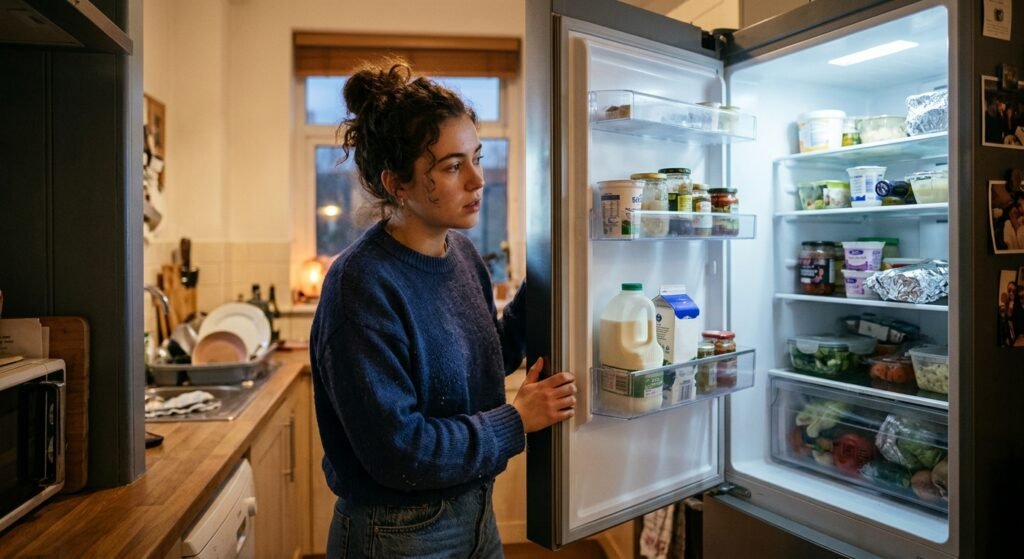
You walk into the kitchen, pull open the refrigerator door, stand in the cold air, stare into the light for five full seconds, and close it without grabbing a single thing. Then you walk back to the living room, sit down on the couch, look at your phone, and somehow find yourself standing right back in front of that same open door three minutes later.
You aren’t hungry. You know you aren’t hungry. You just ate lunch an hour ago. You also know with absolute certainty that no one has visited your kitchen in the last three minutes to stock the shelves with gourmet leftovers. There is no magical kitchen assistant secretly sliding fresh mozzarella sticks behind the jar of yellow mustard. Yet there you stand, staring into the exact same chilled void, holding the door open like you’re waiting for a delayed flight.
The funny part is the change in logic that happens between the first door opening and the third. On the first trip, you’re looking for an ideal snack. You want something delicious, satisfying, and ready to eat immediately. You scan the top shelf, glance at the cheese drawer, decide nothing meets your current high standards, and close the door. That feels reasonable enough.
It’s the second trip where the delusion really begins. You return to the kitchen because your brain is bored, not because your stomach is empty. But since you’ve already checked the obvious spots, you start lowering your expectations. Suddenly, you aren’t looking for a meal anymore. You’re looking for possibilities. You move a jar of mayonnaise two inches to the left as if it might be hiding a fully cooked pastry. You bend down and peer into the vegetable drawer, even though you haven’t bought fresh vegetables since last month. You’re no longer asking for great food. You’re just asking for anything that requires minimal effort to consume.
Lowering Your Food Standards in Real Time
By the fourth or fifth trip, your standards have completely vanished. You’re willing to negotiate with whatever is sitting in the back of the shelf. You find yourself staring at three lonely baby carrots, half a lime, and a jar of cherries from two years ago, wondering if there’s a way to combine them into something resembling a meal. You pick up a slice of cheese, unfold it halfway, look at it, decide against it, and put it right back on the wrapper. You know you’re not going to eat it, but you leave it there just in case the sixth trip brings a sudden surge of desperation.
Nobody ever really talks about why we treat the refrigerator like a physical feed for social media. When you refresh an app on your phone, you’re hoping something new appeared while you weren’t looking. Opening the fridge is basically the exact same habit, except it runs on electricity and cold air. It’s the ultimate physical refresh button for a mind that simply wants a brief distraction from whatever else it’s supposed to be doing.
When you’re trying to write an email, pay a bill, or clean the living room, your brain looks for the easiest possible escape route. The kitchen is always right there, and the refrigerator is the brightest thing in the room. Opening the door gives you a tiny goal to focus on for ten seconds. It creates a temporary pause in your day where nothing is expected of you except looking at mustard jars.
There’s also that strange moment of optimism where you change your posture to see if that changes the contents. You squat down to eye level with the middle shelf. You pull the refrigerator door open just a little bit wider, as if light hitting the shelves at a slightly different angle will reveal a hidden box of takeout. We all know how this ends. The contents of the fridge don’t change just because you leaned to the right.
A Habit We’ll All Do Again Tomorrow
For some reason, this whole process feels completely reasonable every single time we do it. We don’t feel foolish while standing there in the cold light. We just feel hopeful. We’re quietly convincing ourselves that maybe, just maybe, our past self left a surprise gift that our present self somehow forgot about.
At some point, it stops being about the food entirely. It becomes a quiet little ritual that marks the transition between finishing one task and starting another. You close the door, take a slow breath, and finally head back to whatever you were supposed to be doing in the first place.
We’re wonderfully strange creatures. We’re logical, thoughtful, and capable of remarkable things, yet we still spend a surprisingly large portion of our lives opening a cold metal box to confirm that the eggs are still eggs. You’ll probably do it again in about twenty minutes. And honestly, that’s fine. The light is warm, the air is cold, and hope springs eternal behind the salad dressing.