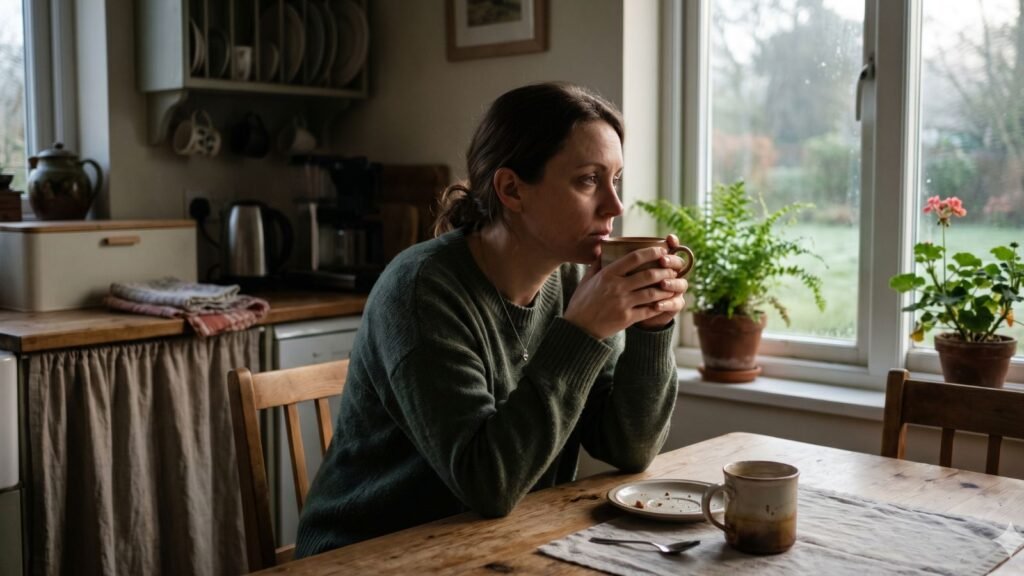
Imagine you’re sitting in a crowded coffee shop, or perhaps at your kitchen table, going through the motion of a perfectly ordinary afternoon. You’re answering emails, making a mental grocery list, or folding laundry. You’ve been carrying a quiet, persistent ache for weeks—maybe from a disappointment at work, a quiet strain in a relationship, or just the exhaustion of keeping everything together. You’re doing a fine job of managing it. You’ve wrapped it up, tucked it away, and gotten on with your life. Then, a close friend sits down across from you, looks past your practiced smile, and asks a simple question: How are you, really?
You open your mouth to give the standard response, the quick, reassuring answer that lets you both move on to lighter topics. But your friend doesn’t look away. They wait, their eyes steady and entirely present. Suddenly, you feel a tightening in your throat. Your chest grows warm, and a wave of panic rises up. Instead of feeling comforted, you feel a strange, sudden desire to escape the room. You might make a quick joke to break the tension, or abruptly ask them about their weekend, desperate to turn the attention away from yourself. It’s a deeply unsettling reaction to the very thing we think we want most: to be understood.
The Threat of Unexpected Kindness
We’re taught to believe that having our pain acknowledged is an immediate relief, like putting down a massive burden after a long walk. But in reality, when someone truly sees our struggle, the initial feeling is often far closer to exposure than comfort. It feels as though someone has walked into a room we’ve spent hours trying to clean, turned on a bright light, and pointed directly at the mess we hoped no one would notice. This reaction is surprisingly common, yet we rarely talk about it because we assume it means something is wrong with us.
To understand why this happens, we have to look at how we survive difficult seasons. When you’re going through a challenging time, your mind naturally constructs a way to keep you moving forward. You learn to compartmentalize, to numb the edges of your worry, and to focus entirely on the practical tasks in front of you. This isn’t a flaw; it’s a brilliant way to cope. It’s how you get through the workday, care for your family, and keep your life functioning. You build a quiet barrier between your emotional reality and the outside world to keep yourself safe from falling apart.
When someone offers genuine, perceptive empathy, they aren’t just offering comfort. They are bypassing that barrier. They are asking you to step out from behind your protection before you’ve had a chance to prepare. The sudden softening of your defenses can feel dangerous because those defenses are the very things keeping you upright. Your brain interprets this sudden vulnerability not as safety, but as a threat to your stability.
Why Safety Feels Risky
Psychologists who study interpersonal relationships have long observed that we tend to protect our inner lives most fiercely when we feel most fragile. Research in attachment and relational science suggests that our willingness to let others see our pain is deeply connected to our past experiences. If you grew up learning that showing distress led to rejection, neglect, or being labeled as dramatic, your nervous system learned to treat vulnerability as a hazard. Even years later, when someone approaches you with genuine care, your body remembers that old lesson. It reacts to kindness with the same caution it would use for an oncoming storm.
There is also a fascinating concept known as cognitive verification, which suggests we feel most comfortable when people see us the same way we see ourselves. If you’ve spent weeks viewing yourself as someone who must be strong, independent, and entirely self-reliant, someone noticing your pain challenges that self-concept. It forces you to confront the reality that you’re tired, that you’re hurting, and that you cannot do everything alone. That realization can be terrifying because it requires you to redefine how you relate to the world.
It’s much easier to remain the helper, the strong friend, or the reliable colleague who always has things under control. Taking care of others gives us a sense of agency. Allowing ourselves to be taken care of, even for a moment, requires us to surrender that control. It asks us to trust that we won’t be dropped, and for many of us, that trust is a difficult thing to give.
The Quiet Process of Softening
If you’ve felt this strange panic when someone tried to comfort you, it’s vital to recognize that your reaction isn’t a sign of weakness or coldness. It’s simply the sound of your protective walls resisting a change. When a door that has been locked for a long time is finally opened, the hinges creak. They resist. The movement hurts a little before it becomes smooth. The discomfort you feel when someone sees your pain is simply the emotional equivalent of those rusty hinges turning.
Healing doesn’t happen in a sudden, graceful transition where we effortlessly let go of our struggles and step into total peace. It begins in the highly awkward, slightly terrifying space where we allow our truth to exist in the presence of another person. It’s the moment we stop trying to convince everyone, including ourselves, that we’re perfectly fine, and instead allow ourselves to be messy, unfinished, and deeply felt.
Maybe the goal isn’t to reach a point where vulnerability feels completely natural and easy. Perhaps the real victory is simply staying in the room when the question is asked. It’s allowing the throat to tighten, letting the tears rise, and trusting that the discomfort is not a warning of danger, but a sign that you’re finally safe enough to let the struggle go.