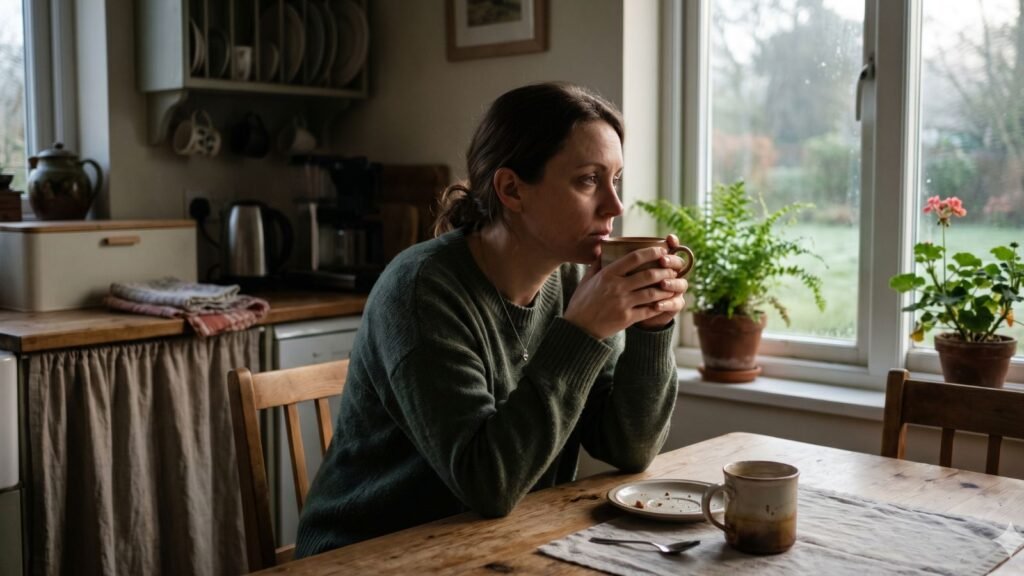
You know that moment when you walk through your front door after a long, demanding day, and without even thinking about it, you let out a long sigh? Your shoulders, which had been practically touching your ears for the last eight hours, finally drop. Your jaw unclenches. The tight band around your chest begins to loosen. You haven’t done any deep breathing exercises, and you haven’t sat down to meditate. You simply crossed a threshold into a space that feels safe, and your physical self responded instantly.
The opposite is just as true. Recall a time you walked into an office kitchen or a family living room where a tense argument had just taken place. Nobody had to tell you what happened. You didn’t need to hear the words. The air itself felt dense, almost electric. Instantly, your posture stiffened. Your breathing became shallow. You braced yourself for a blow that wasn’t even aimed at you, preparing for a battle you didn’t choose to fight.
We like to believe we’re completely self-contained packages. We carry our own personalities, our own thoughts, and our own internal climates wherever we go, moving through life like little armored tanks. But if you pay close attention to your physical self throughout the day, you begin to notice something fascinating. We don’t just move through rooms; we absorb them. Our physical selves soften or stiffen to match the emotional temperature of whatever space we happen to inhabit.
The Invisible Thread Between Us
There’s a beautiful term in psychology that explains this without using complicated language. It’s called co-regulation. It’s the silent, continuous conversation our nervous systems are having with one another all day long. Long before we had spoken language, our ancestors relied on these quiet physical signals to stay alive. If the person next to you suddenly became rigid, your own body needed to react instantly to prepare for danger, even if you hadn’t seen the threat yet. Survival depended on our ability to mirror the tension of the tribe.
Even though our daily lives look very different now, that old biology hasn’t gone anywhere. When you sit down with a friend who is relaxed, speaking slowly, and leaning back in their chair, your body quietly takes notes. Your heart rate slows down. Your muscles release their tension. You match their pace. You aren’t doing this on purpose; your nervous system is simply recognizing safety and choosing to settle down. It’s an act of physical trust.
Researchers who study relationships have found that when people are in sync, their heart rates and breathing patterns actually begin to mirror each other during conversation. It’s a physical dance of empathy. We don’t just understand each other’s feelings intellectually; we feel them in our own muscles and ribcages. We’re constantly tuning our instruments to match the orchestra we’re playing in, even when we don’t realize we’re holding an instrument at all.
The Burden of the Rigid Room
This is why certain environments feel so exhausting, even if you aren’t doing physical labor. If you spend forty hours a week in a workplace where everyone is constantly stressed, defensive, or on edge, you’re spending forty hours a week holding your body in a state of high alert. You’re matching the rigidity of the room just to survive it. Your body is doing the quiet work of protecting you, but that protection comes at a price.
By the time you get home, you might feel physically wiped out, as if you’ve just run a marathon. In a way, you have. Your muscles have been working overtime to maintain that protective stance. It takes a massive amount of physical energy to keep yourself braced against a tense environment. You aren’t just doing your job; you’re carrying the collective tension of the entire office home with you in your lower back and your temples.
What’s worse is that we’ll often blame ourselves for this fatigue. We assume we’re just tired, or that we aren’t managing our stress well enough. We buy ergonomic chairs, try new vitamins, or download apps to help us relax. But sometimes, the fatigue isn’t coming from inside us at all. It’s simply the physical cost of trying to remain upright in a space that is constantly pulling us into tension. We’re trying to heal a body that is simply reacting normally to a difficult room.
Learning to Trust the Softening
There is a unique kind of vulnerability in allowing yourself to soften. When we’re around people who make us feel secure, we let down our guard. We speak more slowly. We laugh more easily. We allow our bodies to take up space in a relaxed, unstructured way. We let ourselves be seen without our defenses, which is both beautiful and terrifying.
This physical softening is actually the foundation of deep connection. You can’t truly bond with someone while your body is preparing for a fight. It’s only when we feel safe enough to lower our defenses that we can share our true selves. Intimacy isn’t just about sharing secrets; it’s about the physical relief of being in a room where you don’t have to hold your breath.
But because many of us have spent years living in high-pressure environments, softening can sometimes feel unfamiliar or even unsafe. You might notice that when you finally have a quiet weekend, you feel restless. Your mind searches for things to worry about because your body doesn’t know what to do with the lack of tension. It feels like a trap. It takes practice to accept the quiet, and it takes courage to let the armor fall away, even when you’re in a perfectly safe room.
The Companions We Choose
Once you realize how much your physical state is influenced by your surroundings, you start looking at your relationships through a different lens. You begin to notice who makes your shoulders drop and who makes them rise. You start to see that some people are simply easier to breathe around than others.
There are people in our lives who act like a warm bath. Just being in their presence feels like a permission slip to breathe. You don’t have to perform, you don’t have to prove anything, and you don’t have to keep your guard up. Then there are those who act like a cold draft, making us instantly hunch our shoulders and pull our coats tighter around us. We love them, but our bodies are always slightly on guard in their presence.
This isn’t about judging people or labeling them. Everyone carries their own struggles and their own internal climates. It’s simply about recognizing the reality of how we affect one another. We’re not solitary creatures. We are deeply connected, and our physical selves are constantly responding to the emotional climate of those we love. Knowing this allows us to be gentler with ourselves when we feel drained, and more appreciative of the people who bring us peace.
A New Way to See Your Space
So the next time you find yourself feeling unaccountably tense, or remarkably relaxed, take a moment to look around the room. Notice the posture of the person sitting across from you. Listen to the tone of their voice. Pay attention to the physical atmosphere of the space you’re in. Ask yourself if the tension you’re carrying actually belongs to you.
Maybe you aren’t as anxious as you think you are. Maybe you’re simply mirroring the anxiety of a room that needs to settle down. Or maybe, when you feel that wonderful, deep release of tension at the end of a long day, you can offer a silent thank you to the space and the people who made it safe enough for you to let go. You’re participating in a silent agreement to let the world soften for a little while.
Perhaps we aren’t meant to be solid, unchanging blocks of stone, unaffected by the world around us. Maybe we’re meant to be like water, gently shaping ourselves to the vessels that hold us, finding our rest when we finally find a place that is still. And maybe, just maybe, the greatest gift we can offer to the people we love is a room where they can finally let their shoulders drop.