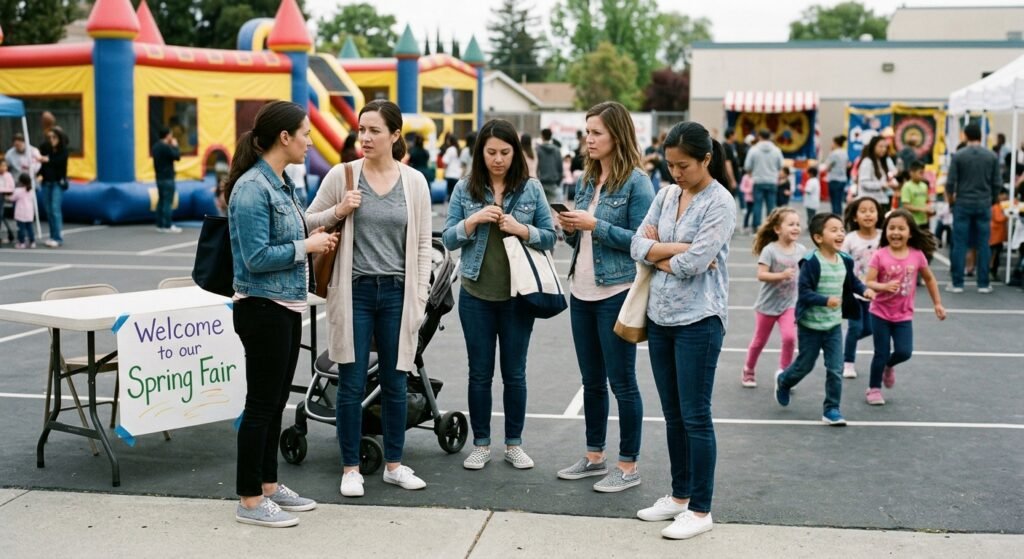
You’re standing by the school gates, waiting for the bell to ring, holding a travel mug of nearly empty lukewarm coffee. Around you, the usual afternoon scene unfolds. Parents are chatting, children’s backpacks are piled on the grass, and everyone is trying to navigate the end of another busy day. Then you notice a small movement nearby. A group of three parents is talking, laughing softly, when a fourth parent walks up to join them. In an instant, the dynamic turns. The circle subtly closes, shoulders angle inward, and the eye contact slips away. It’s a tiny, almost unnoticeable moment, but the coldness in the air is unmistakable.
If that scene feels familiar, it’s because you’ve likely witnessed it, or felt it, dozens of times. We like to think that the social hierarchies of our teenage years disappear once we receive our diplomas and step into the adult world. We tell ourselves that adults outgrow the need to exclude, belittle, or form exclusive cliques. But then we find ourselves at a neighborhood block party, a workplace committee meeting, or a community fundraiser, and we realize that those old schoolyard dynamics never actually ended. They simply changed into something more polished.
The tactics we use to protect our social standing as adults are rarely as loud as they were in middle school. We don’t push people into lockers or write cruel notes. Instead, the aggression becomes quiet and sophisticated. It disguises itself as helpful concern, like when someone shares personal details about a neighbor under the guise of wanting to support them. It hides behind humor, delivered through comments that feel like compliments but leave a lingering sting. It lives in the group chats that are intentionally created without one specific friend, or the invitations that are discussed openly in front of the only person who wasn’t invited.
The Subtle Art of Adult Exclusion
Experts who study how people connect have a name for this behavior. They call it relational aggression, which is a fancy way of describing how we use relationships and social standing to hurt or control others. While we often associate this behavior with teenagers, research indicates that these patterns frequently persist throughout our lives. The main difference is that adults are much better at hiding it. We’ve learned how to freeze someone out while maintaining a polite smile, making it almost impossible for the other person to call us out without looking overly sensitive.
The Plausible Deniability of a Polite Smile
This subtle hostility is particularly tricky because it gives the person doing it a sense of plausible deniability. If you ask why you weren’t included, you’re met with a casual excuse about a busy week or a simple oversight. If you express that a comment hurt your feelings, you’re told you took it the wrong way. The beauty of this adult version of exclusion is that it leaves no fingerprints. It leaves the target doubting their own perception, wondering if they’re simply being paranoid, while the quiet exclusion continues just beneath the surface of polite conversation.
And honestly, that’s what makes these interactions feel so draining. In high school, you usually knew who didn’t like you because they made it obvious. In adulthood, the hostility is wrapped in layers of etiquette and social niceties. You can spend hours analyzing a brief interaction at a soccer game, trying to figure out if a cold shoulder was intentional or if you’re just overthinking a busy parent’s distraction. It takes a lot of mental energy to translate the subtext of adult social circles, especially when the rules seem to change without notice.
Why the Playground Never Truly Closes
To understand why people continue these behaviors long after school is over, we have to look at the deep need for connection and safety. We are wired to want to belong. For our ancestors, being part of the group wasn’t just a social preference; it was necessary for survival. When we feel like our position in a group is threatened, a primitive alarm goes off inside us. Sometimes, the easiest way to feel secure in our own belonging is to make sure someone else is on the outside.
There’s a quiet relief that occurs when a group decides to target someone else. Even if we don’t actively participate in the exclusion, we might stay silent when we see it happening. We laugh at the sharp joke, we pretend we didn’t notice the turned shoulder, and we go along with the subtle freeze out. We do this because we fear that if we stand up for the person being excluded, the circle will open up, swallow us, and then close us out too. Protecting our own spot becomes more important than doing what feels right.
This means that adult relational aggression isn’t always driven by malice. Often, it’s driven by insecurity. The parent who acts as the gatekeeper of the school social group may seem confident, but that gatekeeping is usually a shield. By controlling who is in and who is out, they manage their own fear of being rejected. It’s a cycle that feeds on our collective reluctance to be vulnerable, leading us to build walls instead of bridges, even when we secretly wish for more genuine connections.
The Realization That Changes the View
It’s easy to look at these dynamics and feel a sense of defeat, as if we are destined to repeat the trials of high school forever. But there’s a different way to see this situation. Growing older doesn’t automatically grant us maturity, and it doesn’t automatically heal the old social wounds we carry. Real maturity isn’t a milestone we reach just by turning a certain age; it’s a series of conscious choices we make when we interact with the people around us.
Perhaps the realization we need isn’t about how to change the behavior of the group, but how we respond to it. We don’t have to participate in the silent agreements that keep people on the outside. We can choose to be the person who widens the circle, who makes eye contact with the newcomer, and who refuses to engage in the quiet teardowns disguised as polite conversation. When we stop seeking validation from circles that require us to be unkind, we free ourselves to find relationships built on genuine warmth rather than social strategy.
Maybe the old playground patterns still exist because we keep expecting adulthood to fix us automatically. Once we realize that we are the ones who have to choose a different path, the power of those old patterns begins to fade. We can’t always control how others behave at the school gate or in the neighborhood, but we can control how we show up. And in doing so, we might just help create a space where everyone feels a little less like they’re still trying to survive sophomore year.