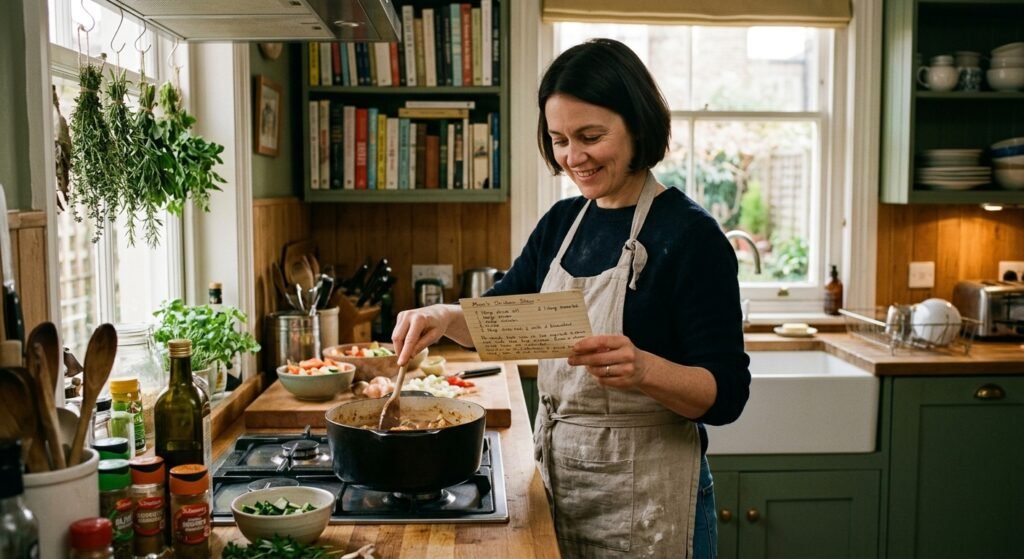
You stand in front of the cutting board, chopping onions exactly the way they taught you to. It is a specific grip; fingers tucked under, knife gliding rhythmically against your knuckles. For a moment, the sound of the knife and the sharp, clean scent of the onion fills the room. Suddenly, you are ten years old again, standing on a step stool in a kitchen that smelled of yeast and warm butter. Then, the weight of the present catches up with you. You realize whose hands you are mimicking. You remember that the person who taught you this grip is someone you have not spoken to in years.
There is a unique kind of stillness that settles over a kitchen when you make a dish passed down by a parent you no longer speak to. It sits right at the intersection of comfort and grief. You want the taste of the beef stew or the specific sweetness of the banana bread, but the recipe feels like a map leading back to a territory you had to leave for your own well-being. You wonder if preheating the oven to their exact specifications is a form of surrender, or if it is okay to want the food even when you can no longer have the relationship.
The Sensory Time Machine
Human memory is a strange, stubborn thing, and food is perhaps its most powerful trigger. You can change your phone number, move to a different city, and spend years building a beautiful, quiet life of your own design. Yet, a single whiff of nutmeg or the particular sizzle of butter in a cast-iron skillet can bypass every emotional defense you have built, instantly pulling you back to a childhood dinner table.
Our brains are wired this way for a reason. The parts of our mind that process smell and taste are deeply intertwined with the areas responsible for emotion and memory. It is why a recipe is not just a list of ingredients; it is an emotional archive. When you recreate a parent’s dish, you are not just feeding yourself; you are reaching back in time to touch a version of your life that was simpler, even if it was also incredibly complicated.
The Conflict of the Kitchen
For many people who have made the painful decision to distance themselves from a parent, cooking these dishes can feel like a quiet betrayal of their own boundaries. You might find yourself standing in the grocery aisle, looking at a can of condensed milk or a specific brand of spices, feeling a sudden wave of guilt. It can feel as though enjoying their signature meal somehow invalidates the pain that led to the silence between you.
This internal struggle is something researchers who study family dynamics see quite often. The consensus among those who study long-term family estrangement is that cutting contact does not automatically erase the love, nor does it quiet the desire for parental warmth. We often talk about estrangement as a clean break, but in reality, it is more like an ongoing negotiation with your own history. You are constantly deciding what to carry forward and what to leave behind.
Reclaiming Your History
Perhaps the most healing realization you can reach while standing over a simmering pot is that the warmth of that food does not belong solely to the person who taught you how to make it. It belongs to you now. The patience it takes to let the sauce reduce, the care put into seasoning the dish, and the quiet joy of a home-cooked meal. These are your experiences, and you get to keep them.
When you recreate those recipes, you are not inviting the chaos back into your life. You are simply acknowledging that beautiful things existed alongside the difficult ones. You are allowing yourself to remember that you were loved, and that you loved in return, even if the structure of that relationship could not survive the weight of adulthood.
Maybe the food was never about holding onto the past or wishing for a different parent. Maybe it is about recognizing that you can appreciate the warmth of the kitchen they built while still choosing the safety of the house you live in today. When you sit down to eat, you do not have to ignore the bittersweetness. You can simply let love and loss share the table, knowing you are strong enough to carry both.