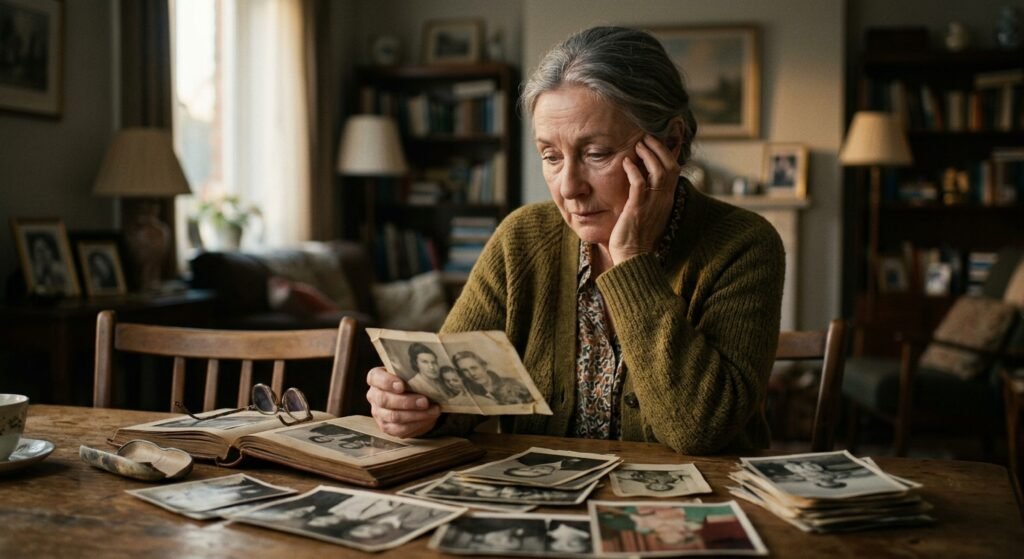
Maybe you are cleaning out a desk drawer on a quiet Sunday afternoon and you come across an old photograph of yourself from ten or twenty years ago. You are not doing anything remarkable in the picture. You are just sitting on a porch, laughing at something someone said, wearing a shirt you haven’t owned in a decade. What catches your attention isn’t the outfit or the hairstyle. It’s the expression on your face. There’s a certain lightness there, an easy comfort that feels almost unfamiliar now. You look at that younger version of yourself and feel a sudden, quiet ache in your chest. You wonder when, exactly, you stopped feeling quite that free.
It’s a feeling that visits many of us as we get older. We look backward and begin to believe that our best chapters have already been written. We look at our past with a deep sense of longing, convinced that the peak of our joy, our excitement, and our promise is firmly in the rearview mirror. It feels as though we’ve spent the second half of our lives simply managing the decisions we made in the first half.
The Filters of Memory
This longing isn’t just about wishing for youth. It’s about how we process the passage of time. When we look back, we tend to filter out the uncertainty, the anxiety, and the bad days. We edit our memories into a highlight reel of warmth, ease, and endless possibility. We forget the sleepless nights spent worrying about money, the awkward early relationship years, and the deep insecurity of not knowing where we belonged in the world.
At twenty, the road ahead feels long and open in a beautiful way. You feel like you could become anyone, go anywhere, do anything. As the years pass, life inevitably gets more defined. We make choices. We commit to careers, partners, neighborhoods, and routines. Every choice we make, while meaningful, quietly closes other doors. Eventually, we look around and realize the road behind us is longer than the road ahead. And that’s when the quiet grief of aging starts to settle in. We aren’t necessarily unhappy with our current lives, but we mourn the feeling of having infinite paths still open to us.
Why the Past Feels So Bright
Researchers who study memory often point to a pattern they call the reminiscence bump. It’s a well-documented tendency for people to remember events from their late teens and twenties more vividly than almost any other period in their lives. During those years, we are experiencing major life firsts. First jobs, first serious relationships, first apartments, first tastes of true independence. Our brains are highly sensitive to novelty. When everything is new, our minds record those experiences in high definition.
As we settle into the comfortable patterns of adulthood, life becomes more predictable. Predictability is wonderful for stability, but it doesn’t leave the same deep imprints on our memory. So when we look back, those early years shine brighter not because they were objectively better, but because they were painted in much bolder colors. We are comparing the vivid fireworks of our youth with the steady, quiet warmth of a hearth fire, and assuming the fireworks were superior.
We also tend to view our past selves with the benefit of hindsight. We look at that young person in the photograph and see someone beautiful, full of potential, and unburdened. But we forget that the person in the photograph didn’t feel that way at the time. They were likely just as confused, tired, and anxious as we are today. We’ve simply forgotten the struggle and kept the magic.
Measuring the Years Differently
Perhaps the real challenge of growing older isn’t that our lives become less exciting, but that we keep trying to measure our happiness with the same yardstick we used when we were young. When we are early in our journey, we measure a good year by its novelty, its dramatic transformations, and its external achievements. We want big things to happen. We want to climb mountains, change jobs, and fall in love in dramatic ways.
But as we mature, the definition of a good life quietly evolves. We start to value different things. A quiet morning with a cup of coffee. A deep conversation with an old friend who knows us completely. The comforting reliability of a partner who has stayed by our side through difficult seasons. The peace of knowing who we are and no longer feeling the need to prove ourselves to every person we meet.
If we expect our later years to feel like our twenties, we will always feel like we are missing out. But a quiet harbor isn’t worse than the open ocean; it’s just a different stage of the journey. The excitement of setting sail is beautiful, but so is the safety of arriving somewhere safe.
New Possibilities in Quiet Spaces
New possibilities don’t stop arriving just because we’ve lived a little longer. They just look different. They are quieter, deeper, and more grounded. Instead of wondering who we will become, we get the privilege of discovering who we actually are when we stop trying so hard to impress the world. We can let go of the pressure to achieve and finally focus on the simple joy of being present.
So if you find yourself looking at old photos and wondering if your best days are gone, take a breath. You aren’t losing your spark. You’re just learning to appreciate a different kind of warmth. The road ahead may have fewer lanes, but the scenery is often much more beautiful when you aren’t rushing past it. You’re not the only one who looks back with a sigh, but maybe the best is not behind us. Maybe it’s just sitting quietly in the room with us, waiting to be noticed.