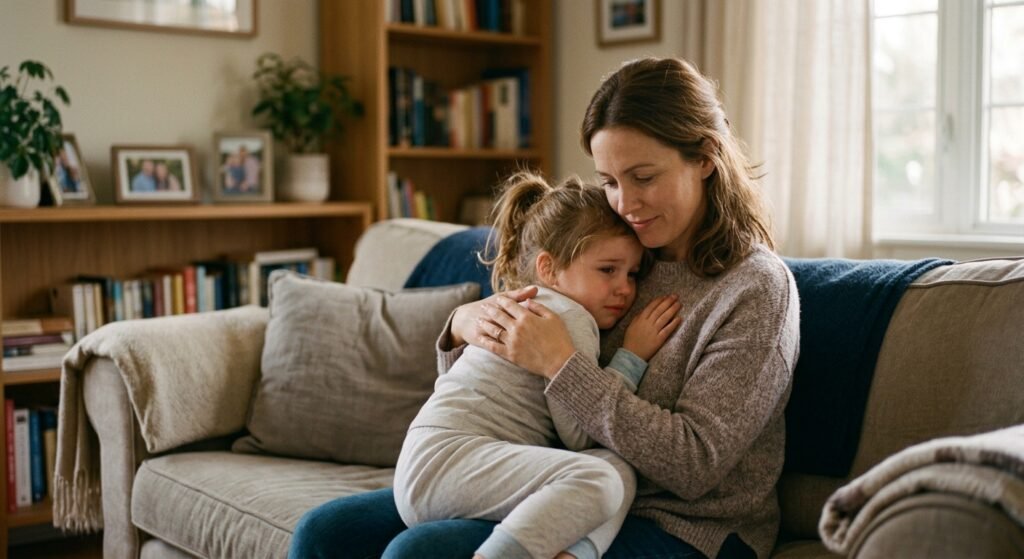
You are standing in the kitchen, washing a few dishes, when you hear a sudden, sharp crack from the living room. It’s the unmistakable sound of a favorite ceramic mug hitting the hardwood floor. Before you can even turn around to say it’s okay, you hear a tiny, breathless apology, followed by a sudden, tense silence.
When you look over, your child isn’t just looking sorry; they are completely frozen. Their shoulders are hunched, their eyes are wide and darting, and they look as if they are waiting for a storm to break over their head. It’s a reaction that feels entirely out of proportion to a broken coffee cup.
In that quiet second, a cold realization settles in your chest. You realize that, for reasons you don’t fully understand, your child doesn’t feel entirely safe here in their own home.
The Silent Atmosphere of a House
We often think of safety as something physical, like locked doors, warm blankets, and a full pantry. If our children have a bed to sleep in, regular meals, and parents who love them, we assume they must feel secure. But emotional safety is a much quieter, more fragile thing. It isn’t just about what is happening in a house; it’s also about what might happen, or what a child fears could happen if they make a mistake.
Children are remarkably intuitive observers of their environment. Long before they understand the complexities of adult life, they learn to read the room. They register the sharpness in our voice when we’re stressed about bills, the cold silence between partners after an argument, and the subtle ways we withdraw when we’re overwhelmed. They don’t need us to explain our stress; their bodies feel it anyway.
When a home becomes emotionally unpredictable, even in small ways, a child’s nervous system pays close attention. They start watching the way we walk through the front door. They listen to the tone of our footsteps. They learn to predict whether it’s a good day or a bad day before we’ve even said a word. Over time, this constant vigilance becomes their normal way of moving through the world, turning their own home into a place where they feel they must constantly tread carefully.
The Barometer of the Household
How Young Minds Read Tension
Family researchers often refer to children as the emotional barometers of the home. Studies in child development suggest that young minds are constantly scanning their caregivers for cues of safety or threat. When parents are chronically stressed, anxious, or emotionally distant, children can interpret that ambient tension as a direct threat to their own security. To a young brain, an emotionally unavailable parent can feel just as destabilizing as an angry one.
This doesn’t mean you are a bad parent, or that you’ve done something wrong. Life is demanding, and we all carry serious burdens that spill over into our household relationships. But when our personal stress dominates the environment, the home stops feeling like a sanctuary and starts feeling like a minefield. The child begins to believe that their primary job is to keep the peace, to be as small and quiet as possible, and to avoid causing any trouble that might tip the balance.
You might notice this in the way they instantly clean up their room without being asked, or how they quickly agree with everything you say. It shows up when they stop sharing their feelings because they don’t want to worry you, or when they retreat to their room the moment the household energy feels slightly tense. It’s a protective strategy born out of a desire to keep themselves secure in the only world they know.
The Quiet Work of Rebuilding
Moving Beyond Perfection
Realizing that your child feels on edge in their own home can feel deeply painful. The natural instinct is to feel defensive, to remind ourselves of all the ways we provide for them, or to tell ourselves they are simply being sensitive. It’s difficult to accept that the place we’ve built to protect them can sometimes feel like a source of anxiety. Yet, acknowledging this reality is the first step toward creating something different.
Rebuilding emotional security doesn’t require us to be perfect parents who never lose our temper or never have stressful days. That standard is impossible to meet, and trying to perform perfection only adds more tension to the air. Instead, it involves changing how we respond when things do go wrong. It means showing our children that mistakes don’t break our connection with them.
When that ceramic mug breaks, it’s an opportunity to show them that a mess is just a mess, not a disaster. It’s about letting them see us apologize when we lose our patience, demonstrating that relationship ruptures can be repaired. When we take responsibility for our own moods and anxieties, we free our children from the responsibility of managing them for us. We let them go back to the simple, necessary job of just being kids.
What True Safety Looks Like
Perhaps we’ve been looking at family safety the wrong way. We tend to view a safe home as a place where conflict never happens, where everyone is always happy, and where the outside world can’t reach us. We try so hard to keep the peace that we end up creating a quiet, fragile stillness where everyone is afraid to make a sound.
But true emotional safety isn’t the absence of storm clouds or the complete elimination of friction. It’s the profound presence of repair. A child doesn’t feel secure because their parents never make mistakes or never experience stress; they feel secure because they know that when things fall apart, the adults in the room will help them put the pieces back together. They learn that their home is a place where they can drop their guard, make mistakes, and be completely messy, knowing that the love holding the walls together isn’t going anywhere.