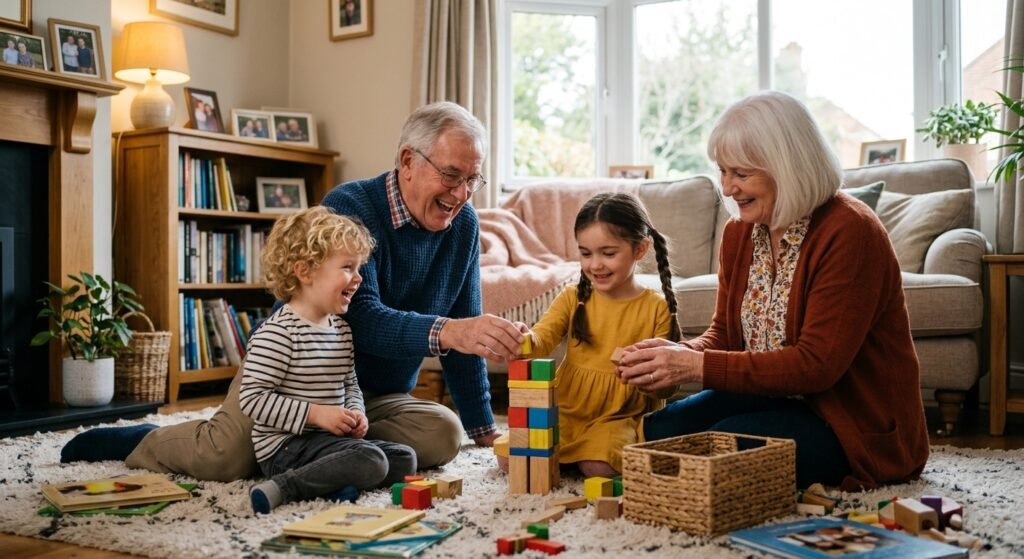
You’re sitting on the living room floor, folding laundry or half-watching television, when you notice something that stops you in your tracks. Your father is sitting on the rug next to your child, patiently rebuilding a plastic toy train track for the fourth time. He isn’t rushing, he isn’t sighing with frustration, and his voice carries a quiet patience you don’t quite recognize from your own childhood.
When you were seven, a broken toy or a spilled glass of juice might have met a sharp reprimand or a sudden wave of tension that made everyone in the room hold their breath. Now, he simply smiles, wipes up the spill with a paper towel, and tells his grandchild that mistakes are just how we learn. It’s a beautiful moment, but inside your chest, it feels complicated. You feel a strange pinch of something you can’t quite name, a mixture of genuine love for the grandparent they’ve become and a quiet, lingering grief for the child you once were.
This experience is far more common than people tend to admit. We often think of healing as a process of fixing what was broken, but sometimes it looks like watching someone else receive the exact care, patience, and warmth you spent your entire youth wishing for. You watch your mother listen intently to your niece talk about a school project, giving her undivided attention without looking at her phone or worrying about the chores. You remember wanting that same presence, only to receive a distracted nod or a lecture about your messy bedroom.
It’s easy to feel confused by these moments. You want to be happy that your parents have grown, and you genuinely are glad that the next generation gets the best version of them, but you also have to sit with the realization that you had to navigate a much harder, sharper version of the very same people.
The Different Seasons of Parenting
People who study family dynamics often talk about how the roles we play are deeply tied to our life stages. When your parents were raising you, they were likely carrying the daily pressures of survival, career building, and the daunting responsibility of shaping a future adult. They had bills to pay, societal expectations to meet, and their own unhealed childhoods trailing behind them. They were in the thick of the struggle, often reacting out of exhaustion rather than intention.
With grandchildren, or simply in their later years, the high stakes of parenting have disappeared. They have the luxury of play without the burden of daily discipline, and the gift of time without the relentless pressure of a ticking clock. Researchers who look at emotional development in later life note that as people age, they naturally prioritize emotional harmony and positive connection over control. They are literally wired to be softer now, but knowing the science doesn’t always make the contrast easier to carry when you’re the one who remembers the older, harder edges.
It takes a lot of emotional maturity to look at a parent’s newfound softness and not feel a quiet resentment. You might find yourself wanting to ask where this patient person was when you were crying in your bedroom, or why it took decades for them to learn how to say they were proud of you. Those questions are natural, and they deserve to be acknowledged rather than swept under the rug.
Making Peace With What Arrived Too Late
Perhaps the most profound realization comes when you stop waiting for them to offer that softness to your past self. You begin to understand that their ability to change is actually a gift, even if the timing feels entirely unfair. When you see your parent gentler now, it proves that people are not static. It shows that growth is possible, even for the people who once seemed entirely set in their ways. It doesn’t undo the loneliness of your own childhood, but it does release you from the belief that you were somehow the cause of their distance or anger.
You realize that their previous sharpness was never about your worthiness as a child. It was about their own limitations as parents. Seeing them love more freely now is a quiet confirmation that the capacity for softness was always inside them, even if they didn’t know how to access it when you needed it most.
So if you find yourself standing in the kitchen doorway, watching your parent do something deeply kind for your own child that they never did for you, let yourself feel both sides of that coin. Let yourself feel the warmth of the present and the quiet ache of the past. You don’t have to pretend the past was perfect to appreciate who they are trying to be today. You can love the grandparent they’ve become while still holding a gentle space for the child who deserved this version of them all along. Maybe healing isn’t about getting the perfect childhood retrospectively. Maybe it’s about standing in the present, watching the people who raised us finally learn how to soften, and realizing that we’ve managed to grow into people who can appreciate the change, even if it arrived a little too late.