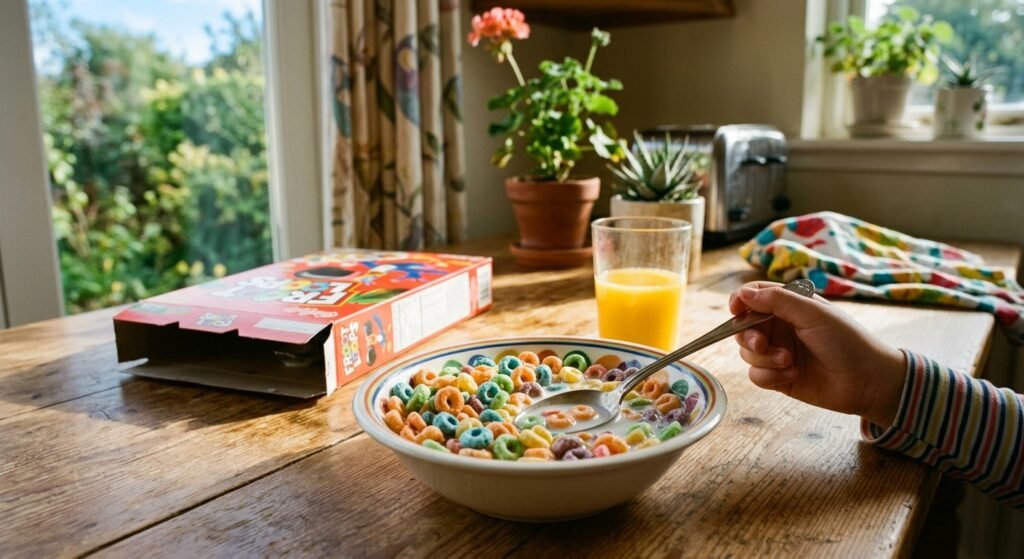
If you’ve ever found yourself standing in your kitchen in your thirties, staring at a box of brightly colored cereal that you haven’t bought since middle school, you know there’s a strange pull to it. You don’t buy it because you think it’s particularly nutritious, and you certainly don’t buy it because it fits into whatever modern diet you’re currently trying to follow. You buy it because, for reasons you can’t entirely explain, you suddenly needed to feel the exact texture of those little crunchy loops floating in cold milk.
You bring the bowl to the table, sit down in the quiet of your morning, and take that first bite. For a fleeting second, the clutter of your incoming emails, your list of obligations, and the general pressure of being an adult quietly recedes. It’s a sensory time machine. You’re not just eating breakfast; you’re visiting a younger version of yourself who sat at a different table, decades ago, without a single clue about how complicated the world would eventually become.
Many of us have these quiet morning rituals. Maybe it’s a piece of white toast smeared with butter and a generous shake of cinnamon sugar, or perhaps it’s a toasted waffle with syrup pooling in the little squares. Whatever the specific menu, the act of recreating these simple plates is rarely about satisfying physical hunger. We’re looking for something else entirely.
The Sensory Architecture of Memory
It’s fascinating how a single taste can bypass all our adult logic. We spend so much energy trying to make sensible, mature choices, yet we remain deeply susceptible to the simple flavors of our youth. That’s because our brains process taste and smell differently than they process sights or sounds. The olfactory and gustatory pathways are wired directly into the emotional centers of our minds, meaning a spoonful of childhood cereal doesn’t just remind us of the past; it makes us feel it.
When you taste that familiar sweetness, your nervous system registers a deep, ancient sense of safety. Researchers who study nostalgia have noted that we tend to seek out these culinary comfort zones during times of transition, stress, or quiet exhaustion. It isn’t a sign of weakness; it’s a beautifully designed coping mechanism. By tasting something that has remained completely unchanged since you were seven years old, you’re offering yourself a temporary anchor in a world that changes far too quickly.
Think about the last time you recreated one of these simple breakfasts. Chances are, it wasn’t on a morning when you felt completely on top of your life, organized, and energized. It was likely a morning when the day ahead felt slightly daunting, or perhaps a Sunday when the silence of the house felt a little too vast. In those quiet moments, the simplicity of a childhood plate offers a gentle buffer against the demands of the present.
The Time Before the Morning Rush
What we’re truly yearning for during these morning nostalgic trips isn’t actually the sugar or the processed flour. We’re longing for the emotional landscape of those early mornings. When you were a child eating that toast, your relationship with the morning was entirely different. You didn’t wake up thinking about bills, relationship dynamics, or career milestones. The morning was simply a space to be filled with play, school, or watching cartoons while the sunlight crept across the carpet.
Back then, someone else was likely managing the quiet machinery of your life. Someone else was worrying about the grocery list, the chores, and the timing of the day. Recreating that breakfast is a quiet way of stepping back into that protected space, even if only for ten minutes before you have to put on your shoes and face the world. It’s a brief strike of independence from the constant pressure of having to figure everything out on your own.
There’s also a beautiful lack of pretense in these meals. In our adult lives, food often becomes performative. We worry about organic labels, carbohydrate counts, aesthetic presentation, and whether our choices align with our wellness goals. A childhood breakfast requires none of that exhausting mental labor. It’s cheap, it’s simple, and it doesn’t care about your goals. It only wants to offer you comfort, exactly as you are.
Finding Comfort in the Mundane
Perhaps the most beautiful realization about these moments is that the magic was never really in the recipe itself. It’s easy to look back and think we miss the specific brand of toaster pastries or the way our parents cut our sandwiches. But if you were to eat those exact foods in a crowded, stressful environment, they wouldn’t taste the same. They work because they represent a period of life when we were allowed to simply exist without needing to justify our space in the world.
Maybe you aren’t actually hungry for the foods of your youth. Maybe you’re just hungry for a morning where you didn’t have to carry the day’s responsibilities yet. And while you can’t go back to being that child, you can occasionally invite that version of yourself to sit at your kitchen table. By pouring that familiar cereal or buttering that toast, you’re recognizing that the kid who loved those simple things is still very much alive inside you, waiting for a quiet moment to feel safe once again.
So the next time you find yourself craving a breakfast that belongs in a middle school cafeteria, let yourself enjoy it without any guilt or doubting. You’re not just feeding your stomach; you’re tending to a memory. And sometimes, a warm slice of cinnamon toast is exactly what you need to remind yourself that beneath all the layers of adult responsibility, you are still the very same person who once found absolute magic in a simple, quiet morning.