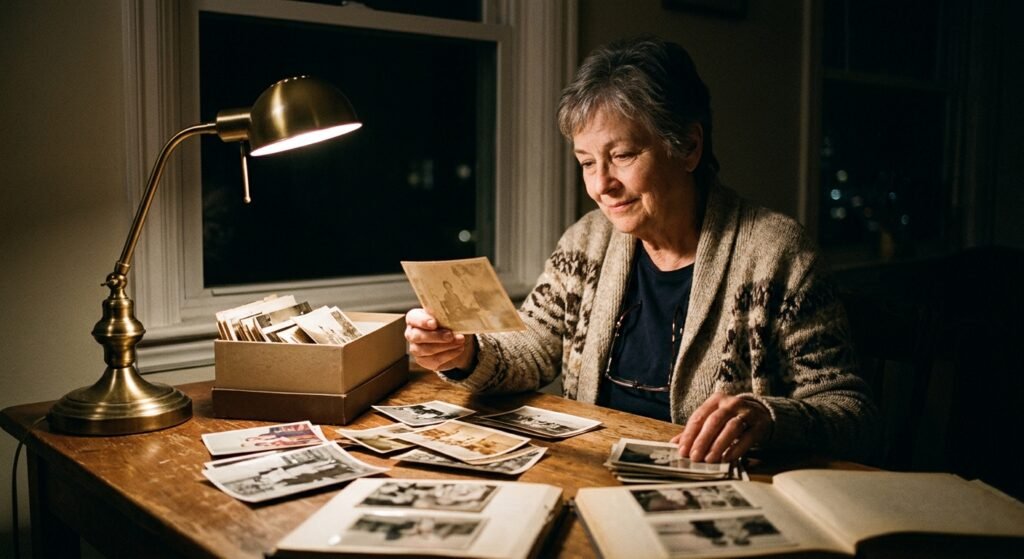
Have you ever been cleaning out a kitchen drawer, or scrolling through your phone’s photo library to find a picture of a recipe, only to stumble upon a face you haven’t seen in years? Suddenly, everything slows down. It’s someone who used to know everything about you. They knew how you took your coffee, the exact name of your childhood pet, and the specific fears that kept you awake at night. Now, they’re a stranger.
You know, through the quiet grapevine of mutual friends or a public social media profile, that they’ve moved on. They’ve got a new job, maybe a new partner, a new city, and a life that doesn’t have your name in it anywhere. Yet, there you are, standing in your kitchen, wondering why they still occupy so much space in your mind.
It’s a strange, quiet kind of grief that we rarely talk about. We understand how to mourn connections that ended in fireworks, where the boundary lines were drawn in sharp, painful arguments. But we don’t really know what to do with the people who simply faded away, leaving us behind while they walked into a future we aren’t part of. It feels embarrassing to admit that you still think about them. You might worry that it means you’re stuck, or that you care too much, or that you’re somehow failing at the art of letting go.
The Silent Archive of Our Minds
Most of the time, this isn’t about desiring to have them back in your daily life. If you actually sat across from them today, you’d probably find that you have nothing left to say. The jokes that once made you laugh until your stomach hurt would likely feel flat. The shared history would feel like a costume that no longer fits either of you. You don’t actually want to go back.
So why does the mind keep returning to them? Why does a song on the radio, a specific rainy afternoon, or a street corner instantly bring their face back into your mind?
It helps to realize that our minds are wired to find patterns and complete stories. When a connection of any kind, whether it was a close friendship, a mentorship, or a deep partnership, fades without a clear, definitive conversation, the story remains unfinished. Decades ago, researchers noticed that people tend to remember tasks they left incomplete far better than the ones they finished. When you finish a puzzle, you put it back in the box and forget about it. But if you’re forced to walk away with three pieces missing, your mind keeps wandering back to the table, wondering where those final pieces went.
The Puzzle of the Unfinished Ending
Our memories work in a very similar way. When someone exits your life without a dramatic ending, your brain treats their absence like an unsolved mystery. There was no final curtain call, no closing credits, just a quiet exit through the side door. Because there was no clear period at the end of the sentence, your mind keeps trying to write the next word, even though the pen ran out of ink years ago.
You’re not obsessed with the person; you’re simply trying to resolve the story. You’re looking at the empty space they left and trying to understand how someone who once felt like home could become a stranger so quickly. The mind struggles with this contradiction. It feels like a glitch in our social wiring. How can two people share so much vulnerability and then simply pretend the other doesn’t exist?
This quiet search for answers is actually a deeply natural response. Some experts suggest that our minds treat social distance and fading connections as a puzzle that needs solving for our own safety. In our early history as a species, staying connected to the group was essential. If someone suddenly stopped looking out for you, your brain needed to know why so you could prevent it from happening again. So, when someone moves on without explaining why, your brain keeps the memory active, treating it as an important lesson that you haven’t fully processed yet.
The Versions of Ourselves We Leave Behind
There’s another layer to this that has very little to do with the other person at all. Often, when you miss someone who has forgotten you, you aren’t actually missing them. You’re missing the version of yourself you were when you knew them.
Think about the era of your life when that person was present. Maybe you were younger, more optimistic, or living in a town you loved. Maybe you were bolder, or perhaps you hadn’t yet experienced the disappointments that shaped your later years. That person represents a specific chapter of your story. When they walked away, they took a piece of your youth, your laughter, or your shared dreams with them.
Thinking about them is a way of visiting that old chapter. It’s a way of checking in on the younger version of you who felt safe, seen, and happy in their presence. The longing you feel isn’t a desire to knock on their door today. It’s a quiet desire to feel the way you felt when that door was wide open.
Letting the Story Stay Unfinished
We live in a culture that demands resolution. We’re told that we need to have conversations, write letters we never send, or find a way to neatly pack away our past so we can move forward. But sometimes, closure is a myth we chase to avoid the discomfort of things simply being over.
Perhaps the realization that helps us breathe a little easier is that some memories stay because we never fully understood their ending, and that’s actually okay. You don’t need to solve the mystery of why they stopped calling, or why the friendship dissolved into silence. You don’t need to force a neat ending onto a story that was messy and incomplete.
The fact that you still think about them doesn’t mean you’re broken, and it doesn’t mean you’re living in the past. It simply means you cared. It means you’re someone who loved deeply enough that the absence of that closeness left a mark. That isn’t something to be ashamed of. It’s a beautiful testament to your capacity for connection.
So the next time their name crosses your mind on a quiet afternoon, you don’t have to fight it. You can simply nod to the memory, appreciate the chapter you shared, and accept that some stories are meant to end with an ellipsis instead of a period. You’re not the only one carrying these quiet ghosts, and sometimes, just letting them exist in the background is the closest thing to peace we can find.