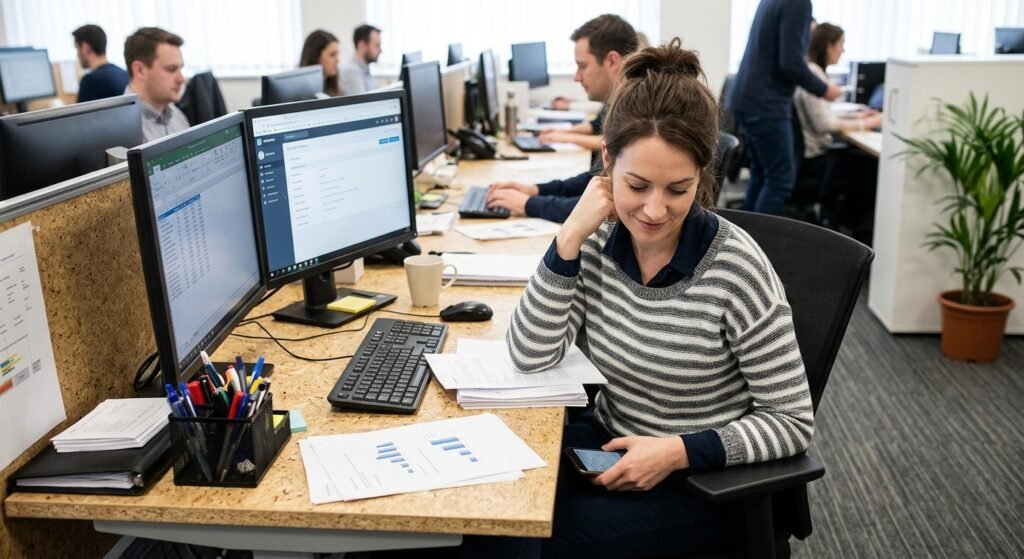
Can we talk about this for a second?
You’re sitting at your desk, a spreadsheet is open, and you’ve got at least three things on your to-do list that actually need to get done before five o’clock. But instead of typing, your hand slowly reaches out, picks up your phone, and unlocks it. Within three seconds, you’re scrolling through videos of a dog learning to play the piano or someone in another state organizing their pantry. You don’t remember making the conscious decision to do this. Your hand just did it on autopilot, moving with the kind of smooth precision that usually takes years of training to master.
The funny thing is how normal this has become. You didn’t think to yourself, “I’m going to stop working now and look at social media.” It’s more like your mind quietly excused itself from the room while your thumbs took over the controls. One moment you were thinking about quarter-three projections, and the next moment you were deeply invested in whether a stranger’s homemade sourdough bread is going to rise properly in the oven.
The Tiny Story We Tell Ourselves
We always tell ourselves the same little lie to make it feel okay. We tell ourselves we’re just taking a quick break, a thirty-second pause to clear our head before we dive back into that report. You convince yourself that this brief distraction will actually make you more productive in the long run. It’s a beautiful little delusion. You believe that looking at pictures of a vacation you’ll never go on is somehow refueling your mental energy for the task at hand.
Five minutes later, you’re still there. Now you’re reading comments on a post about how to properly wash a strawberry. You don’t even like strawberries all that much, but suddenly this feels like critical information that you can’t afford to miss. You’re learning about vinegar ratios and water temperatures as if you plan to start a fruit-washing business by the end of the week. Somehow, in the middle of a busy workday, this suddenly feels completely reasonable.
The Subtle Language of the Brain
At some point, we have to admit that it stops being about the strawberries. You aren’t actually interested in the fruit, the piano-playing dog, or the organized pantry. This is a tiny act of escape. When your day gets a little too full of emails, meetings, and tasks that feel slightly too big, your mind looks for the nearest emergency exit. And that exit just happens to be a small glowing screen in the palm of your hand.
Somehow this always happens right when the work gets slightly harder. You hit a difficult sentence in an email, or you open a document that requires real focus, and your mind instantly signals that it’s time to check if anyone you went to high school with has bought a new car. It’s a wonderfully subtle way of protesting your own desk. Your focus didn’t just slip; it actively ran away to find something easier to do.
We all know how this ends. You eventually lock the phone, put it back on the desk, and try to look busy again. But then, ten minutes later, you find yourself doing the exact same thing. You might even open the same app you just closed, hoping that somehow the internet has created an entirely new batch of entertainment in the last six hundred seconds.
The Art of Looking Busy
The social side of this is where it gets really entertaining. We all do this, but we also try very hard to hide it from anyone who might walk past our desk. There’s a very specific, split-second movement where you tilt the phone screen down toward your lap or suddenly look deeply contemplative. You hold the phone at a precise angle, hoping it looks like you’re reading an extremely important work message or perhaps checking a security alert.
You might even furrow your brow a little bit so it looks like you’re solving a complex problem rather than watching someone bake a giant cookie in a skillet. We pretend we’re deeply engaged in high-level thinking, when in reality we’re just trying to find out if the cookie turned out doughy in the middle. It’s a quiet, shared performance that everyone at the office participates in without ever talking about it.
Maybe we don’t need to feel so guilty about these little moments. Maybe that random, aimless scroll isn’t a sign of laziness or a lack of discipline. Sometimes distraction is just your mind asking for a break. When you spend hours staring at a screen trying to make decisions, your mind eventually needs a soft place to land. It wants to look at things that ask absolutely nothing of it in return.
So the next time you find yourself staring at a video of a stranger cleaning their gutters when you should be editing a presentation, don’t be too hard on yourself. Your mind is just taking a tiny, unauthorized vacation because it has had enough of spreadsheets for the moment. We’ve all been there, and honestly, you’ll probably do it again tomorrow.