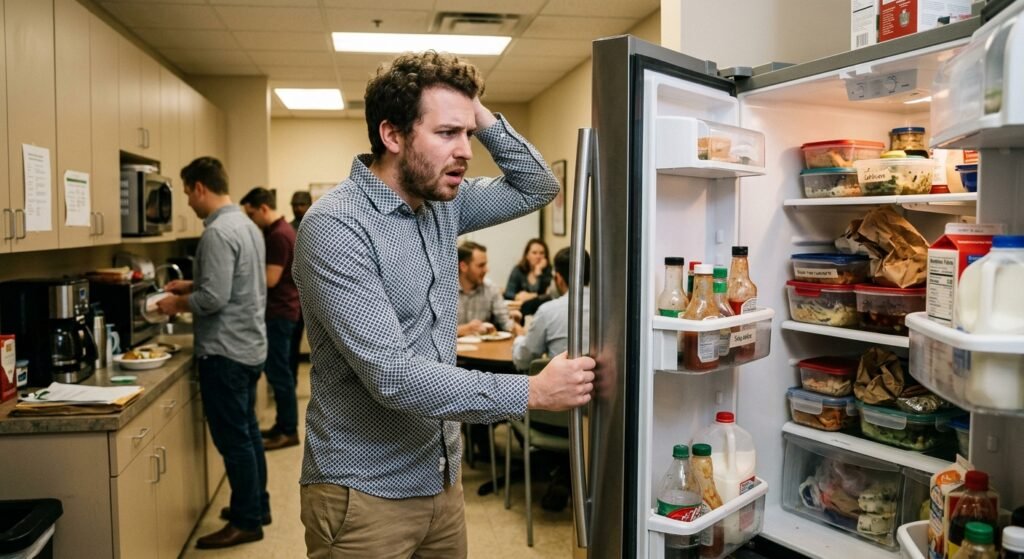
Can we talk about this for a second?
You pack a lunch, put it in a Tupperware container, and walk into the office breakroom. You open the communal refrigerator, find a tiny gap between three different bottles of salad dressing, and slide your food inside. But before you walk away, you do something highly specific. You grab a sticky note, write your name on it in giant letters, and slap it across the lid.
You write your name like you’re claiming land in the name of a distant king. There’s a strange, quiet belief that without that sticky note, your leftovers are basically public property.
The funny part is that we all know how this ends. Nobody’s actually wandering into the breakroom looking to steal a slightly bruised banana or a partially eaten turkey sandwich. Yet, for some reason, the moment a refrigerator is shared by more than four people, we convince ourselves that a lawless society has formed right behind the double doors.
The Magic Safety Label
Think about the psychology of the name tag. You don’t label your food at home. If you live with family or roommates, you might occasionally say, “Hey, please don’t eat that cake,” but you don’t run around the kitchen with a label maker. But at work? That sticky note represents security. It’s your way of saying, “I see you, and I know what you’re capable of.”
Somehow this always happens. You see a bag of grapes with a name written on it in permanent marker. You see a single yogurt cup with initials scrawled on the foil lid. Sometimes people even write the date they brought the food in, as if they’re establishing a legal timeline for their ownership. It’s as if we believe our colleagues are fine, upstanding citizens in the hallway, but the moment they stand in front of the cold air of the fridge, they lose all sense of personal boundaries.
The truth is, we’re all hiding a tiny, silent fear that our lunch is up for grabs. And the funny thing is, the rules we create to protect our food are completely imaginary. A sticky note has never actually stopped a truly determined lunch thief. If someone really wanted your leftovers, a piece of yellow paper isn’t going to stand in their way. But we write the names anyway because it makes us feel like we have some control over the situation.
The Mystery of the Abandoned Condiments
Then there’s the other side of the communal fridge behavior. The stuff that gets left behind. At some point, it stops being about the food and starts being about a strange, collective denial.
Every office refrigerator has at least one bottle of salad dressing that’s been sitting on the door shelf since the Clinton administration. There’s a jar of mustard that’s practically part of the shelf now. Nobody wants to throw it away because nobody wants to be responsible for discarding someone else’s property. What if Sarah from accounting suddenly needs that exact bottle of ranch dressing from three summers ago? What if discarding it causes an unspoken rift in the department?
So, instead of cleaning it out, everyone collectively decides to pretend it doesn’t exist. We just push it further into the back, behind the newer, fresher items, hoping it’ll quietly dissolve into the atmosphere. Five minutes later, you’re standing there looking at a jar of salsa that’s turned an interesting shade of blue, and you just shrug and close the door.
The Friday Afternoon Cleanout
This leads us to the ultimate weekly ritual: the Friday afternoon refrigerator purge. This is when the rules of the office fridge get surprisingly serious. Usually, a paper sign appears on the door on Thursday afternoon, warning everyone that any food left in the fridge by Friday at four o’clock will be thrown away. Not just moved, but discarded entirely.
This warning creates a very specific kind of panic. You see people rushing to the breakroom right before four to rescue a plastic container they haven’t thought about since Monday. Suddenly, that leftover pasta is the most valuable thing they own. They’ll carry it back to their desk like a prized possession, even though they’ve absolutely no intention of eating it over the weekend.
For some reason, this suddenly feels completely reasonable. We’d rather carry a soggy container of food all the way home on the train than let the office refrigerator claiming system win. It’s a quiet victory. You saved your Tupperware. You beat the system.
A Shared Understanding
At the end of the day, these funny little rituals aren’t really about the food at all. They’re about how we navigate being around each other in a shared space. We write our names on bags, we leave the ancient mustard jars alone, and we panic over the Friday cleanout because it’s a way to create order out of the everyday chaos of working together.
It’s a gentle way of acknowledging that we’re all sharing the same space, trying to get through the day, and hoping nobody takes our snack. It’s a small, silent agreement that keeps the peace.
So tomorrow, when you write your initials on your yogurt, don’t feel silly. Everyone else is doing the exact same thing, probably with the exact same marker. We all do this, and honestly, we’ll probably do it again tomorrow. It’s just how we keep our little corner of the workplace running smoothly.