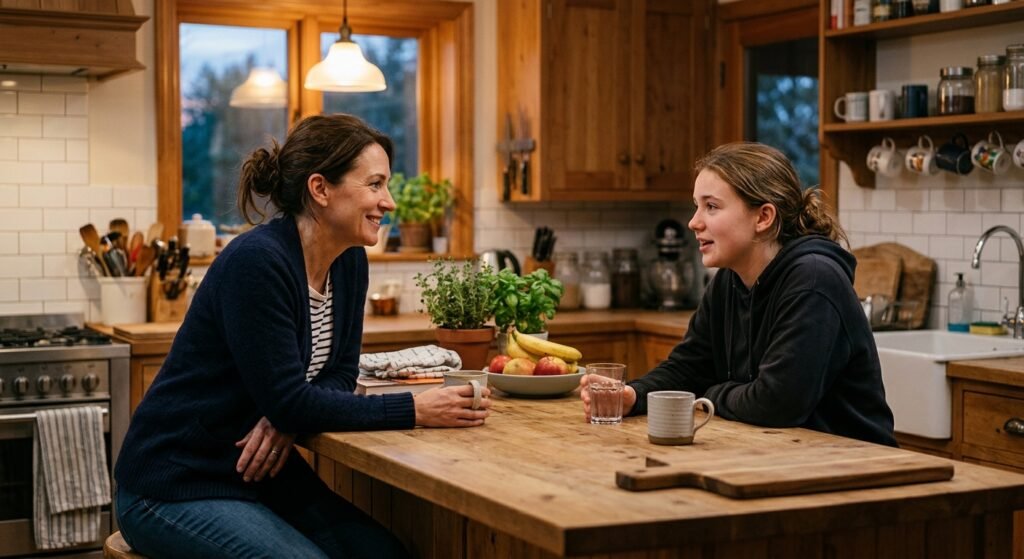
There is a specific look children give you when they are waiting for an answer. It’s not just curiosity; it’s a quiet, absolute confidence that you possess the master key to how the world works. Maybe they’ve asked you why a close friend suddenly stopped playing with them, or how to handle a difficult classmate, or how you know which career path is the right one. You stand there, perhaps holding a half-sliced apple or staring at a cluttered kitchen table, feeling the quiet expectation resting on your shoulders. You want to offer a perfect, polished piece of wisdom that settles the question forever. But inside, you are quietly realizing that you are still trying to figure out those exact same things yourself.
We tend to treat adulthood like a destination we eventually reach, a place where the roads are paved and the signs are clear. When we become parents or caretakers, that expectation intensifies. We feel this unspoken obligation to act as if we’ve already crossed the finish line of personal growth. We want to be the steady, unshakeable guides who have conquered doubt, mastered relationships, and solved the riddle of daily balance. We worry that if we show any cracks in our confidence, the people depending on us will feel insecure.
The Myth of the Finished Product
So, we put on a brave face. We offer advice that sounds certain, even when we’re feeling anxious. We pretend we know exactly what to do when plans fall apart, or when life takes an unexpected turn. We hide our own transitions, our career doubts, and our relationship struggles, keeping them tucked away behind closed doors. We do this out of deep affection, of course, because we want to protect them from the messy, uncertain parts of being alive. But in doing so, we might accidentally create an impossible standard.
When children only see us when we are calm, resolved, and perfectly in control, they start to believe that this is the baseline for being an adult. They assume that one day, they too will suddenly stop feeling confused, insecure, or lost. Then, when they inevitably encounter those feelings in their own lives, they wonder what they did wrong. They assume their self-doubt is a personal failure rather than a natural part of living.
It’s a subtle form of pressure that we pass down without meaning to. By hiding our own ongoing learning process, we teach them that uncertainty is something to be ashamed of, rather than a space where growth happens. We make them think that growing up means running out of questions.
The Value of “I Don’t Know”
Admitting that we don’t have all the answers can feel terrifying. It feels like letting go of the steering wheel. But in reality, saying “I don’t know, but let’s figure it out” is one of the most reassuring things a young person can hear. It changes the dynamic from a performance into a partnership. It shows them that it is entirely possible to navigate life without having a complete map in your pocket.
People who study family psychology often point out that emotional honesty is far more valuable than a facade of perfection. When children see their parents navigate mistakes, handle disappointment, or simply admit to feeling overwhelmed, they are witnessing something deeply valuable. They are seeing resilience in action. They learn that emotions aren’t obstacles to be avoided, but experiences to be felt and managed.
This doesn’t mean we should burden our kids with our adult anxieties or make them responsible for our emotional well-being. There is a vast difference between being vulnerable and being helpless. It’s about letting them see the process. It’s about letting them see you make an apology, try a new hobby and fail at it, or change your mind after learning new information. These small, daily moments of honesty teach them that being a person is an ongoing project.
A Different Kind of Security
There is a beautiful relief that comes with letting go of the need to be all-knowing. When we stop trying to be perfect, we actually become more approachable. Our kids start to realize that they can bring their own messy, unfinished thoughts to us because we understand what it feels like to be in the middle of something unresolved.
This realization changes the way we look at our role as guides. We don’t have to be the people who have already arrived at some flawless destination. Our job isn’t to shield them from the reality of change, but to show them that change is nothing to fear. We can show them that even when we are confused, we can still be kind, patient, and hopeful.
Maybe the greatest gift we can give our children isn’t a set of perfect answers, but the comfort of knowing that the questions never really stop. When they see that we are still learning, still growing, and still figuring things out day by day, they realize they don’t have to be perfect either. They can breathe a little easier, knowing that growth is a lifelong journey, and they will never have to walk it alone.