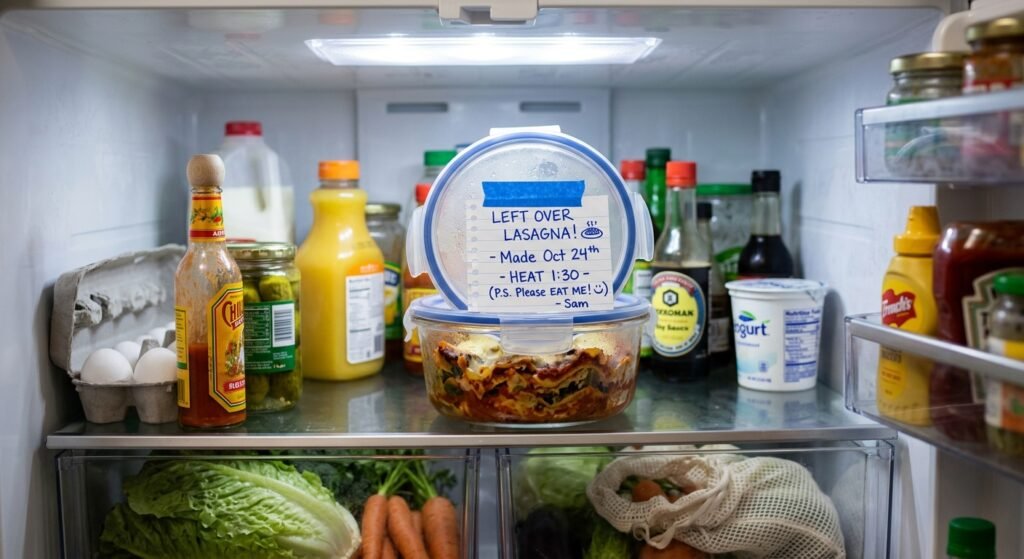
You open the refrigerator late at night, the cool light spilling onto the kitchen floor, and there it is. A small glass container sitting on the middle shelf, holding a single slice of homemade lasagna or the last portion of yesterday’s curry. It’s not just sitting there by accident. It has been neatly packed, perhaps wrapped in foil, or placed right at the front where you can’t miss it. You know instantly that someone else wanted this, but they chose to leave it for you instead. And suddenly, you feel a strange, quiet hesitation. You aren’t just hungry anymore. You’re standing there holding a tiny, edible dilemma.
It’s a very specific kind of guilt, isn’t it? It’s not the deep guilt of doing something wrong, but rather the tender discomfort of being considered. You realize that someone you love had a moment of choice. They were hungry, they had something delicious right in front of them, and yet their mind traveled to you. They pictured your hunger, your long day, or how much you love this particular meal, and they quietly closed the container and put it away. When you eat that food, you’re consuming their restraint. You’re consuming their daily decision to put your comfort just a fraction ahead of theirs.
The Small Transactions of Shared Lives
Psychologists who study close relationships often talk about how intimacy isn’t built on grand romantic gestures but on these tiny, almost invisible daily interactions. There is a quiet beauty in how we share resources in a home. In the study of family dynamics, researchers refer to this as micro-sacrifices. These aren’t the dramatic sacrifices of storybooks or history. They are the small, unglamorous moments where we choose another person’s small comfort over our own. Over time, these tiny acts of consideration build a sense of safety and trust that grand gestures can never quite match.
When someone saves you the best part of a meal, they are making a bid for connection. They are signaling that you are present in their mind even when you aren’t in the room. It’s a physical representation of their affection, wrapped in plastic and chilled to thirty-eight degrees. And that’s precisely why it feels so complex to eat it. We live in a culture that teaches us to earn everything we receive. When care arrives so freely, without any expectation of a reward, our first instinct is often to wonder if we deserve it.
The Geography of the Refrigerator
If you look closely at any shared kitchen, you can practically see the picture of how the people inside feel about one another. The refrigerator is a communal diary. There is the shelf of things we share, the door of things we forget, and then there are those quiet, protected zones where loved ones leave peace offerings. Maybe it’s a parent saving the exact piece of chicken they know you prefer. Maybe it’s a partner leaving the last couple of bites of a dessert they paid for themselves because they saw how much your eyes lit up when you tasted it. These are gestures that don’t come with a speech or a demand for a thank-you. They are just left there, waiting to be discovered in the quiet of an ordinary evening.
In those moments, the food ceases to be just nourishment. It becomes a language. It is a way of saying “I see you” or “I know you’ve had a difficult week” without having to find the right words to explain it. It is a form of care that doesn’t demand your attention or put you in their debt. It just waits for you to be hungry.
Accepting the Care We Didn’t Ask For
Perhaps the guilt we feel standing in front of the open fridge isn’t really about the food at all. Maybe it’s a reflection of how difficult it can be to simply let ourselves be loved. It’s easy to show appreciation when someone buys us a grand gift or helps us through a major crisis because those moments demand a clear, equivalent response. But when care arrives in the form of a leftover slice of pizza, it’s so small that we don’t quite know what to do with the warmth it creates. We feel like we owe them something, yet there’s no logical way to pay them back for a saved meatball.
So instead of feeling worthy of the gesture, we feel a gentle pinch of guilt. We think about their hunger, or we worry that we’re taking more than we give. We wonder if we should have been faster, or if we should have insisted they eat it instead. It is the natural reaction of a heart that wants to make sure things are fair, even when love isn’t keeping score.
But maybe the realization we need isn’t about balancing the ledger of who ate what. Maybe saving those leftovers was never about the food itself, but about the joy of knowing you would find them. When you eat what was saved for you, you aren’t taking something away from them. You are completing the circle of their care. You are letting them love you in the quietest, most ordinary way they know how. And sometimes, the best way to say thank you is simply to pull up a chair, pick up a fork, and let yourself be cared for.