
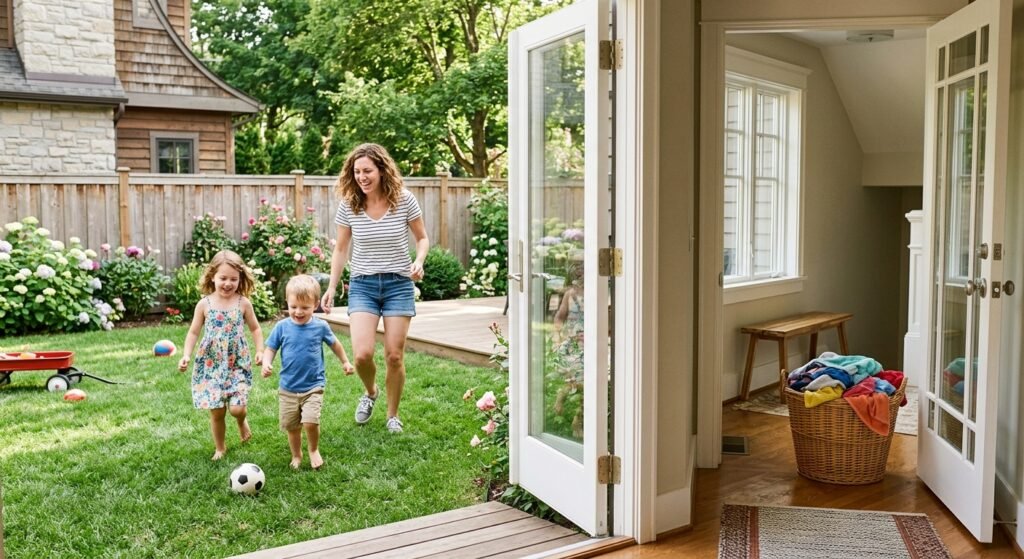
You’re standing in the bedroom, surrounded by a mountain of clean laundry that still smells like lavender and warm dryer sheets. You’ve sorted the socks, you’re halfway through matching the t-shirts, and there is a satisfying rhythm to the work. It’s a rare moment of quiet productivity in a house that usually feels like it’s constantly moving. Then, you feel a gentle tug on your sleeve. Your five year old is standing there, holding a plastic bucket, asking you to come outside to help find a beetle they’re sure is hiding near the garden gate.
Your first instinct is almost always to bargain. You tell them you’ll be out in just five minutes, as soon as you finish this last pile of towels. You sincerely believe that if you can just cross this one chore off your list, you’ll be able to step outside with a clear mind and actually enjoy the afternoon. You think you’ll be a better companion if you aren’t worrying about the chores waiting for you inside. But by the time the last towel is folded and put away, the shadow of the neighbor’s house has covered the garden, your child has wandered off to play with something else, and the brief window of connection has closed for the day.
The Mental Itch of the Unfinished
Why is it so difficult to walk away from an unfinished task, even when the alternative is something we genuinely want to do? Psychologists often point to our natural tendency to fixate on incomplete goals. When we leave a project halfway finished, our brains continue to carry a silent mental reminder that keeps us feeling slightly anxious. We’ve been trained to believe that relaxation is a reward we must earn through productivity, which makes us treat every unfinished chore like a test we haven’t passed yet.
But when you’re raising children, the work is never actually finished. There will always be another sink full of dishes, another floor to sweep, and another basket of clothes waiting to be folded. If we wait for a completely clear desk before we allow ourselves to play, we’ll spend their entire childhood waiting. Researchers who study family dynamics suggest that children don’t measure our love by the orderliness of our homes. Instead, they feel most secure when we show them that they’re more important than our schedules, even if it’s only for ten minutes in the middle of a busy afternoon.
The Illusion of Afterwards
We often tell ourselves that we’re keeping up with the house for our family’s sake, and there is real truth in that. Creating a clean, predictable space is a beautiful way to show care. But sometimes, the constant rush to tidy up acts as a shield against the vulnerability of slowing down. Folding clothes has clear rules and an obvious ending, while sitting on the grass with a child asks us to step into a world without a plan. It requires us to listen to long stories about imaginary friends, to look closely at ordinary rocks, and to simply exist without trying to achieve anything.
That kind of presence can feel surprisingly uncomfortable when we’re used to measuring our worth by how much we accomplish each day. Standing in the yard requires us to match a child’s slower, wandering pace. It asks us to accept that the world won’t fall apart if we leave the laundry in a messy pile on the sofa. When we choose to step outside anyway, we’re practicing a quiet form of bravery. We’re deciding that a messy living room is a reasonable price to pay for a memory.
What Stays With Us
Think back to your own childhood for a moment. You probably don’t remember if your parents always kept the beds made or if the pantry was perfectly organized. You don’t look back on your early years and feel grateful that the laundry was always folded on the same day it was washed. Instead, you remember the moments when the adults in your life suddenly dropped what they were doing to join you in your world. You remember the times they ran through the sprinkler, or sat on the kitchen floor to color, or let you stay up late to look at the stars.
Those are the memories that remain because they made you feel seen and valued. The basket of unfolded laundry sitting on your couch isn’t a sign of failure or neglect. It’s a sign of a home where people are actively living, playing, and growing together. It is proof that you chose to prioritize a passing moment of joy over a task that can easily be completed tonight when the house is quiet.
Maybe the realization we’re looking for isn’t that we need to be perfect parents who never care about chores. It’s simply that the chores aren’t a barrier to our happiness. The laundry will always be there, waiting for us to return to it. But the small voice asking us to step outside into the sunshine is only going to ask for a little while longer. When we choose to leave the pile behind, we’re not ignoring our responsibilities. We’re simply remembering which ones matter the most.