The Metallic Click of the Lock
Think about the exact moment you get home after a long, demanding day. You step inside, push the front door closed, and turn the deadbolt. There is a solid, familiar metallic click that echoes quietly in the entryway. Maybe you drop your keys on the counter, kick off your shoes without lining them up, and let out a long breath you didn’t even realize you were holding.
In that single moment, your entire physical presence changes. Your shoulders drop. The muscles in your face soften. The mental checklist you’ve been carrying around since morning suddenly feels lighter, or at least, temporarily suspended. It’s not just that you’re physically inside a building; it’s that you have crossed an invisible line back into yourself.
We spend so much of our lives performing, even when we don’t mean to. When you walk through an office, navigate a busy grocery store, sit in traffic, or even catch up with acquaintances, you are quietly managing how you are perceived. You make eye contact, you nod politely, you adjust your posture, and you keep your guard up just enough to navigate the friction of the world. It’s not exhausting because it’s bad; it’s just the cost of participating in society.
But your own space asks absolutely nothing of you. The sofa doesn’t care if you’re smiling. The kitchen table doesn’t require a witty conversation. The worn out t-shirt you’ve kept for ten years doesn’t ask you to look put-together. Behind your own door, you are completely off the hook.
The Invisible Weight of Being Seen
For many of us, this quiet sanctuary is something we only fully appreciate when it is temporarily taken away. If you’ve ever stayed in a busy hotel, crashed on a friend’s couch, or lived through a chaotic home renovation, you know the distinct, low-humming restlessness of not having a place to fully let down your guard. You might be perfectly safe physically, but emotionally, you are still on duty. You are still a guest, still observing the rules of someone else’s environment.
The feeling of emotional security is less about the physical furniture we own and more about the psychological permission to be completely unmonitored. It is the freedom to be messy, to be quiet, to eat breakfast for dinner, or to stare at the wall for twenty minutes without anyone asking if you are okay.
Environmental psychologists have spent decades studying why human beings are so deeply attached to their physical nests. They often talk about the concept of territoriality; not in an aggressive, animalistic way, but as a basic human need for control over our immediate surroundings. When we can control who enters our space, what the lighting feels like, and where our belongings rest, our minds receive a powerful emotional signal: you are safe to rest.
It turns out that our minds are sensitive to boundaries. In the ancestral past, survival depended on constantly scanning the horizon for changes, threats, and social dynamics. Today, our horizons are crowded with digital notifications, work expectations, and unpredictable social interactions. A closed door is one of the few physical tools we have left that tells our ancient, protective minds that the scanning can finally stop.
The Quietest Luxury
We live in a culture that often sells peace as something we have to actively purchase or achieve. We are told we can find it in a structured meditation app, a weekend getaway, a spa treatment, or a perfectly curated wellness routine. We try to schedule calm into our calendars as if it is another task to be completed.
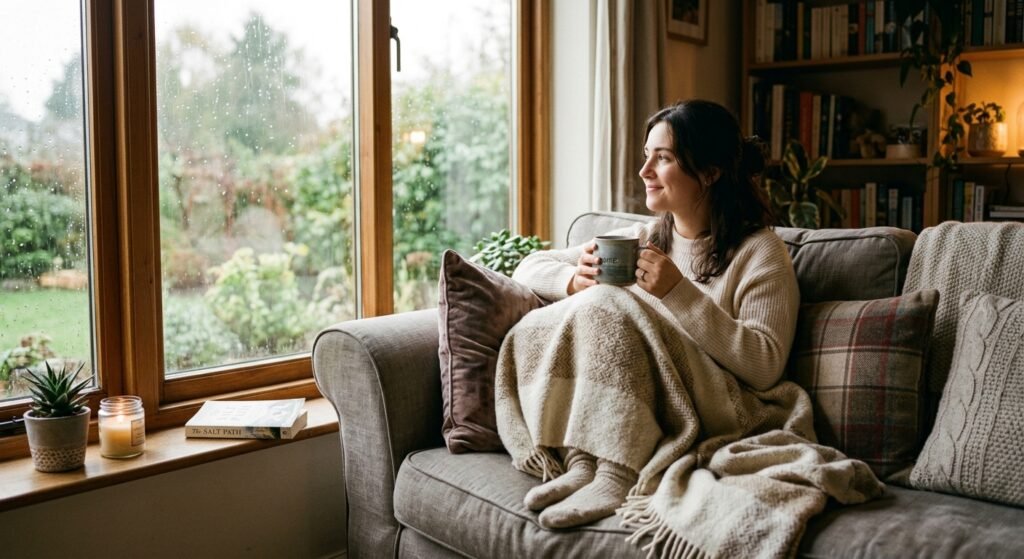
But the most profound peace is usually much smaller, quieter, and entirely free. It’s the silent afternoon when the sun hits the floorboards at just the right angle, and you realize you have nowhere else you need to be. It’s the sound of rain tapping on the windowpane while you drink a warm cup of tea in a room where every object has a quiet story.
It’s the absolute luxury of pulling on your favorite, threadbare sweatpants and knowing that the world outside can wait until tomorrow. These moments don’t demand our attention, which is precisely why they are so healing. They allow us to transition from a state of doing to a state of simply being.
A Place to Put Down Your Armor
There is a beautiful relief in having a space that knows your secrets and doesn’t judge you for them. Your home sees you when you are too tired to wash the dishes, when you are pacing the floor worried about the future, or when you are celebrating a small, private victory with a ridiculous dance in the kitchen. It holds space for the versions of you that you don’t show to your coworkers, your neighbors, or sometimes even your closest friends.
When we talk about wanting to feel safe, we are rarely talking about locks and alarms. We are talking about the comfort of predictability. We are talking about knowing that when we close the door, the noise of everyone else’s opinions, expectations, and demands is instantly muffled. We are left with only our own voice, which can finally be heard once the background noise of the world quietens down.
Perhaps we have been looking at peace the wrong way. We tend to chase it as a destination or a future milestone we will reach once our lives are finally, perfectly organized.
But maybe peace isn’t something you have to search for out in the world. Maybe it is simply what is left over when you finally close the door, put down your armor, and realize that you are allowed to just exist in the quiet space you’ve built for yourself. You are not the only one who needs to retreat from the world sometimes. This is not to escape life, but to remember who you are when nobody else is watching.