
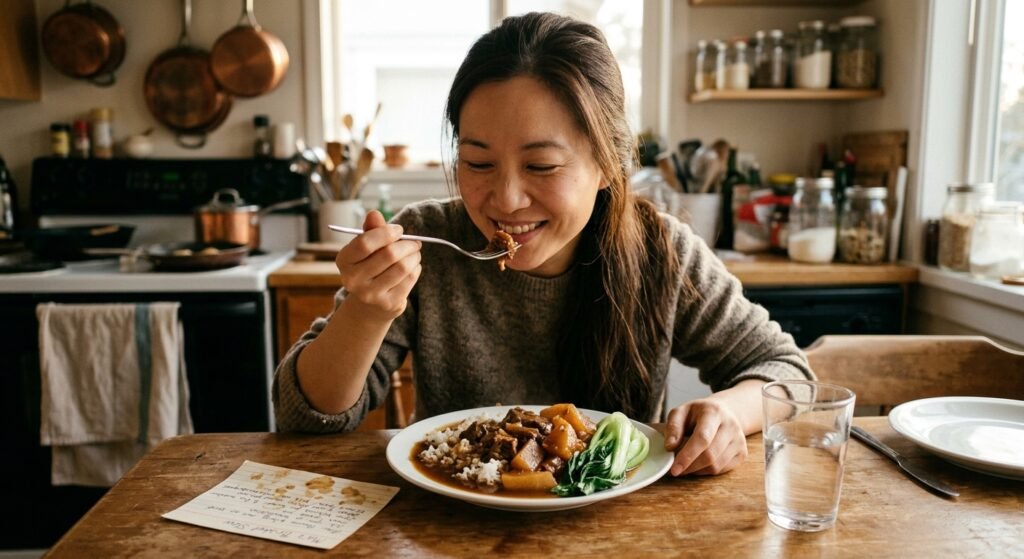
You are standing in your kitchen on an ordinary Tuesday, perhaps rummaging through the pantry for a quick snack before a meeting, when you spot a jar of generic grape jelly. You spread a little on a piece of toast, take a bite, and suddenly the kitchen around you dissolves. You aren’t standing at your counter anymore. You are seven years old, sitting on a vinyl chair with your legs swinging, watching your grandmother slice a sandwich diagonally while the radio plays quietly in the background.
It is a strange, almost dizzying feeling how quickly a single flavor can hijack your entire day. You didn’t plan to travel back thirty years this afternoon. You didn’t sit down to look through old photo albums or reminisce about people you haven’t seen in decades. Yet, here you are, feeling the exact texture of that old linoleum floor beneath your feet, all because of a spoonful of cheap fruit spread. It feels less like a memory and more like a physical relocation.
The Secret Language of Our Senses
Most of our daily memories are fragile things. We try so hard to preserve our lives through digital photos, calendar entries, and journals, yet those details often feel static and distant when we look back at them. You look at a picture of a vacation from five years ago, and while you recognize your younger self smiling back, you have to work to remember how you actually felt in that exact moment. The memory is there, but you have to actively pull it out of storage.
Taste and smell don’t ask for permission, and they certainly don’t require any effort. They bypass the logical, busy parts of our brain that manage our schedules, organize our lists, and worry about our careers. Instead, a single bite of a familiar dish acts like a skeleton key, unlocking doors we didn’t even realize were locked. Suddenly, the emotional landscape of a childhood home or a long gone summer afternoon is fully restored, complete with the quiet sense of safety that defined those years.
Why Our Brains Save the Flavors
There is a beautiful biological reason for this sensory time travel. Brain science shows us that our pathways for processing smell and taste are uniquely positioned right next to the amygdala and the hippocampus, the emotional and memory hubs of our minds. Other senses, like sight and sound, have to take a longer path, stopping at various translation centers along the way. But taste and smell have a direct, priority ticket to where our feelings live.
Memory researchers often refer to these sudden, sensory evoked recollections as involuntary memories. They are uniquely vivid because they haven’t been dusty or worn down by constant retelling. When you look at an old family photograph frequently, you gradually start remembering the photograph itself rather than the day it was taken. But because you might go decades without tasting a specific brand of ginger ale or a certain style of roasted chicken, that sensory memory remains perfectly preserved in its original wrapper, waiting for you to find it again.
The Comfort of Who We Used to Be
When we find ourselves moved by a simple taste, we aren’t just remembering a recipe. We are remembering a version of ourselves that we thought we had outgrown or forgotten. We remember the quiet simplicity of a time when our biggest responsibility was finishing our homework or deciding which game to play outside. We remember the people who took the time to feed us, to cut the crusts off our bread, or to teach us how to bake cookies on a quiet afternoon.
There is a profound tenderness in realizing that these memories are still there, living quietly in the background of our busy lives. As we grow older, we take on so many roles and responsibilities. We become professionals, parents, partners, and caretakers. We carry the quiet anxieties of adulthood and the constant pressure to keep moving forward. It can be easy to lose touch with the child who once felt completely safe and cared for by someone else.
But that child doesn’t disappear. They are simply waiting under the surface. And sometimes, it only takes one bite of cinnamon toast, or a sip of a specific soup, to remind you that you are still that same person. You are still the person who loved those simple things, who felt secure in the warmth of a family kitchen, and who was worthy of being looked after.
The Memory Keepers We Carry
We often think of memory as a mental filing cabinet, a place where we store facts, dates, and historical events of our lives. But perhaps memory is much more physical than that. It lives in our fingers when we play an instrument we haven’t touched in years, and it lives on our tongues when we taste something that instantly feels like home. Our bodies remember things our busy minds simply don’t have the space to carry anymore.
This is why we often crave specific foods when we are feeling overwhelmed or lonely. We call them comfort foods, but the comfort rarely comes from the calories or the ingredients. It comes from the emotional safety net attached to those flavors. We are seeking a temporary retreat to a time when life felt manageable, predictable, and kind.
Finding the Way Back Home
In our search for meaning and stability, we sometimes look for grand gestures or profound realizations. We read books about personal growth, we set ambitious goals, and we try to build perfect routines. We want to believe that the key to happiness is something complicated we have yet to discover.
Yet, perhaps the most comforting truth is already hiding in the ordinary corners of our daily lives. Maybe we don’t need to work so hard to find our way back to peace. Maybe our minds have quietly built a network of secret pathways, using nothing more than the taste of a certain cookie or the scent of a family kitchen, to ensure we never truly lose the best parts of our past.
The next time a sudden flavor catches you off guard and brings a quiet tear to your eye or a soft smile to your face, let yourself stay in that moment for an extra heartbeat. Don’t rush back to your emails or your list of tasks right away. You aren’t just eating. You are visiting with the people who loved you, reconnecting with the child you used to be, and remembering that no matter how much the world changes around you, the feeling of home is never truly out of reach.