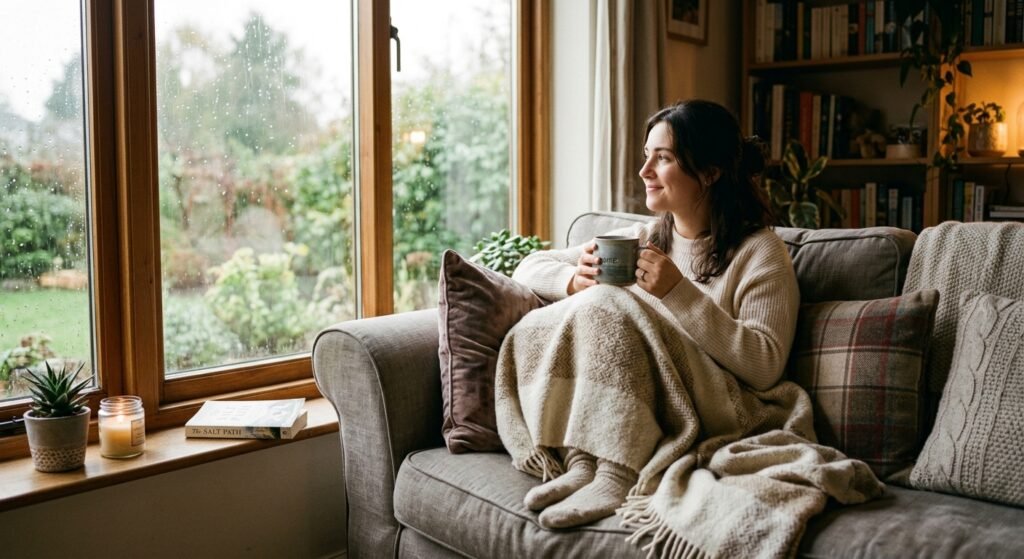

You sit down on a Sunday evening with a planner open and a cup of herbal tea cooling beside you. You are mapping out the upcoming week with the precision of a project manager. There is a slot for the gym, a block for meal prep, a designated window for reading, and exactly thirty minutes set aside for quiet reflection. It looks perfect on paper, a beautiful portrait of a healthy, productive person who has everything under control.
Yet, as you stare at this immaculate schedule, you don’t feel peaceful. You feel a familiar, tight pressure in your chest. You realize that your plan to unwind has somehow become another list of chores.
This is the modern paradox of wellbeing. We’ve taken the concept of life balance and turned it into a second job. We track our sleep scores with a sense of impending dread, monitor our daily steps as if our worth depends on them, and feel guilty when we can’t squeeze a meditation session into a chaotic morning.
It’s a frustrating way to live, but we do it because we want to feel okay. We believe that if we can just balance the scales perfectly, we’ll finally reach that elusive state of calm.
The Trap of the Perfect Balance Sheet
When we think of balance, we often picture a tightrope walker. We imagine someone moving with flawless precision, never wavering, keeping every part of their body perfectly aligned. It looks beautiful, but we forget how much strain it takes to stay in that position. It requires constant, relentless effort.
In our own lives, we try to achieve this same rigid symmetry. We believe we need to give equal energy to our careers, our friendships, our health, and our creative passions all at the exact same time. If one area slips, even slightly, we feel like we’re failing.
Psychologists who study stress have noticed that when we treat leisure activities like goals to achieve, those activities lose their ability to restore us. A study in the Journal of Consumer Research found that scheduling leisure activities actually reduces our enjoyment of them because we begin to view them as work. The moment we attach a deadline or a metric to our peace of mind, it stops being peaceful.
We’ve essentially gamified our rest. We want to be the best at relaxing, the most efficient at sleeping, and the most disciplined at mindfulness. In doing so, we’ve missed the entire point of these practices.
The Exhaustion of Self-Optimization
This drive to optimize everything often comes from a place of fear. We live in a fast-moving world that constantly tells us we’re not doing enough, and so we assume the solution is to organize ourselves more tightly. We buy more planners, download more apps, and set more alarms.
But you can’t organize your way out of exhaustion. When you try to schedule every moment of recovery, you simply create a new kind of fatigue. It’s the weariness of being your own taskmaster, constantly checking your progress against an invisible standard.
Think about the last time you had a truly restful afternoon. It probably wasn’t a day where you checked off all your wellness goals. It was likely a day when your plans fell apart, and you allowed yourself to simply sit on the couch and watch the shadows move across the wall. It was a moment of unplanned, unscheduled freedom.
There’s a vast difference between doing things that are good for you and doing things to prove you are good. When we confuse the two, our self-care becomes just another performance.
Learning to Let the Scales Tip
The real secret of a balanced life might be that it doesn’t look like balance at all, at least not in the short term. Real life is messy, uneven, and unpredictable. Some weeks will require almost all of your attention to go toward a work project. Other weeks will demand that you focus entirely on a friend who is going through a difficult time.
And that’s okay. Allowing the scales to tip isn’t a sign of failure. It’s a sign of responsiveness. It means you are engaging with life as it actually happens, rather than trying to force it into a rigid spreadsheet.
When we stop demanding that every single day contain a perfect percentage of work, play, rest, and exercise, we open up space for actual breathing room. We give ourselves permission to be uneven.
Perhaps balance isn’t a destination we reach where nothing ever moves. Maybe it’s more like a dance, where we learn to lean into whatever the present moment requires. It’s the understanding that you can be extremely busy this week and deeply restful next week, and that the sum of those moments is where peace actually lives.
So the next time you feel overwhelmed by your own wellness routine, consider this. You don’t have to do it all perfectly. You don’t have to track every breath or optimize every hour of sleep. Sometimes the most balanced thing you can do is to close the planner, let the schedule slide, and just let yourself exist for a little while. You’re not the only one who needs a break from trying so hard to be well.