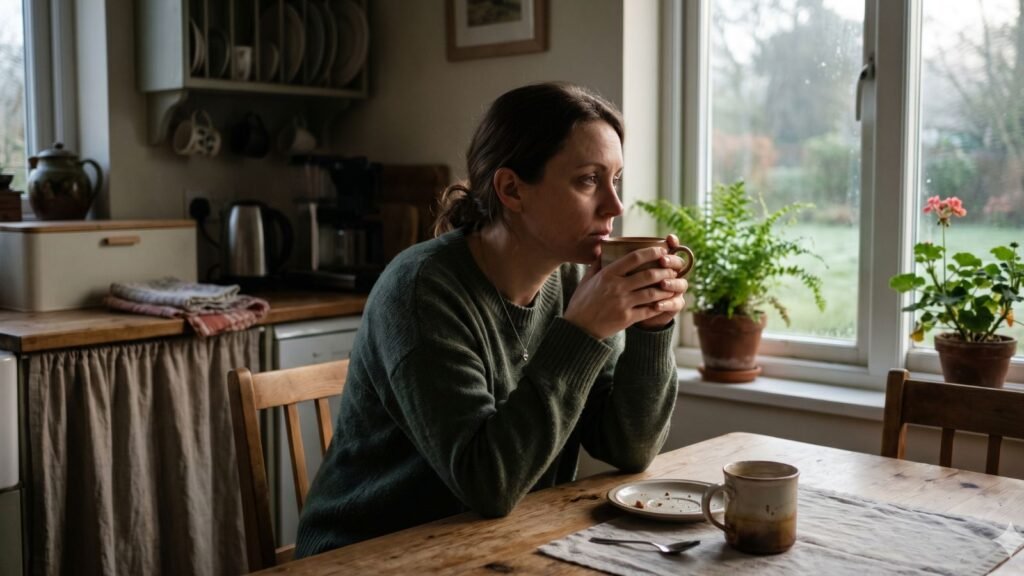
Imagine you’re standing in your kitchen, and someone you know does something completely, uncomplicatedly nice. Maybe a neighbor walks over to return a garden tool you lent them, and they’ve cleaned it beautifully. Or perhaps a coworker drops off a pastry on your desk because they remembered you had a tough meeting yesterday.
It’s a simple gesture. But instead of feeling a warm rush of appreciation, something else happens. A tiny, quiet alarm goes off behind your ribs. You find yourself wondering what they want from you, or when they’ll ask for a favor in return. You start looking for the hidden terms and conditions. You look at their warmth and feel a strange, creeping sense of unease.
It’s a confusing way to live, but it’s far more common than we care to admit. We want to be the kind of person who accepts love and generosity with open arms, yet we often meet kindness with the same caution we’d use to approach a suspicious package on our doorstep.
The Unspoken Price Tag We Keep Looking For
When you’ve spent years navigating environments where nothing was ever truly free, kindness starts to feel like a loan you didn’t agree to take out. You look at a generous act and immediately begin calculating the interest rate. You think about how and when you’ll have to pay it back, because in your mind, every nice gesture comes with an invoice.
This suspicion often comes from a very logical place in your past. If you grew up around people who used gifts as leverage, or whose affection was highly conditional, you learned that soft moments were usually followed by a sharp turn. A sudden compliment was often the prelude to a demand. An unexpected favor was actually a form of collateral. Your mind adapted to protect you by deciding that believing in unconditional kindness was a vulnerability you couldn’t afford.
By anticipating the hidden motive before it could be revealed, you felt like you were staying one step ahead of the disappointment. It was a brilliant defense mechanism. The problem is that when you keep your shield up for too long, it starts to feel less like protection and more like a barrier keeping out the very things you actually want.
Why the Mind Prefers Familiar Discomfort
There’s a curious quirk in how our minds seek safety. Experts who study relational patterns have long observed that we don’t necessarily gravitate toward what’s good for us; we gravitate toward what’s familiar. Our brains are designed to predict the world around us, and predictability feels safe, even when the thing we’re predicting is unpleasant.
When you’re used to keeping your guard up, someone being genuinely kind to you feels like a disruption to your entire ecosystem. It forces you to question your rules about relationships. It suggests that maybe the world isn’t as hostile as you thought, which is a lovely idea, but also a terrifying one because it means you might be unprepared if you let your defenses down.
When we receive kindness that doesn’t match our internal view of ourselves, we experience a quiet internal tension. To resolve that tension, we sometimes find ourselves trying to find fault in the other person or pushing them away. It’s easier to believe someone has a hidden agenda than it’s to accept that we might be worthy of kindness without having to earn it.
Learning to Rest in the Unfamiliar
So how do we begin to live with this unease? It doesn’t happen by forcing ourselves to suddenly trust everyone we meet. True trust isn’t a switch we flip; it’s a slow gathering of evidence. It’s built in the tiny, quiet moments where people show up for us and ask for nothing in return, and we slowly allow ourselves to believe them.
The next time someone does something nice for you and you feel that familiar tightening in your chest, you don’t have to fight it. You don’t have to force yourself to feel instant gratitude. You can simply notice the suspicion. You can acknowledge that your unease isn’t proof of their bad intentions; it’s just an old friend trying to protect you from a pain you remember all too well.
Perhaps the real realization is that you don’t have to instantly feel comfortable with kindness to let it in. You can simply stand there, feeling slightly awkward, and let the nice thing happen anyway. You don’t have to pay it back immediately, and you don’t have to earn it. Over time, these small, safe moments accumulate, slowly teaching us that sometimes a cup of coffee is just a cup of coffee, and some people simply want to be kind.