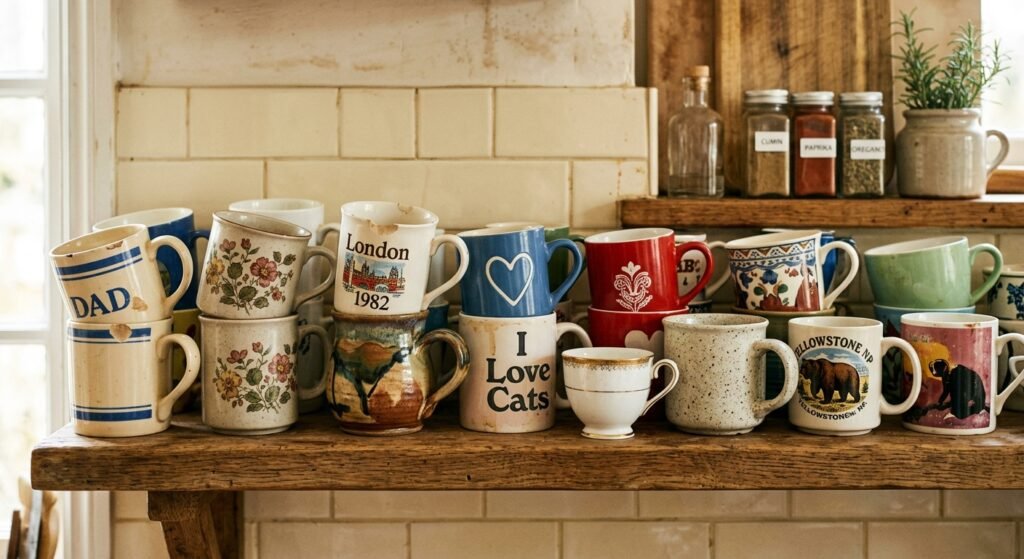
If you open your kitchen cabinet right now, there is a very good chance you will find a quiet hierarchy staring back at you. On one side sit the matching sets, the pristine ceramic cups that came in a neat box of four or six, looking polished and entirely respectable. On the other side is the misfit collection. Among them is likely a single cup with a faded logo from a place you haven’t visited in a decade, or perhaps one with a thin spiderweb crack running down the handle, or a small chip along the rim where you have to be careful how you sip. Yet, when you are having a difficult morning or simply seeking a moment of quiet before a busy day begins, that chipped, imperfect cup is almost always the one you reach for first.
It is a funny little habit that makes very little practical sense. If you were entertaining guests, you would probably hide it in the back of the shelf, worried it might make you look cluttered or careless. But when it is just you, standing in the quiet of your kitchen while the coffee brews, that specific cup feels like a warm greeting. It fits your hand in a way the newer, more expensive ones never quite manage. We keep these cracked pieces of pottery not because we are short on dishes, but because they have quietly stopped being dishes altogether.
The Stories Written in Ceramic
Every chip and scratch on an old cup is a tiny landmark of a day you lived through. You might look at a mark near the handle and remember the exact rainy Tuesday morning you dropped it while trying to balance your keys, your bag, and your dog’s leash all at once. Another scuff might remind you of a late night conversation at a dining room table with a friend who has since moved across the country. The pristine options in your cupboard do not have these markings because they have not participated in your life yet. They are merely observers, waiting in the wings, while the cracked ones are the ones that have been down in the arena with you.
Psychologists who study how we relate to the material world have long noted that we do not see our possessions as completely separate from ourselves. There is a familiar concept in psychology called the extended self, which suggests that the things we choose to keep around us actually become part of our identity. When we lose or discard an object we have owned for a long time, we often feel a quiet sense of grief because it feels like a small piece of our history is being erased. The cup you brought from your very first apartment isn’t just a container for tea; it is a physical anchor to the person you were when you were starting out, trying to figure out how to pay your bills and cook a decent meal.
Why We Resist the New and Perfect
There is a certain safety in things that are already slightly broken. When a cup is brand new, perfect, and expensive, it demands a level of care that can feel exhausting. You worry about staining the pristine white interior, or placing it down too forcefully on a stone countertop. But once a cup has its first chip, the pressure is off. It becomes resilient. It enters the realm of everyday life where spills happen, keys get dropped, and mornings are messy. In a world that constantly demands we look polished, organized, and put together, there is a profound relief in holding something that is allowed to be imperfect.
This emotional connection is often why we feel a strange pang of sadness if one of our favorite mismatched cups finally breaks beyond repair. It feels silly to explain to someone else why you are mourning a cheap souvenir cup, but you aren’t really mourning the ceramic. You are mourning the routine it represented. You are missing the quiet mornings it witnessed, the hard seasons it helped you get through, and the sheer comfort of its reliable presence in your hand. Our objects absorb our daily rhythms, becoming silent witnesses to the quietest parts of our lives.
Containers for Our Unseen Moments
Think about how much of our lives happens in the spaces between major events. We celebrate the promotions, the weddings, and the big moves, but we actually live in the quiet, ordinary hours of the early morning and the late evening. These are the moments when we are most truly ourselves, stripped of our professional roles and social expectations. And almost always, during those quiet hours, there is a cup nearby. It sits on your desk while you write an email, rests on your nightstand while you read, and warms your hands when you receive a piece of difficult news.
Maybe we don’t hold onto these cracked and chipped cups because we are sentimental about the objects themselves. Maybe we hold onto them because they are the only things in our homes that have watched us grow without asking us to change. When you look at that old, faded cup in your cabinet, you aren’t just seeing a piece of kitchenware. You are seeing a companion that has quietly carried your mornings, your stress, your quiet joys, and your transitions right along with you. And perhaps, in keeping them on our shelves, we are comfortingly reminding ourselves that we, too, are allowed to carry a few chips and cracks while still being deeply valued.