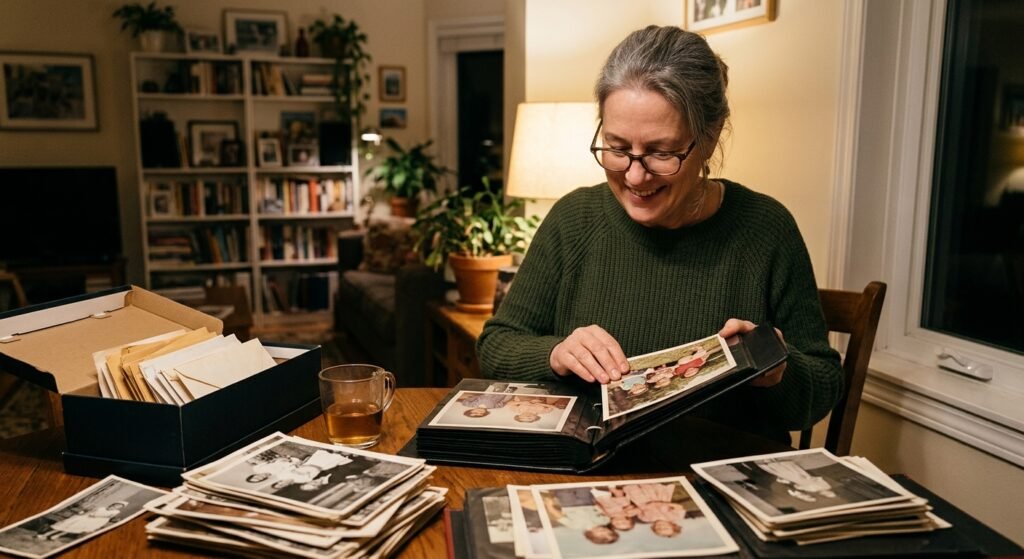
If you search through an old drawer or flip through a dusty photo album, you might find a picture of your parents from before you were born. Maybe they’re standing on a porch, wearing faded denim, laughing at something off-camera. They look thin, a little wild, and impossibly young. If you look closely at their eyes, you might notice something that never occurred to you when you were growing up. They look entirely unsure of what comes next.
For the first few decades of life, we don’t see our parents as people. We see them as institutions. They are the keepers of the rules, the providers of dinner, the ultimate authorities on how the world works. When they are angry, we assume we did something wrong. When they are distant, we think it’s because of us. We internalize their moods and construct our entire sense of safety around their presence. It’s only natural; to a child, a parent is the center of the universe.
But then you grow up. You reach twenty-five, thirty, or thirty-five, and you look around your own apartment, realizing you’re still trying to figure out how to keep a houseplant alive and how to handle a difficult boss. You feel like an imposter pretending to be a grown-up. And suddenly, a cold realization washes over you. Your parents were this exact age when they were holding you in their arms, trying to decide how to raise a person. They didn’t have a secret playbook. They were just figuring it out as they went, often with very little help.
The Towering Figures of Our Childhood
It’s a strange transition when you begin to see your parents as peers rather than giants. You start to notice the cracks in the facade they kept up for so long. You see the way your father’s hands shake slightly when he’s anxious, or the way your mother’s voice gets quiet and defensive when she feels criticized. You realize that the temper tantrums, the cold silences, and the unreasonable rules weren’t calculated strategies of discipline. They were often just the reactions of stressed, tired, and unhealed children who happened to have children of their own.
Many of us carry hurts from our early years that feel almost impossible to resolve. We ask ourselves why they couldn’t just be more patient, why they couldn’t have listened to us, or why they made choices that left us feeling so small. We spend years waiting for an apology that will likely never arrive, or looking for a level of emotional maturity they simply don’t possess. We want them to be the parents we needed, rather than the people they actually are.
But if you look back at their own upbringing, the picture starts to fill in. You learn about a grandfather who was cold and distant, or a grandmother who struggled with her own private grief. You begin to recognize that the emotional atmosphere your parents created wasn’t built from scratch. It was largely inherited. They passed down the tools they were given, even if those tools were broken, rusty, and dangerous.
Passing Down What We Haven’t Healed
There’s a subtle beauty in understanding the concept of generational inheritance, though it doesn’t require a degree in psychology to see it in action. Writers and thinkers often talk about how patterns travel through families like a quiet heirloom, moving from one generation to the next until someone decides to stop and look at them. When a parent snaps at a child for making a simple mistake, it’s rarely about the spilled milk. It’s the echo of a voice from thirty years prior, shouting at them for the exact same thing.
Recognizing this doesn’t mean you have to excuse their behavior. Compassion and boundaries can live in the same room. You can deeply understand why your mother struggled to show affection while still acknowledging that her coldness hurt you. You can feel profound empathy for your father’s difficult childhood while still deciding that you won’t allow his anger into your home today. Understanding isn’t about letting people off the hook; it’s about seeing the hook clearly so you can finally unhook yourself.
When we stop demanding that our parents be perfect, we give them permission to be ordinary. We start to see that they were operating with a limited set of resources. They had their own fears, their own financial anxieties, and their own unaddressed wounds. They were trying to build a shelter for us while their own internal walls were crumbling. They made mistakes because they didn’t know any better, or because they were too exhausted to do what was right.
The Freedom of Softening Our Anger
Holding onto resentment is an exhausting endeavor. It keeps us tethered to the past, constantly relitigating trials where we are both the victim and the judge. We wait for our parents to change, to suddenly see the light, to validate our pain, and to finally give us the closure we crave. But often, they aren’t capable of giving us those things. They are still those same scared, defensive kids, wrapped in older bodies, trying to protect themselves from a world they never fully understood.
The real healing doesn’t come when they finally apologize. It comes when you look at them and realize they can’t apologize for something they don’t even understand. It comes when you see their limitations not as a personal failure of love toward you, but as a reflection of their own personal struggles. When you see your parents as flawed, wounded individuals who did the best they could with what they had, the anger begins to lose its sharp edge.
Maybe the point was never to have perfect parents who never made mistakes. Maybe the point is to realize that we are all just clumsy travelers trying to find our way in the dark. By offering our parents a little bit of grace, we quietly offer it to ourselves as well. We acknowledge that we, too, will make mistakes, that we will stumble, and that we will sometimes pass down our own unhealed pieces to the people we love.
In the end, you don’t have to forget the ways you were hurt, and you don’t have to pretend everything was perfect. But you can look at that old, faded photograph with a new kind of tenderness. You can see two young people standing on the precipice of a life they weren’t prepared for, holding their breath, and hoping for the best. And you can quietly realize that they were just children themselves, trying to guide you through a world they were still trying to figure out.