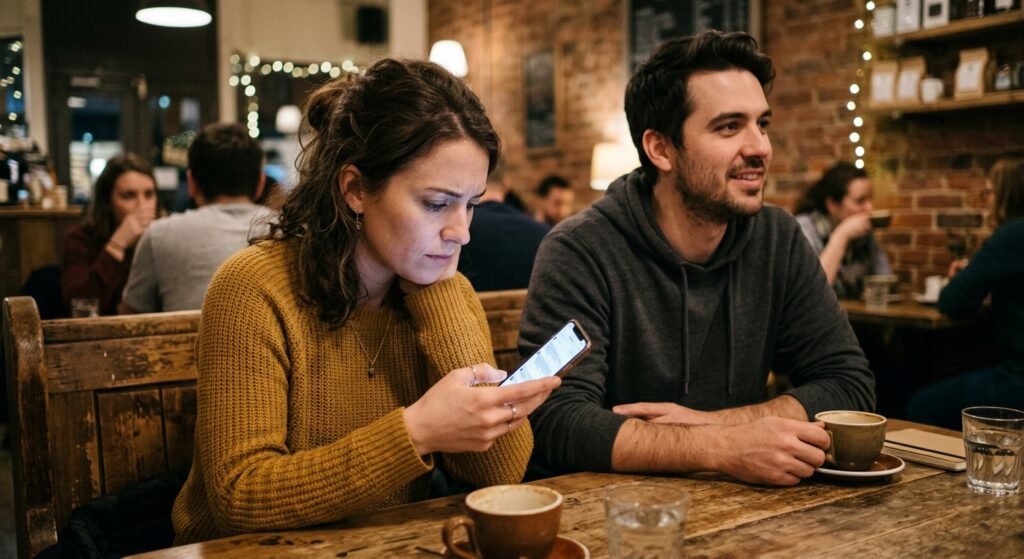
You are sitting on the couch together, the soft glow of your phone screens lighting up the dark room. It’s an ordinary Tuesday evening. Maybe you just shared a joke, or maybe you are just enjoying the quiet ease of being in the same space. On a whim, you open their profile. You scroll past the pictures of weekend trips, the craft beers, the dog at the park, and the group photos with coworkers. You keep scrolling, looking for a trace of yourself. But there’s nothing. Not a tag, not a photo, not even a casual mention in a caption. To anyone looking from the outside, the person you love appears entirely single.
It’s a strange, hollow feeling that’s difficult to explain to anyone else without sounding small or insecure. If you bring it up, you worry you’ll sound like you’re obsessed with online validation. You might tell yourself it’s just an app, that what you have in the real world is what actually matters. But the quiet ache remains, humming in the background of an otherwise lovely relationship, leaving you wondering why the person who claims to love you in private seems so hesitant to acknowledge you in public.
The Quiet Pain of the Digital Shadow
There’s a modern assumption that if something isn’t online, it doesn’t exist. While that’s a bit extreme, there’s a deeper truth beneath our online habits. The spaces we curate online have become the modern equivalent of a front yard. When someone invites you into their house but keeps the front gate firmly shut, you eventually start to wonder what they are trying to protect, or who they are trying to keep out.
Sociologists who study modern relationships often point out that public acknowledgement has always been a key part of commitment. Long before smartphones existed, people wore rings, held hands in public squares, and introduced their partners to neighbors. These small actions were not just social customs; they were signals. They told the community that this person is chosen, that they are a meaningful part of someone’s life. When a partner keeps their digital life entirely separate, it can feel like a modern way of withholding that signal.
This isn’t about needing every single moment of your life broadcast to strangers. Most people don’t need a public declaration of devotion every week. What they need is to feel that they aren’t a secret. When you are completely absent from your partner’s online presence, it can feel less like privacy and more like curation. It makes you wonder if they’re keeping their options open, or if they are curating their life for an audience that you don’t fit into.
Privacy Versus Privacy’s Shadow
It’s common to hear the argument that some people are simply private. They don’t post much, they dislike the constant buzz of social platforms, or they prefer to keep their personal life personal. That’s a completely valid perspective. But there’s a distinct difference between a private relationship and a hidden one. If your partner rarely posts anything at all, their lack of photos of you makes sense. It aligns with who they are. The confusion arises when they are highly active online, sharing their meals, their thoughts, and their friends, yet leaving a deliberate blank space where you should be.
Psychologists note that consistency is what builds trust in relationships. When there’s a mismatch between how someone treats you when you are alone and how they present their life to the world, it creates a quiet friction. It forces your mind to try and solve a puzzle that shouldn’t exist. You begin to analyze their motives, questioning whether they’re embarrassed by you, or if they’re trying to maintain an image of availability for someone else. This mental loop is exhausting, and it rarely leads to a place of peace.
In fact, research into online relationship behaviors suggests that hiding a partner, sometimes called pocketing, is often linked to a desire to avoid the complications of commitment or to keep a foot in the door of the single world. It’s a way of enjoying the warmth of a partnership behind closed doors while maintaining the freedom of a single identity in the digital public square. But regardless of the reason, the impact on the partner who is hidden is almost always the same: a slow, steady erosion of safety.
The Need to Exist in the Same Reality
When you try to talk about this, the conversation often gets derailed by the mechanics of the apps themselves. You might argue about tags, archives, or how often they check their notifications. But those details are rarely the real issue. The real issue is much simpler, and much more tender. It’s the desire to be integrated into your partner’s life, rather than kept in a separate, closed compartment.
We all want to feel chosen. And part of feeling chosen is knowing that the person we love is proud to have us by their side, whether that’s at a backyard barbecue or on a digital grid. It’s about knowing that our presence is valued enough to be acknowledged, not hidden away like a treasure they are afraid to lose, or a mistake they are trying to conceal.
Perhaps the real realization here is that wanting to be visible isn’t a sign of insecurity or a craving for shallow attention. It’s a very natural desire for your relationship to exist in the same light as the rest of your partner’s life. When someone truly chooses you, they don’t just choose you behind closed doors. They choose you in the open, where everyone can see. And you deserve to be with someone who doesn’t just love you when the lights are low, but who is glad to let the world know you are there.