A Different Kind of Discovery
You are digging through a closet or looking for some old paperwork when you happen to pull out a shoe box. Inside, resting beneath old theater tickets and postcards, is a single photograph from decades ago. In the picture, your parents are standing in a kitchen that you haven’t thought about in twenty years. Perhaps the wallpaper is an outdated shade of yellow, or the laminate countertops are showing their age. You see yourself as a small child, looking up, while your parents stand slightly apart, their faces caught in that strange, suspended animation of a camera flash.
For a long time, looking at a photo like this might have brought up a familiar sting. You looked at it and instantly remembered the tension in that kitchen, the arguments that echoed down the hallway, or the quiet coldness that seemed to settle over dinner. You saw the distance between your parents, or the way they seemed too distracted to fully see you. That hurt has been a defining feature of your inner landscape for years. It’s the story you’ve told yourself about where you came from, and for very good reasons, it felt like the only story that mattered.
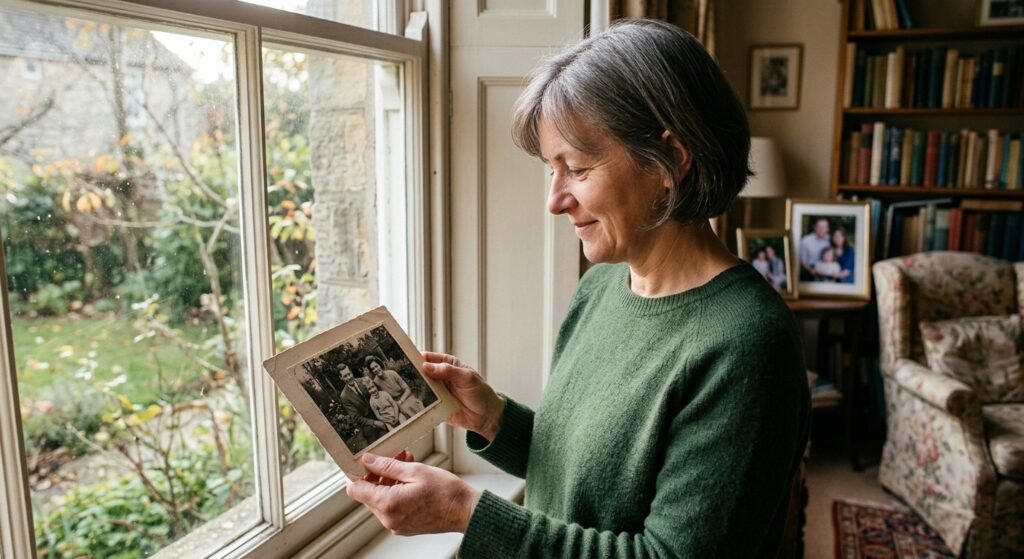
But today, something different happens. You look at the image, and instead of feeling that old spike of defensiveness or sorrow, you notice something else. You notice how young your parents look. You notice how cheap their clothes were, or how tired your mother’s eyes seemed behind her smile. You notice your father’s posture, which looks less like authority and more like sheer exhaustion. For the first time, you don’t just see the parents who let you down. You see two young people who were clearly overwhelmed, trying to navigate a world they hadn’t figured out yet.
The Way We Rewrite Our Past
We often treat our memories as if they are permanent records stored in a filing cabinet. We assume that what happened is fixed, and that our feelings about those events should remain the same forever. Yet researchers who study memory tell us something far more fascinating. Every time we recall a memory, we aren’t pulling a dusty book off a shelf; we are active participants in recreating the scene. Our minds rebuild the past using the tools, the wisdom, and the emotional safety we possess in the present moment.
How We Protect Ourselves
When you are younger and still processing the wounds of childhood, your mind naturally focuses on survival. You remember the moments of neglect, the unfair expectations, or the chaotic atmosphere because those were the things you had to protect yourself against. Your focus is entirely on how those actions affected you. It’s a necessary phase of growing up, a way of validating your own pain and establishing your own boundaries.
But as you find your own footing in adulthood, something quietly transitions. You start to experience your own complicated seasons. You learn what it’s like to try your best and still fall short. You experience the stress of trying to pay a mortgage, or the quiet panic of having people rely on you when you feel completely unprepared. Through these experiences, your capacity for perspective expands. When you look back at your childhood family, you begin to view them through the lens of shared experience rather than childhood expectation.
Seeing the Context Beyond the Pain
This transition doesn’t mean you are excusing the things that hurt you. It doesn’t mean you are pretending everything was perfect or that the mistakes made back then didn’t matter. Rather, it means your view is simply getting wider. You are beginning to see the background of the photograph, not just the foreground.
Experts in the field of narrative psychology find that our well-being is deeply connected to the stories we tell about our lives. When we are able to build a coherent life narrative, we tend to feel more at peace. This doesn’t require a happy ending where everything is resolved with a neat bow. Instead, it involves integrating the difficult parts of our history into a larger, more complex picture. It’s the moment we realize that our parents’ limitations were usually a reflection of their own unresolved histories, not a measure of our worth.
In that old kitchen photograph, you start to see the invisible pressures that surrounded them. Maybe they were dealing with financial strain that they tried to hide from you. Maybe they were carrying their own unhealed wounds from the families they grew up in. When you see them as people rather than just as your parents, you begin to realize that they were operating with a limited set of tools. They couldn’t give you what they didn’t have themselves.
The Quiet Freedom of Acceptance
There is a unique kind of peace that arrives when you stop demanding that your past be different than it was. For years, you might have held onto a quiet hope that someday, somehow, you would get an apology, or that the story would make sense in a way that took away the sting. You wanted the people in that photograph to be the protectors you deserved.
Letting go of that expectation is profoundly difficult, but it’s also where true healing begins. When you look at the faded print now, you aren’t looking for what was missing. You are simply acknowledging what was there. You are accepting that these were flawed, struggling people who loved you the best way they knew how, even if that way was clumsy, inconsistent, or painful.
This realization changes the way you move forward. You no longer need to carry the responsibility of fixing a history that cannot be changed. The girl or boy in that photograph survived, grew up, and found a way to build a life of their own. By seeing your family stories with this new perspective, you aren’t changing what happened. You are simply changing what the memory does to you when you hold it in your hands.
Perhaps that is the real gift of growing older. You realize that you don’t need a perfect childhood to have a meaningful present. You look at the old photo one last time, notice the yellowing tape on the corners, and place it back in the box. The hurt is still a part of the story, but it’s no longer the whole story. You close the lid, slide the box back onto the shelf, and step back into the quiet comfort of the life you’ve built for yourself.