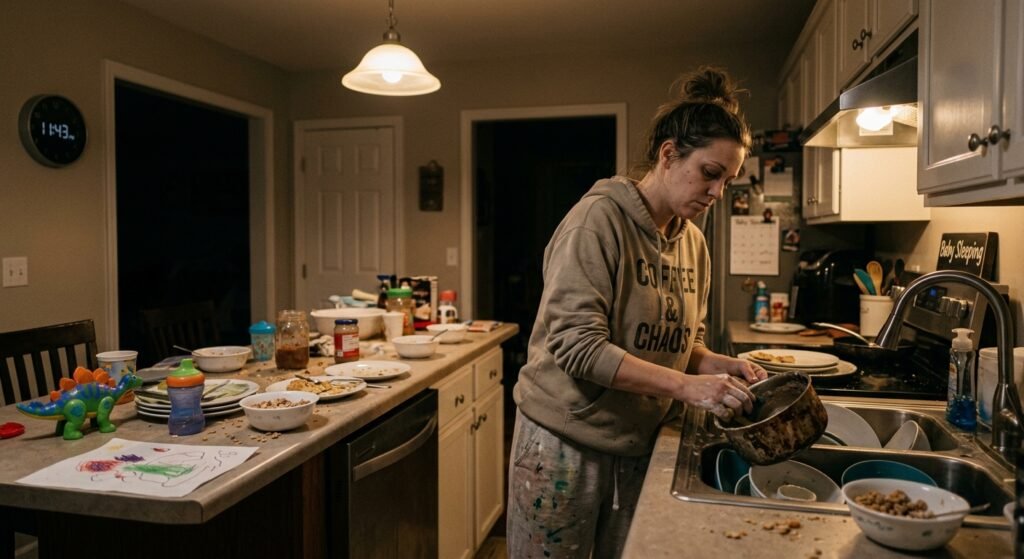
You’re sitting on the living room floor, surrounded by a scattered sea of plastic blocks and half-chewed board books, looking at the clock. It’s only quarter past five in the afternoon. The day has already lasted what feels like a lifetime, yet there are still hours left before bedtime. In this exact moment, you feel a familiar, quiet ache. You’d give anything for someone to walk through the front door, not to do anything grand, but just to hold the baby for ten minutes so you can drink a cup of tea while it’s still hot. Or perhaps just to have another adult in the room to look at and say, “We made it through Tuesday.”
But the door stays closed. Your family lives several hours away, or perhaps they’re simply too busy with their own lives. Your friends are equally buried under their own mountains of laundry and work deadlines. So you pick up the blocks, wipe down the kitchen counter, and keep going. You do it because you have to, but you can’t help but wonder why this feels so profoundly difficult. You find yourself thinking about that phrase you hear everywhere: “It takes a village to raise a child.” And you ask yourself, where is mine?
The Beautiful Myth of the Village
Many people grow up believing they’ll eventually find a built-in community when they have children. We imagine neighbors popping over with casseroles, grandmothers living just down the road, and weekends spent in a big, messy, joyous circle of cousins and close friends. It’s a comforting picture. It’s also a picture that feels increasingly distant from the reality of modern life.
Today, modern parenting often happens in isolated pockets. We buy homes far from our hometowns for work. We live in neighborhoods where people wave from their driveways but rarely step inside one another’s kitchens. When you lack that automatic support system, parenting stops feeling like a shared adventure and starts feeling like a logistical marathon. Every dentist appointment, every grocery run, and every late-night fever becomes a complex puzzle that you have to solve entirely on your own.
The hardest part of this isolation isn’t the physical exhaustion. It’s the quiet guilt that comes with it. When you feel overwhelmed, it’s easy to assume the problem lies with you. You tell yourself that if you were just more organized, more patient, or more resilient, you wouldn’t feel this way. You look at other parents online who seem to be thriving and assume they’ve figured out a secret you somehow missed.
Why Independence Is a Lonely Standard
There’s a subtle cultural expectation that successful people should be entirely self-sufficient. We’re taught to take pride in managing our careers, our households, and our families without asking for help. But while self-reliance is useful in many areas of life, it’s a deeply painful standard to apply to parenthood.
When we look at how communities operated throughout history, the idea of two parents—or worse, a single parent—raising children completely on their own is a very recent experiment. Anthropologists who study family structures note that for the vast majority of history, children were cared for by multiple adults. Neighbors, older siblings, aunts, and elders all shared the daily tasks of watching, teaching, and comforting the young. This shared care wasn’t just a luxury; it was the foundation of survival. It protected parents from burning out, and it gave children a rich network of relationships to rely on.
Knowing this history doesn’t suddenly make your daily life easier, but it does offer a reassuring perspective. It means your exhaustion isn’t a personal failure. It’s a natural response to trying to do something alone that was always meant to be done together. You aren’t struggling because you’re weak. You’re struggling because you’re trying to carry a load designed for an entire community.
Building Bridges Instead of Waiting for a Village
If the traditional village doesn’t exist for you, it’s easy to feel hopeless. But many parents are discovering that while we can’t always recreate the close-knit communities of the past, we can find small, meaningful ways to build our own versions of support. Sometimes, that means letting go of the idea that we have to appear perfect to the outside world.
It starts when you allow yourself to be vulnerable with another parent at the park, admitting that you’re having a hard week instead of pretending everything is fine. It happens when you trade babysitting hours with a neighbor, even if you’re nervous about asking. These small moments of connection don’t solve the larger structural issues of modern life, but they do create tiny pockets of relief. They remind us that we aren’t the only ones feeling this way.
Perhaps the most important transition is changing how we look at our own needs. Asking for help isn’t a sign that you’re failing to handle your life. It’s an acknowledgment of your limits, which is one of the healthiest things any parent can do. When we stop trying to be superhero figures who can do it all, we make space for others to step in, even in small ways.
So the next time you find yourself standing in your kitchen at the end of a long day, feeling the strain of doing it all yourself, try to be kind to yourself. Remember that you were never supposed to be the entire village. You were only ever meant to be a parent. And maybe realizing that you can’t do this alone isn’t a defeat at all. Maybe it’s simply a quiet return to an ancient truth: that we were never meant to carry our families in isolation, and you were only ever meant to be one part of the story.