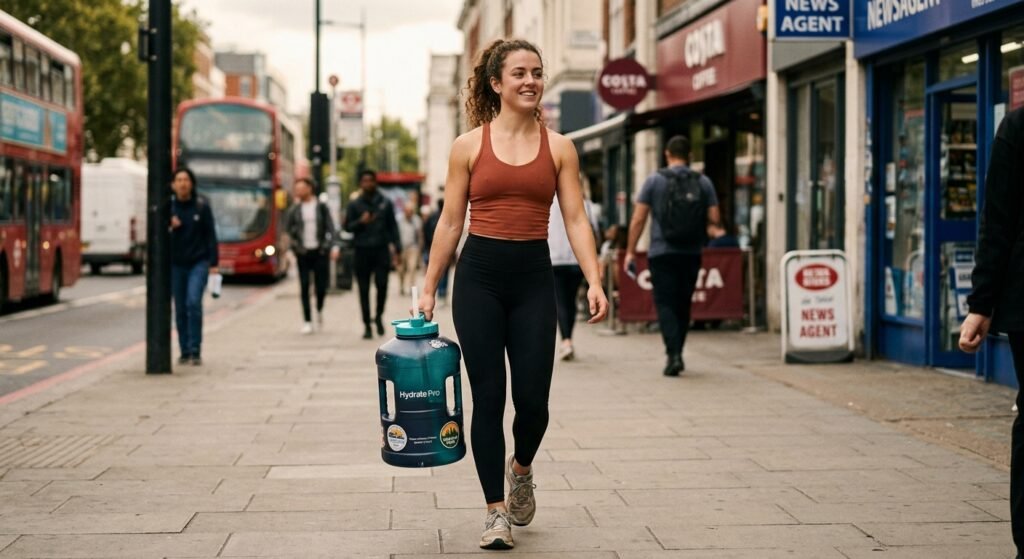
Can we talk about this for a second?
You’re getting ready to leave the house for a quick ten minute trip to the grocery store down the street. You grab your keys. You grab your phone. Then, without even thinking, you reach for a massive, insulated metal cylinder that’s currently filled with exactly thirty two ounces of icy cold water. It’s bulky, it clanks against everything, and it doesn’t fit in any cup holder known to modern engineering. But you carry it out the door anyway, cradling it in your arm like a prized trophy.
We aren’t planning a journey across a barren wasteland. We are going to buy laundry detergent and maybe some bananas. There is a very high probability we won’t even take a single sip during the entire trip. Yet, the simple act of leaving the house without this specific container suddenly feels like we’re embarking on a risky trek without any supplies. We look at people who walk around without carrying anything and wonder how they survive the sheer thrill of going an hour without constant hydration.
The Portable Security Blanket
Somehow, this object has transitioned from a basic kitchen utility into a trusted companion. It travels with us from the bedroom to the living room, then to the kitchen, and eventually into the car. If we move to a different chair, it comes along. It sits next to us during virtual meetings, acting as a convenient prop when we need a moment to think before answering a question. Taking a slow, deliberate sip of water is the ultimate way to buy five seconds of thinking time, and everyone in the meeting knows it.
The attachment becomes even more obvious when we look at the pure variety of these containers. Everyone has a specific preference. Maybe you’re devoted to the one with the massive handle that makes you look like you’re carrying a small bucket of paint. Or perhaps you prefer the sleek design with the straw that allows you to sip without ever breaking eye contact with your computer screen. Some of us have decorated these metal surfaces with waterproof stickers that act as a visual resume of our hobbies, favorite coffee shops, and state parks we visited once five years ago.
There’s a funny little story we tell ourselves about why we need this constant companion. We tell ourselves it’s all about health and hydration. We track our ounces. We celebrate when we finish the first giant bottle before noon, feeling a surge of accomplishment that seems slightly disproportionate to the actual task of swallowing liquid. We’ve convinced ourselves that drinking water is the secret key that unlocks productivity, clear skin, and a perfectly balanced life.
The Tiny Hydration Panic
But at some point, it stops being about the water and starts being about the comfort of having it there. Think about the mild wave of panic that hits when you realize you left your bottle in the car or, worse, on the kitchen counter at home. You aren’t actually thirsty yet. You drank water twenty minutes ago. But suddenly, the air feels a little drier, your throat feels a little tighter, and you’re convinced you won’t survive the afternoon without your familiar metal cylinder nearby. It’s the exact same feeling as realizing your phone battery is at four percent, except this time it’s your body you’re worried about.
This habit gets even funnier when we look at how we treat the water itself. It can’t just be any water. It has to be the correct temperature. Many of us have very specific rules about the water and ice ratio. We know exactly how many ice cubes are required to achieve the perfect chill without creating an annoying ice dam that blocks the straw. If the ice melts completely, the magic is gone. Warm water from an insulated bottle somehow feels like a personal betrayal, even though it’s the exact same liquid we were happily celebrating an hour earlier.
We also have to talk about the sound. Anyone who has ever dropped a full, insulated metal bottle on a hardwood floor or in a quiet library knows the sheer terror of that moment. It doesn’t just fall; it rings out with a deep, echoing chime that lets everyone within a three block radius know you’ve arrived. You stand there, apologizing to the room, while your bottle slowly rolls away, completely unharmed because those things are built to survive a major fall. You pick it up, dust it off, and immediately place it right back on the edge of the table, ready to do it all over again.
A Little Piece of Home
Why do we become so attached to these big metal cups? Maybe it’s because the world can feel a little chaotic sometimes, and carrying a reliable source of cold water is a tiny, manageable way to feel prepared. It’s a small piece of our personal routine that we can carry into any unfamiliar environment. Whether you’re sitting in a waiting room, starting a new job, or just sitting on the couch watching television, that bottle represents a small, comforting constant that is entirely under your control.
We look at our collection of bottles in the cupboard, the ones we don’t use anymore because we found a new favorite, and we feel a strange sense of loyalty to them. We can’t bring ourselves to throw them away. They’ve been through things with us. They’ve sat in hot cars, traveled on planes, and survived countless drops.
So, the next time you find yourself packing a giant container of water for a quick trip to the mailbox, don’t worry about the logic of it. You aren’t the only one. We’re all walking around with our oversized metal cups, quietly comforting ourselves one sip at a time. Go ahead and take it with you. You’ll probably need a sip by the time you reach the driveway anyway.