The Kitchen Rules Change When Nobody Is Watching
Can we talk about this for a second?
You find yourself with the entire house to yourself for an evening. There’s no one around to coordinate with, no preferences to balance, and no social expectations to maintain. In theory, this is your chance to cook whatever elaborate meal you love or quietly order that special dish you’ve been craving all week. You have complete freedom and all the time in the world.
Instead, within twenty minutes, you’re standing in the dim light of the open kitchen, eating cold shredded cheese directly out of the bag with your bare hands.
You aren’t even sitting down. You haven’t turned on the main overhead light. You’re just leaning against the counter like a midnight detective investigating your own pantry, convincing yourself that a slice of turkey rolled around a string cheese stick constitutes a fully realized dinner.
The funny part is how quickly our standards adjust the moment the audience leaves the room. During normal hours, when other people are present, you’re someone who uses actual plates. You care about presentation. You might even put a napkin under a slice of toast so crumbs don’t scatter across the table. You act like a responsible adult who understands basic culinary harmony.
The Magic of the Standing Dinner
But when you’re alone, a completely different set of rules takes over. For some reason, sitting at a dinner table by yourself feels like too much commitment. Pulling out a placemat, setting down silverware, and pouring a drink into an actual glass suddenly seems like hosting a party for one, and that feels entirely unnecessary. So you choose the standing dinner instead.
There’s a subtle logic at work here. In your mind, if you eat standing up in front of the counter, you haven’t officially sat down to eat. And if you haven’t officially sat down to eat, then whatever you’re currently consuming barely counts as a meal. It’s just a series of casual floating snacks that happen to take place during dinner time.
This is how the famous solo dinner menu is born. It’s never just one normal item. It’s a random collection of items that have absolutely no business existing together on the same table.
You start with something reasonable, like half an apple. Then, because the apple didn’t quite finish the job, you grab six salted crackers. While chewing those, you spot a jar of salsa sitting near the back of the shelf. There are no tortilla chips, so you dip a leftover slice of garlic bread into the salsa. Then you finish the experience with four chocolate cookies and a spoonful of peanut butter straight from the jar.
The Illusion of Zero Dishes
If anyone walked into the kitchen at that exact moment and asked what you were having, you’d probably pause, look at the spread on the counter, and say with complete confidence that you’re just having a light bite before making actual food.
We all know how this ends. You never make the actual food. You just wipe your hands on a paper napkin, close the pantry door, and consider the evening a success because you didn’t dirty a single bowl.
That is really what drives most of these choices. It’s the deep, unspoken desire to avoid dishes. Taking out a pan means you eventually have to clean a pan. Scooping pasta into a bowl means that bowl joins the sink stack. But eating a cold leftover meatball directly off a fork while staring at your phone? That’s clean, efficient, and leaves zero evidence behind.
Nobody talks about how satisfying that tiny quiet victory feels in the moment. You’ve somehow fed yourself, saved twenty minutes of cooking time, and avoided washing a single bowl. It feels like you’ve discovered a clever shortcut that the rest of the world hasn’t figured out yet.
Why Solitude Makes Us Creative
At some point, it stops being about convenience and becomes about freedom. When you’re eating with others, you have to follow social agreements. You can’t put mustard on a donut or dip potato chips into leftover chocolate frosting without receiving at least one concerned glance from across the table. Society has boundaries, and dinner tables enforce them.
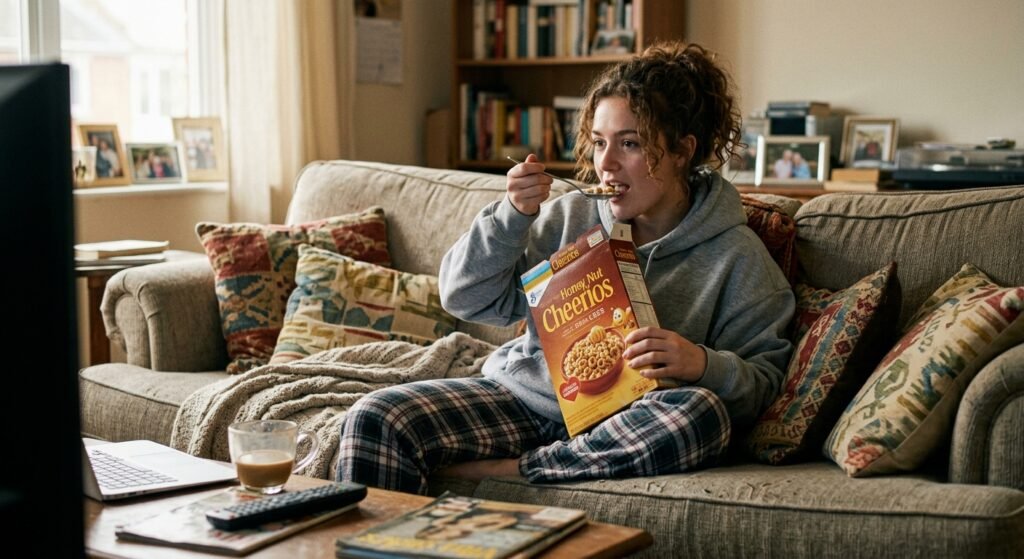
When you’re alone, those boundaries disappear completely. You can experiment. You can eat dessert first, move on to something salty, go back to dessert, and round it out with a handful of cereal directly from the box. You’re the head chef of a very private, judgment free restaurant where the menu changes every thirty seconds based on whatever catches your eye.
Psychology actually explains this pretty simple behavior. All day long, we spend our energy making structured choices, following social rules, and trying to present our best selves to the world outside. When we finally get a quiet moment entirely to ourselves, our brain looks for the path of absolute least resistance. Stripping away the formality of mealtime is just one small way we let down our guard and relax.
So the next time you find yourself standing alone in your kitchen at eight o’clock at night, dipping a pretzel into a jar of marshmallow fluff while staring into the bright light of the open freezer, don’t feel bad about it. You aren’t failing at adulthood. You’re just enjoying one of life’s tiny, harmless luxuries.
We’ve all done it. We’ll probably do it again the next time the house goes quiet. And honestly, as long as you don’t drop the peanut butter jar on the floor, it’s one of the best parts of having the place all to yourself.