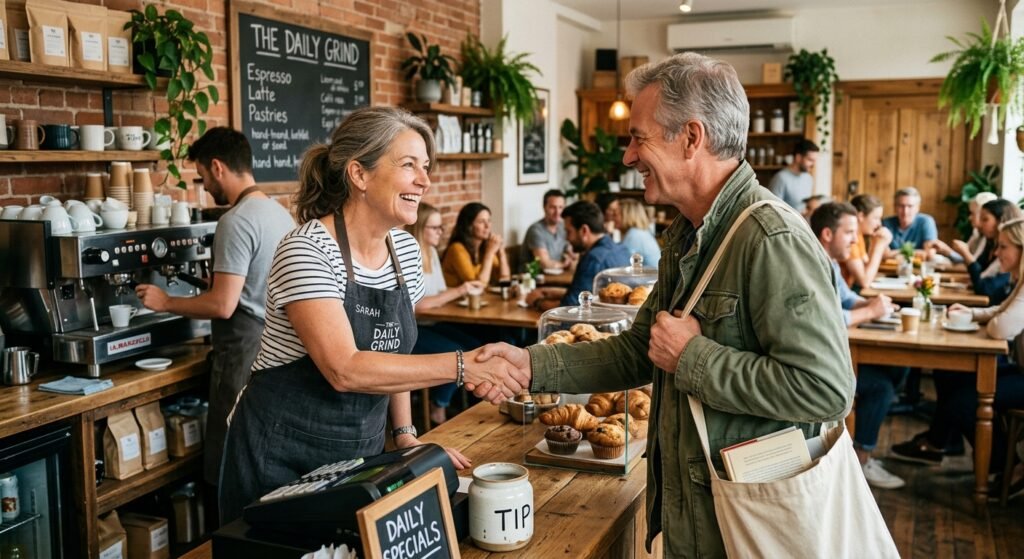
There’s a quiet moment that happens when you walk into your local coffee shop on a regular Tuesday, and before you even say a word, the person behind the counter gives you a small nod and reaches for the right cup. You didn’t ask for it. You didn’t have to explain anything. They simply saw you come through the door and remembered.
It’s such a tiny moment that it’s easy to overlook. Yet, if you pay attention, that simple recognition carries a surprising amount of warmth. It brightens your morning in a way that feels entirely different from a discount code or a speedy transaction.
You haven’t just bought a drink. You’ve been recognized.
Why Recognition Feels Like Safety
In a world where so much of daily life happens behind glass screens and automated touchpads, being seen by another person in the real world carries real emotional value. Most of us spend our days moving through spaces where we’re completely anonymous. We merge onto roads full of strangers, walk down busy sidewalks, and scroll past thousands of faces we’ll never know. It’s easy to feel like you’re floating through your day without making much of an impression on anyone.
That’s why these small, repetitive places in our lives matter so much. They act like anchor points in our week. Psychologists who study social connection often highlight the importance of what they call weak ties, which are those casual, low-stakes relationships with neighbors, local shopkeepers, or the person who walks their dog along your street at the exact same time every evening. Research consistently shows that people who maintain a steady web of these brief, friendly interactions feel significantly happier and more grounded in their everyday lives.
We don’t need every person in our lives to know our deepest secrets or our personal history. Sometimes, just having someone know how you take your tea or that you always sit by the window is enough to make the world feel a little safer and a lot less distant.
We Build Small Homes Outside Our Houses
Think about the places where you feel most comfortable outside your own front door. It’s rarely the most expensive restaurant in town or the flashiest new spot on the corner. More often, it’s the quiet neighborhood diner with slightly worn vinyl booths, the local library branch where the librarian remembers what author you finished last month, or the small park bench where the morning sun hits just right.
These places quietly become extensions of our personal lives. They offer a specific kind of comfort because they ask so little of us. You don’t have to perform, explain yourself, or impress anyone. You just get to exist in a space that has learned your patterns over time.
When you’ve had a long week where you felt overlooked at work or exhausted by life’s daily demands, stepping into a familiar room where someone greets you by name does something remarkable. It quietly restores your sense of place. It tells you that even if the rest of your day was chaotic, here is a corner of the world where you fit right in.
It Is Never Really About The Coffee
It’s easy to assume we keep going back to the same local spots because the food is better or the commute is convenient. We tell ourselves we’re loyal customers because of the quality of the service or the speed of the line. But if you look a little closer at your own habits, the truth is usually much softer than that.
We return to familiar places because we’re looking for proof that our presence matters. We’re looking for subtle reassurance that if we didn’t show up for a few days, someone might notice we were gone.
Maybe we don’t actually need a better morning routine or a brand-new space to feel grounded. Maybe what we’re really searching for is simply the quiet comfort of being expected somewhere, even if it’s just by a friendly face behind a counter who already knows your order.