Can We Talk About This For A Second?
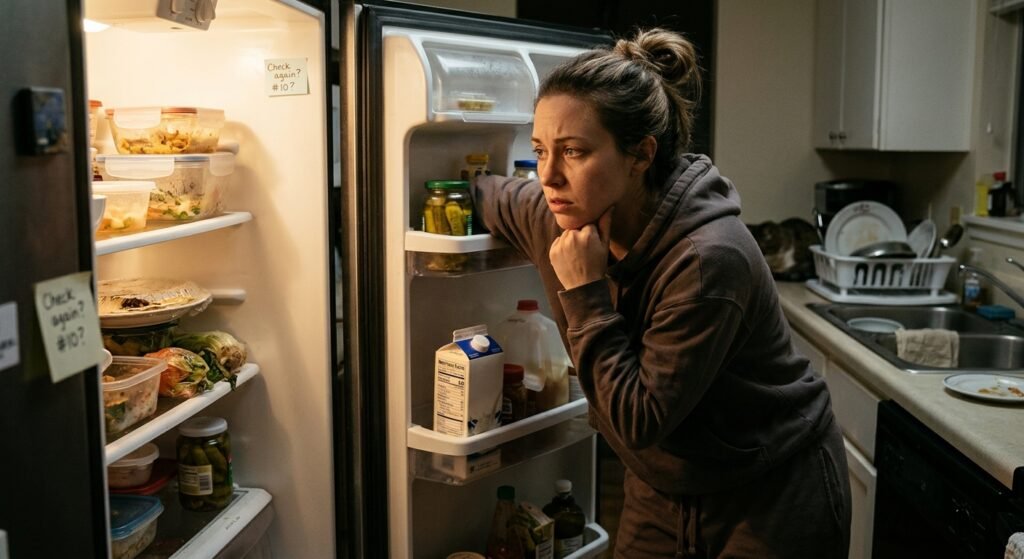
You walk into the kitchen, open the refrigerator door, stand in the cold glow for ten seconds, pull back, and close it. You didn’t select anything. Nothing grabbed your attention. So you turn around, wander into the living room, check your phone, and then five minutes later, find yourself standing in front of the exact same open refrigerator again.
The funny part is that nobody in your house bought groceries in those five minutes. No mysterious benefactor snuck in through the back door to restock the shelves with fresh takeout or artisanal cheese. You know this. Your brain completely understands how reality works. Yet, there you are, pulling open the handle with the quiet belief that maybe, just maybe, something delicious materialized out of thin air while you were looking at a text message.
We’ve all done it. In fact, most of us do it multiple times a day. You open the door, scan the top shelf, check the drawers, sigh, and walk away. Ten minutes later, you’re back. Only this time, you lower your gaze. You lean in a little closer. Suddenly, items that were completely unappealing during pass number one start looking remarkably interesting during pass number four.
Lowering Your Standards Five Minutes Later
On the first visit, you were looking for a full meal. You wanted a hot slice of leftover pizza or a perfectly packaged deli sandwich. By the third visit, you’ve lowered your standards to a block of cheddar cheese and a handful of grapes. By the seventh visit, you’re genuinely staring at a half-full jar of dill pickles and a bottle of yellow mustard, wondering if there’s a way to combine them into a respectable snack.
At some point it stops being about the food. You aren’t even hungry anymore. You’re just restless.
When you open the door, you’re not actually looking for nourishment. You’re looking for a plot twist. You’re seeking a tiny moment of entertainment, a brief pause between whatever task you were supposed to be doing and whatever task you’re trying to avoid. The cold air against your face feels like a soft reset button for your brain. Standing there gives you five seconds where nobody is asking you for anything, no notifications are popping up, and the only decision in front of you is whether to eat a yogurt that expires tomorrow.
There’s also a strange kind of hope involved. Every time you open that door, you’re practicing a tiny form of stubborn optimism. You convince yourself that the environment might have changed while your back was turned. It’s the same reason people scroll through social media, close the app, and immediately open it again three seconds later. We’re constantly hoping that the universe has updated its inventory in the last minute and left something delightful waiting just for us.
The Hidden Logic Of Kitchen Exploration
Psychologists might say this behavior is driven by a simple search for reward or a natural reaction to transition periods in our day. When our minds are switching from work mode to relaxation mode, or from being busy to being bored, we naturally crave a small, predictable interaction. Opening a door that lights up and cools your face is surprisingly satisfying, even if the reward inside is just an onion and three condiments.
Somehow this always happens when we’re trying to figure out what comes next. You finish a work assignment, you stand up, and you go to the kitchen. You finish watching a show, you stand up, and you go to the kitchen. The room has become the designated waiting room of everyday life, and the refrigerator is the main event.
Think about the quiet logic we tell ourselves during each visit. During pass one, you reject the leftover roasted vegetables because they feel too healthy. During pass five, you re-evaluate those same vegetables with newfound respect. You tell yourself that if you reheat them and add enough hot sauce, they’re practically a fresh dinner. By pass eight, you’re taking individual slices of turkey directly out of the container with your fingers, standing directly in front of the light like a late night scavenger who has lost all sense of decorum.
For some reason this suddenly feels completely reasonable in the dark.
Making It Look Purposeful
The best part is how we try to make it look purposeful. If someone walks into the room while you’re on your sixth visit, you don’t admit that you’ve been standing there every ten minutes like a lighthouse keeper inspecting the coast. Instead, you pick up a jar of mayo, turn it around, inspect the label with intense focus, and put it back down, as if you were just double-checking an expiration date for important administrative reasons.
We all know how this ends. Eventually, you either assemble a completely random assortment of items that have no business being on the same plate, or you finally give up, close the door, and accept that the kitchen isn’t going to produce a miracle tonight.
But tomorrow afternoon, when you’re feeling a little restless or looking for a five-second break from your desk, you’ll walk right back into the kitchen. You’ll grab that handle, pull open the door, and let the cool light wash over you once again.
And honestly? That’s completely fine. It turns out that repeatedly checking an empty shelf isn’t a sign of forgetfulness. It’s just proof that deep down, we’re all remarkably optimistic creatures who refuse to give up hope that something good might appear when we least expect it. So go ahead and take another peek. Maybe pass number eleven is the one that changes everything.