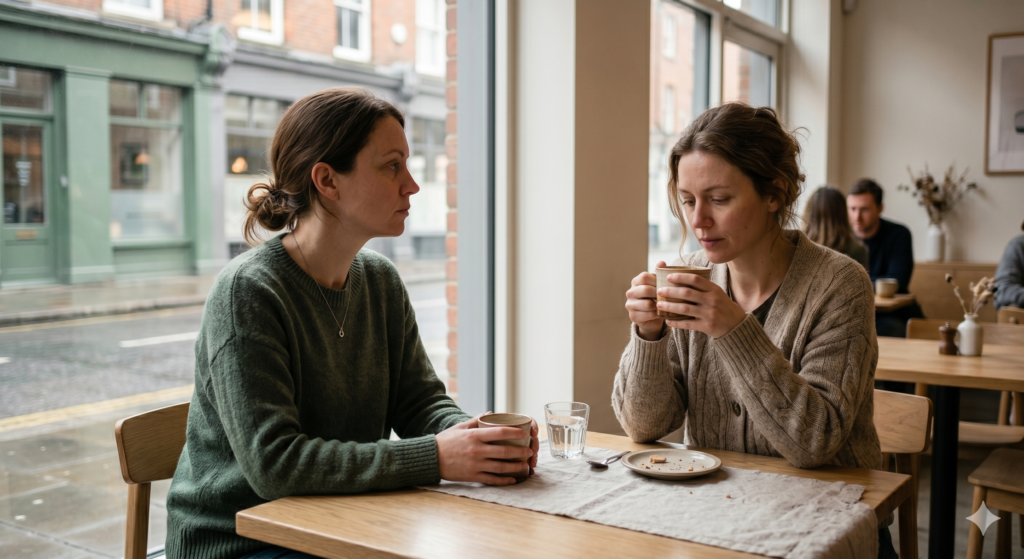
You probably know the exact moment your mood turned bad. Maybe a meeting ran late, someone snapped at you in traffic, or you woke up with an unexplained cloud hovering over your head. By the time evening arrives, you’re drained, irritable, and thoroughly unimpressive company.
With most people in your life, you know what’s expected of you next. You put on a smile, pull up a cheerful voice, and apologize for being quiet. You try to be good company because being bad company feels like a social failure. But every once in a while, you find a friend who changes the rules entirely.
You sit on their couch, drop your bag on the floor, and say nothing. They take one look at you, pass you a glass of water, and return to whatever they were doing. No lecture, no forced cheer, no interrogation. Just permission to be completely unlovely for an hour.
The Exhaustion of Always Performing
So much of adult life requires a subtle level of performance. You manage your reactions at work, stay polite with neighbors, and make enthusiastic small talk at gatherings even when your brain feels completely fried. Over time, you learn that people prefer you when you’re easy, pleasant, and upbeat.
That expectation becomes so automatic that you start treating yourself like a host who always has to keep the guests entertained. When a bad mood strikes, you feel guilty for bringing down the energy in the room. You catch yourself saying things like, “Sorry, I’m awful company tonight,” as if you’re offering an apology for your actual personality in that moment.
Observational research in social psychology shows that maintaining an upbeat emotional front requires real effort. When you feel forced to hide your genuine state of mind, your brain remains in a mild state of alertness. You’re constantly checking your facial expressions, measuring your vocal tone, and editing your thoughts before they leave your mouth.
It’s why coming home after a long day of forcing smiles feels physically tiring. You haven’t just been working; you’ve been acting.
When Connection Doesn’t Ask for an Act
That’s what makes certain friends feel like a deep breath of fresh air. They’re the rare people who don’t ask you to edit yourself before stepping into their space.
When you’re around them, you don’t have to pretend that everything is fine. If you’re quiet, they don’t assume you’re angry at them. If you’re annoyed, they don’t rush to fix it with silver linings or inspirational quotes. They just let the mood sit in the room without treating it like a problem that needs to be solved.
There’s a quiet intimacy in being allowed to sit in silence on someone’s floor while they scroll through their phone or cook dinner. You aren’t entertaining each other. You aren’t working to keep the conversation alive. You’re just two people sharing space, resting in the comfort of not needing to impress anyone.
In those moments, the pressure to be interesting or pleasant disappears entirely, leaving behind something far more comfortable: relief.
Safety Is Found in the Silence
Sociologists who study long-term bonds often note that the strongest relationships aren’t defined by how much fun two people have together. They’re defined by how much friction and stillness the bond can handle without pulling apart.
When a friend grants you permission to be low energy or grumpy, they’re sending a subtle but powerful signal. They’re showing you that your value in their life isn’t tied to your output. You don’t have to bring high energy, quick humor, or sharp conversation to deserve a place in their living room.
That kind of acceptance is surprisingly rare. Most social spaces ask you to earn your stay through charm, helpfulness, or positivity. A friend who accepts your off days removes that requirement entirely. They offer a quiet space where you can let down your guard without worrying about losing your place.
And honestly, that changes how you move through the world. Knowing you have even one spot where you can show up completely empty makes the rest of life’s demands much easier to handle.
The Space to Simply Be
It’s easy to celebrate the friends who light up a room, the ones who plan the trips and make everyone laugh until their sides hurt. Those friendships are wonderful, but they only cover half of life.
The other half of life takes place in the quiet corners: after bad news, during long weeks, and in those ordinary moments when you simply don’t have anything left to offer. In those moments, you don’t need a cheerleader. You just need someone who won’t ask you to put your mask back on.
Maybe real closeness isn’t about finding people who always make you feel better. Maybe it’s about finding people who make it safe to feel bad until you’re ready to come back to yourself.
And when you find someone like that, you realize that the greatest gift a friend can give you isn’t a quick fix for your bad day. It’s simply letting you sit in it until the sun comes back up.