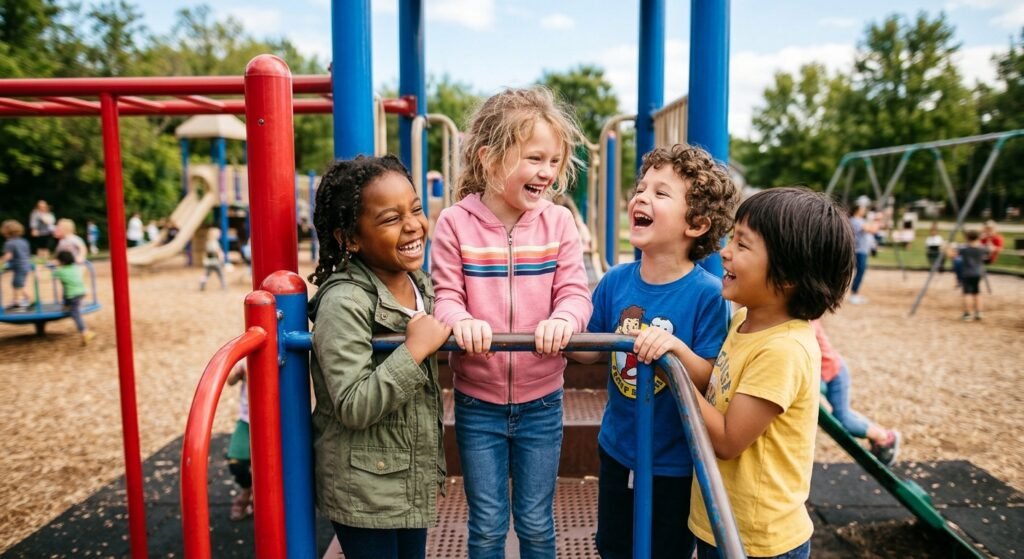
There’s a specific kind of quiet tension you carry as a parent when you drop your child off somewhere new. You watch them step into a crowded room or walk toward a busy playground, their small hands clutching their backpack straps just a little too tightly. You stand near the fence, lingering longer than you probably need to, silently hoping someone turns around and calls their name.
You remember what it felt like to stand on the edge of a group, wondering if there was space for you. You know how big a lunchroom can look when every table seems already claimed. So you wait, holding your breath, until you see them take those first hesitant steps toward another kid building with blocks or swinging on the monkey bars.
And when that initial connection doesn’t happen right away, you carry that quiet ache with you through the rest of your day. It stays in the back of your mind while you answer emails or prepare dinner, a persistent thought asking if they’re doing okay over there on their own.
The Unspoken Pressure Of Watching From The Sidelines
Parenting brings a strange kind of emotional mirroring. When your child feels left out, you don’t simply watch their experience from the outside. You feel it directly in your own chest. Their social world becomes intimately tied to your own peace of mind, even when you try your best to stay grounded.
That feeling isn’t dramatic, and it rarely turns into big conversations. It’s found in the quiet moments on the drive home from school when you ask who they played with at recess, and they give you a quick, vague answer before staring out the window. It’s the subtle sting of realizing they spent another afternoon wandering near the school steps while other kids ran around in loud, laughing groups.
You can offer comforting words, encourage their confidence at home, and host playdates, but you can’t force friendship to spark. Connection is something they have to find on their own terms, in their own time. And watching that process unfold from a distance requires a patience that feels remarkably hard to hold.
The Science Of Social Safety
Psychologists have long understood that belonging isn’t just a pleasant social bonus for growing minds; it’s a foundational emotional need. From our earliest developmental stages, having a secure base of peers helps young people figure out who they are outside the boundaries of their family. Friends become the mirrors through which children learn trust, negotiation, and self worth.
Researchers who study developmental relationships often point out that peer acceptance serves as an emotional cushion. When a child finds even one good friend, their stress levels drop noticeably, and their willingness to explore new environments increases. It isn’t about having a huge circle or being popular. It’s about knowing there’s at least one person who looks forward to seeing you walk into the room.
When you witness that dynamic begin to form, you aren’t just seeing two kids playing tag or sharing snacks. You’re observing a core need being met right before your eyes. You’re watching your child build a small, safe harbor in a world that can often feel overwhelming and unpredictable.
The Quiet Joy Of The Ordinary Afternoon
Then one day, the pattern changes in the most subtle way imaginable.
You pull up to the school sidewalk or walk into a park, and you don’t see your child standing alone near the doorway. Instead, you see them hunched over a sidewalk drawing with someone else, both of them whispering about something so funny they can barely keep still. Or you open the front door to find them sitting on the floor, arguing passionately about the rules of a game they made up five minutes ago.
They aren’t looking around to see if they fit in anymore. They aren’t adjusting their posture or checking to see if anyone is paying attention. They’re simply existing, completely relaxed, fully absorbed in the company of someone who gets them.
The relief that sweeps through you in that moment is almost startling in its depth. It isn’t a loud, triumphant feeling, but a deep, quiet exhale that clears out weeks or months of hidden worry. You realize you can finally let go of that quiet worry you’ve been carrying on their behalf.
Belonging Is A Mirror Across Generational Lines
Maybe the reason this moment touches parents so deeply is that it touches two places in us at once. It soothes the part of us that wants desperately to protect our kids from feeling alone, but it also reaches back to the child we used to be. It reminds us of how much it meant when someone made room for us at the lunch table or picked us for their team.
We spend so much time believing our main job is to protect our kids from the world, to be their entire universe of comfort and security. But watching them find their own people reveals a broader, gentler truth. It shows us that our children are stepping into a wider network of kindness, finding laughter and support that extend far beyond our own home.
Seeing your child find their people doesn’t mean they won’t ever face hurt or disappointment again. But it gives you a soft, lasting reassurance that they don’t have to navigate those moments entirely on their own. And perhaps that’s the ultimate relief: realizing that while you introduced them to the world, they are slowly, beautifully, finding their own place inside it.