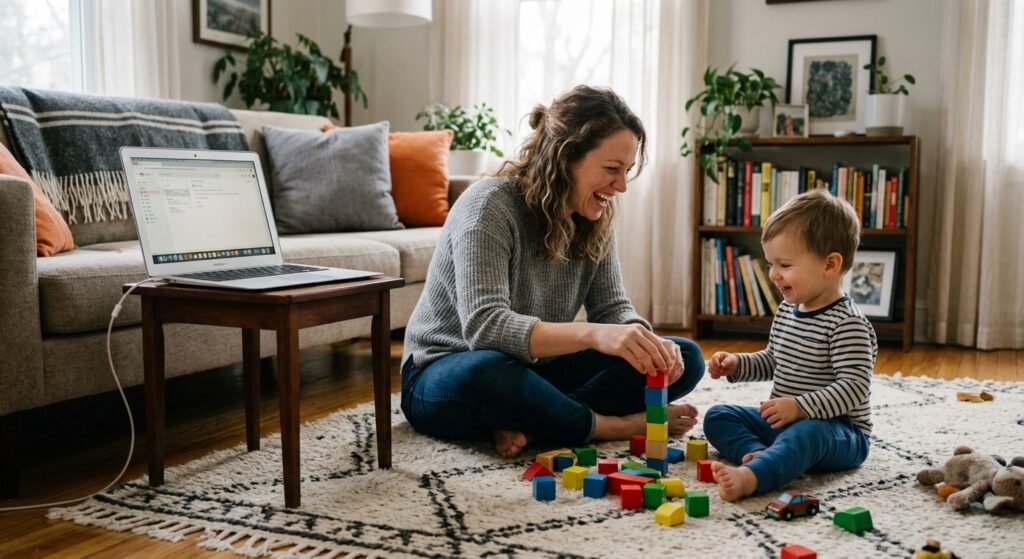
You are sitting at your desk, and the cursor is blinking on an unfinished email. Your phone is resting beside your keyboard, lit up with notifications that feel urgent. You have a task list that seems to grow longer every time you look away. Then, there is a soft touch on your elbow. You look down to see a small hand holding a plastic dinosaur, and a voice asking if you want to play.
It is a moment we experience dozens of times a week. It triggers a very specific kind of internal friction. On one hand, you want to be the kind of parent who is always available, who drops everything to build the fort or color the picture. On the other hand, your livelihood, your stress levels, and your task list are all screaming that you just need fifteen more uninterrupted minutes to finish what you started.
So we negotiate. We say, “Just five more minutes, sweetheart,” or “Let me finish this one thing first.” We promise a future version of ourselves that will be fully present, but when those five minutes pass, there is always another email, another chore, or another text message waiting for our attention. The boundary between our work lives and our family lives has become so blurry that we are constantly trying to exist in both worlds at once, usually failing to satisfy either.
The Cost of the Constant Raincheck
When we constantly postpone these small invitations, we are not just managing our schedules. We are quietly teaching our children how we value our time. Children do not understand deadlines, quarterly goals, or the pressure of an overflowing inbox. To them, time is not currency to be saved or spent. It is simply the space where connection happens.
When they invite us into their world, they are making what psychologists call bids for connection. These are small, sometimes awkward attempts to say, “Look at me, play with me, show me that I matter to you.” When we turn them down, even with the best intentions and the gentlest voices, those bids go unanswered. Over time, if those bids are consistently declined, children simply stop making them. They learn to navigate their worlds without expecting us to join them, and we lose those small windows of shared joy that are so difficult to retrieve later.
The Science of Showing Up
Researchers who study child development have found that children do not actually need hours of our undivided attention to feel secure and loved. Instead, they thrive on brief, deeply engaging moments of true connection. A study on parental responsiveness showed that when parents are fully present and engaged for even ten or fifteen minutes of play, it significantly lowers stress hormones in children and strengthens their emotional resilience.
It turns out that the quality of our attention matters far more than the quantity. When you close the laptop, put your phone face down, and sit on the floor to build a block tower, your child notices the complete change in your energy. You are no longer half listening while typing with one hand. You are there, in the room, sharing the laughter when the tower inevitably falls. That feeling of complete focus is deeply comforting to a child. It acts as an emotional anchor, letting them know that they are more important than whatever is happening on that glowing screen.
Finding the Courage to Pause
Choosing to play when work is unfinished requires a specific kind of courage. It requires us to challenge the quiet belief that our worth is tied to our productivity. We live in a culture that rewards constant motion, where being busy is often treated as a badge of honor. We worry that if we step away from our desks, we will fall behind, fail someone, or prove ourselves to be irresponsible.
But most of the tasks we treat as emergencies are actually just routines. The email can sit in the draft folder for another ten minutes. The spreadsheet will still be there after dinner. The world will not stop spinning because you paused to help find a lost puzzle piece. When we choose connection over productivity, we are practicing a form of boundary setting that protects our families from the constant demands of the outside world.
It is also worth noting how these pauses affect us. When we step away from our screens to engage in play, our own nervous systems get a chance to reset. We get to step out of the stress of deadlines and enter a space of simple curiosity and imagination. In a way, our children are offering us a life raft, inviting us to step away from the pressure of adulthood and remember how to exist in the present moment.
The Realization That Changes the View
Perhaps the real reason we struggle with these interruptions is that we see them as disruptions to our actual lives. We view work as the serious business of living, and play as a distraction we must fit into the margins. We tell ourselves that we will play when the work is done, when the house is clean, when the stress is gone, and when life is finally quiet.
But life is never completely quiet. The work is never fully done.
Maybe the invitation to play isn’t a distraction from the important things. Maybe it is the important thing. Perhaps we aren’t pausing our lives to play with our children. Maybe, in those small, unexpected moments on the living room floor, we are letting our children rescue us from a life spent waiting for the right time to live.