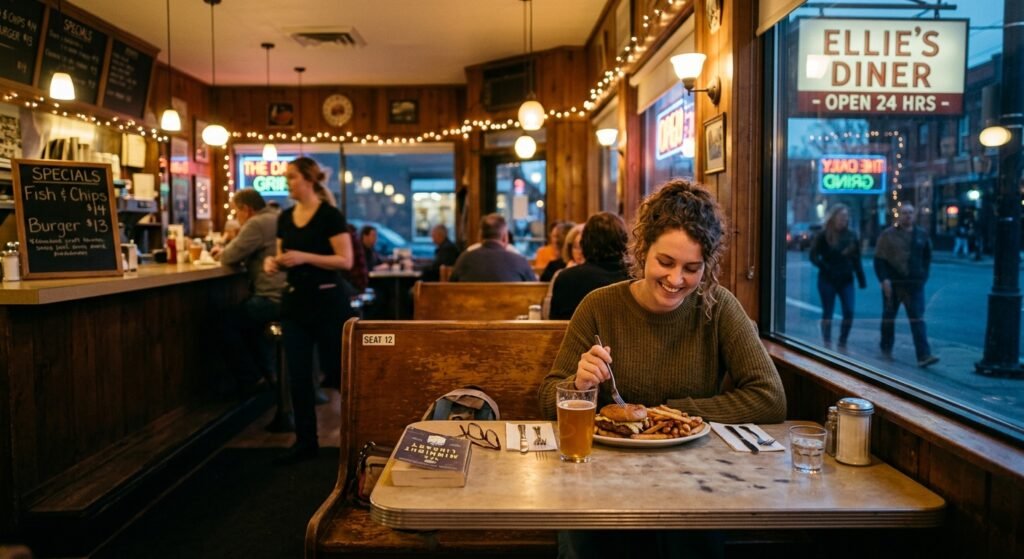
You slide into the booth, the vinyl giving a familiar, high-pitched squeak beneath you. It is mid-afternoon, that quiet stretch of the day when the lunch rush has faded and the dinner crowd is still hours away. The laminated menu is slightly sticky, the air smells of toasted bread and old coffee, and the light coming through the window is soft. You are entirely alone, and for a moment, you feel a brief, instinctive urge to pull out your phone, to look busy, to prove to anyone watching that you are waiting for someone or have somewhere else to be.
But then you don’t. You place the phone face down on the table, take a sip of water, and look around. There is a quiet magic in refusing to apologize for your own company, especially in a place built for gathering.
The Performance of Being Together
For a long time, we are taught that eating is a social act. We share tables, we pass plates, we fill the silence with updates about our careers, our families, and our plans. It is beautiful, of course, but it also requires a certain amount of emotional effort. When you sit across from someone, you are always, to some degree, performing. You are listening, reacting, validating, and sharing the space. You are keeping the conversational ball in the air, ensuring that nobody feels neglected or bored.
When you sit alone in a diner, that silent contract disappears. You do not have to worry about whether you are chewing too loudly, whether your stories are engaging, or if you are taking up too much of the conversation. You do not have to explain why you want pancakes at three in the afternoon, or why you are staring out the window instead of making eye contact. The relief that comes with this is immediate, even if we do not always recognize it right away.
It is easy to mistake this relief for loneliness, but they are not the same. Loneliness is the painful feeling of being disconnected from the world. Solitude, especially the kind found in a diner booth, is something else entirely. It is a deliberate choice to step out of the stream of expectations and simply exist alongside the world, rather than trying to manage it.
The Myth of the Spotlight
Most of us carry a quiet, persistent belief that we are the main characters in everyone else’s day. If we walk into a restaurant alone, we assume the people at the corner table are wondering why we do not have friends, or if we have just gone through a difficult breakup. We think the host is looking at us with pity when we ask for a table for one. We feel a sudden urge to explain ourselves, perhaps by mentioning that we are just traveling through town or waiting for a colleague who couldn’t make it.
But the truth is far gentler. People are far too busy thinking about their own lives, their own bills, and their own cold coffee to wonder why you are eating a club sandwich by yourself. When we realize this, the imaginary spotlight we carry around finally turns off. The pressure to justify our presence fades.
In fact, there is something deeply comforting about being unimportant in a crowded room. In a diner, everyone is in transit. The truck driver in the corner is thinking about his next delivery, the young couple near the door is whispering about their weekend, and the waitress is wondering when she can take her next break. You are allowed to be a background character, and in that obscurity, you find a rare kind of freedom.
The Diner as a Sanctuary of the Ordinary
There is a reason why diners are the ultimate setting for this kind of quiet contentment. They are not pretentious places. They do not demand elegant attire or sophisticated knowledge of wine pairings. They do not ask you to impress anyone. The menu is a comforting map of things you have known your entire life, and the staff is usually too practical for pretense.
In a diner, you do not have to perform sophistication. You can butter your toast all the way to the edges. You can read a book, stare at the pattern on the counter, or simply watch the syrup slowly run down the side of your waffle. It is a space where the simple acts of eating, drinking, and thinking are allowed to be enough.
When we stop treating these moments as waiting rooms for our next social engagement, we start to appreciate them for what they are. It is not a sad compromise or a sign of isolation. It is a quiet celebration of your own existence. You are showing up for yourself, treating your own appetite and your own thoughts as worthy of a dedicated hour.
Ending the Need to Explain
Perhaps the most significant change happens when you stop bringing props to defend yourself against the appearance of being alone. For years, many of us have used books, laptops, or phone screens as shields. We hold them up to tell the world that we are not lonely, that we are just working. We use them to avoid looking like we are sitting in our own silence.
But when you finally put the shield down, you realize that solitude becomes much easier when it stops feeling like something to explain. You do not need an excuse to be by yourself. You do not need to prove that you are productive, or that you are busy, or that your solitude is merely temporary.
Sitting alone with a hot cup of coffee and a warm plate of food is its own justification. It is a simple realization that your own mind is a pleasant place to spend an afternoon. You do not need to fill every silence, nor do you need anyone else to validate the quiet joy of a Tuesday afternoon. In the end, the diner booth becomes a small, personal sanctuary where you can finally stop explaining yourself to the world, and simply enjoy the company you have been keeping your whole life.