
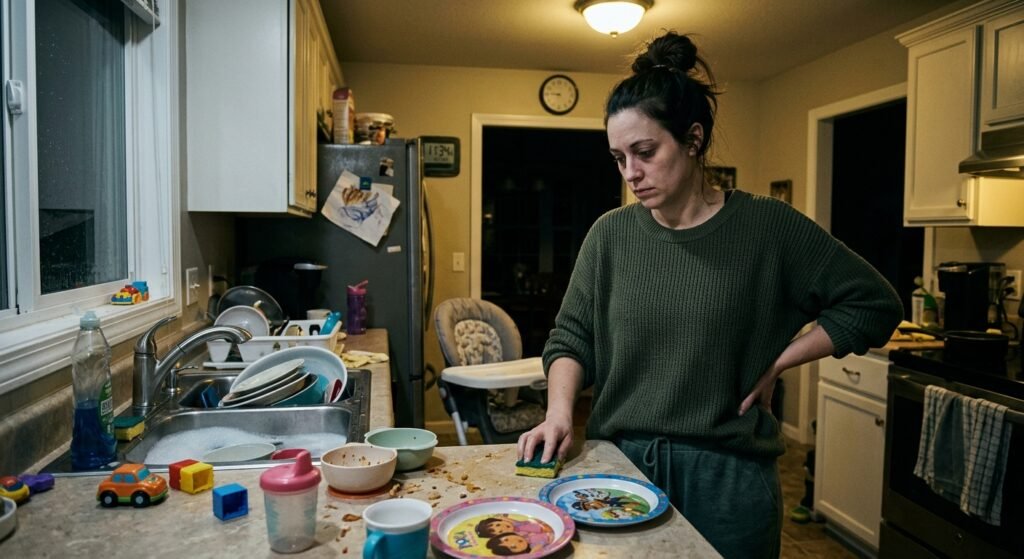
You are standing in the middle of the grocery store aisle, staring at a wall of juice boxes, when you realize you have been holding your breath. It is a random Tuesday morning, and your mind is running a quiet, high-speed inventory of things that have nothing to do with groceries. You are trying to remember if the permission slip for the school field trip was signed, whether the blue sneakers still fit, and if the cough you heard from the hallway last night requires an appointment with the doctor.
Nobody else is looking at you, and to the outside world, you are simply a parent shopping for snacks. But inside, you feel a peculiar kind of isolation that is hard to explain to anyone who has not lived it. It is the realization that while there are other people who love your children just as much as you do, you are the one who holds the master key to their daily existence. You are the default parent.
The Silent Registry of Daily Life
Being the default parent isn’t about who does more chores or who drives the carpool more often. It is about who holds the mental registry of the entire family. You are the one who knows without looking which drawer contains the spare batteries, when the dog last ate, and exactly how many nuggets must be on the plate before a dinner table standoff begins. It is a constant, quiet stream of micro-decisions that never really stops, even when you are asleep.
What makes this role so uniquely isolating is that much of the work you do is completely unobservable. When you buy next season’s clothes three months in advance because you know a growth spurt is coming, nobody applauds. When you gently steer a conversation away from a topic you know will upset your toddler, there is no praise. You are managing the emotional climate of the home, predicting storms before they arrive, and making sure everyone else has what they need to thrive.
Because this effort is quiet, it often goes unnoticed by the very people who benefit from it most. Your partner might be entirely willing to help, but they are waiting for instructions. They ask what needs to be done, which sounds like an offer of support but actually adds another task to your list: management. Having to delegate the work is, in itself, a form of labor that keeps you locked in the role of director.
The Quiet Cost of Constant Anticipation
Sociologists and family researchers often talk about the difference between physical labor and cognitive labor. While physical labor is visible, cognitive labor is the invisible planning, execution, and monitoring of family life. Studies suggest that the person who carries this cognitive load often experiences a distinct form of emotional fatigue that isn’t solved by a quick nap or a weekend away.
This fatigue doesn’t come from loving your children any less, nor does it mean your relationship is failing. It comes from the sheer volume of anticipation required to keep a household running smoothly. You are constantly living three steps ahead of everyone else. While your family is enjoying the present moment, you are thinking about lunch tomorrow, the laundry that needs to be moved to the dryer, and whether there is enough gas in the car for the morning commute.
This constant forward-thinking creates a quiet barrier between you and the people you love. You might be sitting on the living room floor surrounded by toys, watching your kids play, and yet feel miles away because your mind is occupied by the logistics of the next twelve hours. It is a strange paradox: you are physically closer to your family than anyone else, yet you feel entirely solitary in the management of their lives.
The Unspoken Role of the Primary Protector
There is also a subtle grief that comes with being the first line of defense for every emotional crisis. When a child scrapes a knee, gets their feelings hurt at school, or wakes up from a bad dream, they run to you. On one hand, this is a beautiful privilege that speaks to the deep safety you have created for them. On the other hand, it means you are the designated shock absorber for everyone else’s difficult emotions.
You absorb the tantrums, the tears, the frustrations, and the developmental transitions, often while trying to keep your own emotions perfectly balanced. You have to be the steady anchor, which means you rarely have the space to feel unsteady yourself. Over time, this requirement to remain constant can make you feel like you are disappearing behind the role you play.
You look around at other parents at the park or the school gate, wondering if they are also carrying this quiet, internal monologue. You want to ask them, but you worry that speaking the truth aloud will sound like you are ungrateful for the family you wanted so badly. So you keep it to yourself, assuming that everyone else is managing the pressure with much more grace than you are.
Finding Your Way Back to the Present
The solution to this loneliness isn’t as simple as asking your partner to do more dishes or scheduling a spa day. Those things are helpful, but they don’t address the fundamental feeling of being the sole keeper of the family map. The change begins when we recognize that we cannot protect everyone from every discomfort, nor can we predict every future need perfectly.
Sometimes, the most loving thing we can do for ourselves, and our families, is to let the invisible ball drop occasionally. It is allowing the refrigerator to run low on milk, letting the laundry pile up, or letting someone else figure out what to make for dinner, even if they do it differently than you would. It requires stepping down from the director’s chair and allowing yourself to be just another passenger in the daily journey of family life.
Perhaps the quiet realization of being the default parent is that you were never meant to carry the family world on your shoulders alone, even if you are capable of doing so. The loneliness doesn’t mean you are doing it wrong, and it doesn’t mean you aren’t supported. It is simply a sign that you have spent so much time holding the threads of everyone else’s lives that you have forgotten how to let yourself be held. Realizing this allows you to step back, breathe, and remember that your presence matters far more than your performance.