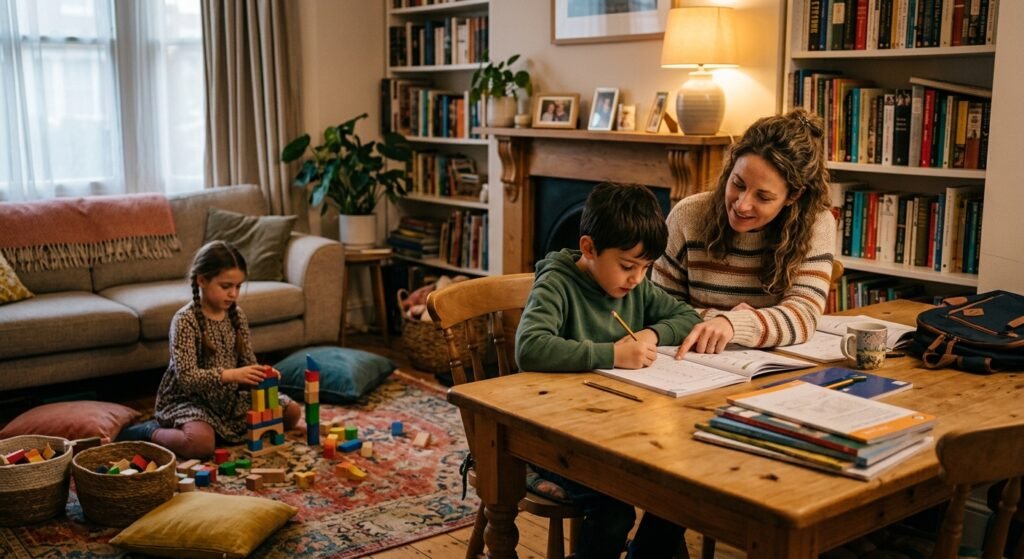
If you have more than one child, there is a quiet, uncomfortable question that probably keeps you up sometimes, long after the hallway lights have been turned off and the house has finally gone still. You might not even say it out loud to your partner, let alone your closest friends. But it sits there anyway, heavy and persistent: Why is it so much easier to love one of them some days?
You try desperately to keep the scales balanced. You divide the last slice of birthday cake with mathematical precision. You spend the exact same amount on holiday gifts, tracking the totals on a secret spreadsheet so nobody feels left out. You tuck them into bed with the same phrases, kiss their foreheads in the same spot, and try to split your Saturday afternoons right down the middle.
Yet, in the quiet, unscripted moments of daily life, the differences slip out. You notice how your voice naturally softens when your oldest asks a question, while that same question from your youngest can sometimes make your jaw tighten. You find yourself leaning in to listen to one child’s rambling story about their school day, while with the other, you find your eyes drifting to your phone, nodding along on autopilot. You feel a warm, effortless companionship with one, and a constant, low-grade tension with the other, as if you are permanently bracing for a clash.
It is a deeply unsettling realization. We are told from the moment we become parents that our love should be a perfectly level playing field. When it doesn’t feel that way, the guilt can be suffocating. But if you have ever looked at your children and realized you treat them differently, you aren’t failing. You are simply navigating one of the most complex, unspoken truths of family life.
The Myth of the Equal Scale
We tend to think of parenting as something we do to our children, a set of actions we apply equally to whoever happens to be in the room. But parenting is not a monologue; it is a relationship. And just like any other relationship in your life, the chemistry is going to be different depending on who is standing in front of you.
Think about the people you naturally click with in the outside world. Some people share your sense of humor, your quiet pace, or your need for order. Others operate on a completely different frequency. They are louder, faster, or more sensitive. When those differences occur in friendships or at work, we accept them as natural human variation. But when they show up at our own kitchen table, we treat them as a moral failing.
The truth is, some children are simply easier for us to understand. One child might share your quiet temperament. They like to read in the corner, just like you did, and they handle transitions with a calm, predictable ease. When they get upset, you know exactly what to say because you have lived inside that exact feeling yourself. Your relationship feels like a smooth, paved road.
Then there is the other child. They might be high-energy, stubborn, or deeply emotional. When they get frustrated, they scream, or they shut down completely, leaving you feeling entirely out of your depth. Every interaction feels like you are trying to assemble furniture without the instructions. It takes more work, more patience, and a lot more emotional currency. It is not that you love them less; it is that communicating with them requires a completely different language, one you are still trying to learn.
The Invisible Mirrors We Carry
For decades, researchers studying family dynamics have pointed to a concept they call “goodness of fit.” It is a simple, reassuring way of looking at a very complicated reality. The idea is that a child’s temperament and a parent’s temperament either align naturally or they create friction. It is not about anyone being a “bad” parent or a “difficult” child; it is about how your individual nervous systems react to one another.
If you are a person who deeply values quiet and personal space, a highly verbal, touch-seeking child is going to push you to your sensory limits daily. It is not because they are doing anything wrong, and it is not because you do not cherish them. It is simply that their natural state of being requires you to stretch past your comfort zone, while their sibling’s quiet nature allows you to stay comfortably within it.
But the differences we feel often go deeper than mere personality traits. Sometimes, the child who triggers our deepest frustration is the one who holds up a mirror to the parts of ourselves we like the least.
If you spent your own childhood feeling anxious and trying desperately to please everyone, watching your child walk into a room with a stubborn, defiant attitude can feel terrifying. Subconsciously, you might react to their defiance with extra sharpness, not because they are behaving badly, but because their boldness triggers an old, quiet fear inside you. You think, I was never allowed to act like that.
On the other hand, if you struggled with being shy and overlooked as a child, watching your own child struggle to make friends can feel like a direct ache in your chest. You might find yourself hovering, pushing them too hard, or reacting with a desperate anxiety that you never show toward your more socially confident child.
The Ghost of Our Unfinished Stories
In this way, our children often become time machines. They carry us back to our own unfinished stories. The child who matches our surviving strategies feels safe. The child who challenges those strategies feels like a threat to the peace we have fought so hard to build.
When we find ourselves reacting with irritation, impatience, or distance, it is rarely about the spilled milk or the forgotten homework. It is about the echo of our own past. We are not just parenting the child in front of us; we are parenting the child we used to be, trying to protect them from the pain we still remember.
Once you realize this, the guilt begins to lose its grip. You can start to see that your differing reactions are not proof of a cold heart. They are simply maps of your own unhealed spaces.
Moving Toward Awareness, Not Perfection
So, what do we do with this awareness? The goal is not to force ourselves into a state of perfect, robotic neutrality. You cannot force chemistry, and you cannot pretend that every interaction feels exactly the same. Your children would see through that performance anyway.
Instead, the magic lies in the simple act of noticing. It is about catching yourself in those micro-moments and offering yourself a bit of grace. Pause before you react. When you feel that familiar flash of irritation with the child who always pushes your buttons, take a breath. Ask yourself: Is this reaction about what they are doing right now, or is it about how this moment makes me feel?
Acknowledge the unique connection. Allow yourself to enjoy the easy connection you have with one child without feeling like it is a betrayal to the other. At the same time, look for the quiet, small ways you can connect with the child who feels more challenging, on their terms rather than yours.
Separate behavior from identity. Remind yourself that the child who triggers you is not doing it on purpose. They are not “difficult”; they are just different. They are trying to figure out how to exist in a world that might feel just as confusing to them as it does to you.
You do not need to be a perfect parent who feels exactly the same way about each child every single second of the day. That parent does not exist. What your children actually need is a parent who is willing to look at them clearly, separate from their own baggage, and meet them exactly where they are.
Perhaps being a fair parent doesn’t mean offering everyone the exact same version of yourself. Maybe it means having the courage to look at each child for who they actually are, and loving them enough to meet them there, even when it asks you to grow in ways you didn’t expect.
The next time you catch yourself using a slightly different tone, or feeling that familiar pang of guilt, take a slow breath and let it go. You are not failing. You are just learning how to love two entirely different worlds at the very same time, and that is a beautiful, messy thing to do.