
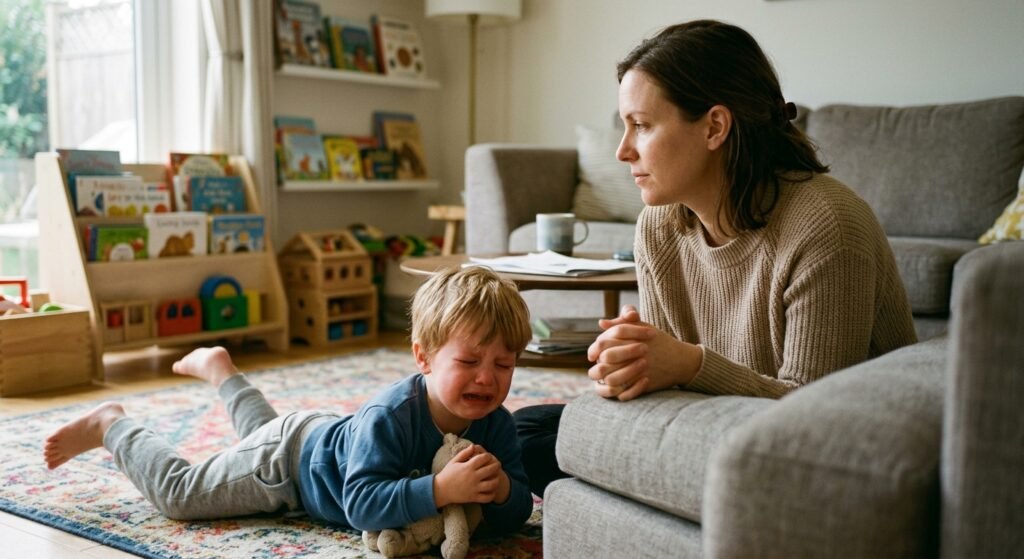
You are kneeling on the living room rug, looking into a pair of tear-streaked eyes, trying to explain why a sudden change in plans is not the end of the world. Your voice is a masterpiece of gentle authority. You explain that sometimes things do not go our way, that we have to take a deep breath, and that throwing a shoe across the hallway will not actually make the rain go away so we can visit the park.
Your child looks at you, sniffing, trying to absorb this monumentally mature advice. You feel a quiet surge of parental pride. You have handled the moment with patience, grace, and wisdom. But then, as you stand up and brush the carpet fibers off your knees, a cold splash of reality hits you. You remember how you reacted yesterday when your favorite coffee shop was closed, or how you spent three hours quietly simmering because a project timeline was rescheduled at the last minute. You did not throw a shoe, but you certainly wanted to.
The Echo Chamber of Our Own Advice
We spend a remarkable amount of energy coaching our children through the messy, loud business of growing up. We teach them how to share, how to sit with disappointment, how to apologize when they have hurt someone, and how to stop looking at what everyone else has. We treat these struggles as developmental phases, like learning to tie shoes or losing baby teeth. We speak of them as things to be conquered and left behind in childhood, assuming that once they reach adulthood, these challenges will naturally fade away.
But if you listen closely to the advice you dispense on any given Tuesday, you might start to notice a strange echo. The very behaviors you are trying so gently to nudge your child out of are often the exact same behaviors you are still struggling to manage in yourself. We tell them to use their words instead of slamming doors, yet we retreat into frosty silence when we are annoyed with our partners. We tell them that progress matters more than perfection, yet we lie awake at night agonizing over a minor mistake we made at work.
The truth is, we do not actually outgrow our emotional hurdles. We just get better at dressing them up in adult clothes. A toddler’s grocery store meltdown and an adult’s silent, resentful driving on the highway are powered by the exact same engine of frustration. The only difference is that the adult has learned how to suffer quietly, or perhaps how to channel that anger into a passive-aggressive email.
The Unspoken Mirror of Parenting
There is a unique kind of humility that comes with realizing your home is not a classroom where you are the teacher and your child is the student. Instead, it is more like a shared studio where you are both trying to paint the same difficult portrait with varying degrees of success. When our children struggle with vulnerability, or sharing, or admitting they made a mistake, it can feel incredibly frustrating to watch. But if we are honest with ourselves, that frustration rarely comes from their behavior alone. It comes because they are holding up a mirror to the very things we still have not figured out.
When you plead with your child to please just listen and stop trying to control every single detail of their afternoon, you might actually be confronting your own struggle to let go of control. When you feel a flash of irritation because they cannot seem to tolerate being bored for ten minutes without a screen, you might have to ignore the quiet buzz of your own phone vibrating in your pocket. The things that trigger us most in our children are almost always the parts of ourselves we are still trying to tame.
Psychologists who study family dynamics often talk about this as a form of emotional inheritance. It is not that we are actively teaching our children our worst habits, but rather that our children are incredibly sensitive barometers of our internal climates. They do not just hear what we say; they absorb how we live. When we try to force them to master a skill we have not yet practiced ourselves, a quiet friction builds in the household. We are asking them to do the heavy emotional lifting we have been avoiding for decades.
The Lifelong Classroom
This realization does not mean we are failing as parents, nor does it mean we should stop guiding our children. Rather, it invites us to look at the daily struggles of parenting with a different kind of lens. What if the lessons we are trying to teach our children are actually the lessons we still need to keep learning ourselves? What if the constant repetitions of “be patient,” “say you are sorry,” and “it is okay to make mistakes” are meant for the adult in the room just as much as the child?
When we look at parenting as a parallel journey of growth rather than a one-way street of instruction, something beautiful happens. The pressure to be a perfect, finished product begins to lift. You can stop pretending that you have it all figured out, which is a massive relief, because your children already suspect that you do not. Children are remarkably perceptive; they can smell the gap between our advice and our actions from a mile away.
Instead of feeling guilty about this gap, we can choose to find a quiet hope in it. When your child sees you make a mistake and genuinely apologize—not with the defensive justification of an adult, but with the simple clarity you demand from them—you are showing them what real growth looks like. You are demonstrating that learning does not stop when you reach a certain height or get a certain job. You are showing them that being human is a lifetime project.
The next time you find yourself delivering a beautifully reasoned speech about patience, or sharing, or emotional flexibility, try to let the words linger in the air for a moment. Instead of sending them entirely across the room, let a few of them drift back toward you. You might find that the very advice you are giving is exactly what you needed to hear today.
We are all still working on the same basic things. We are still trying to share our toys, still trying to keep our tempers when we are tired, and still trying to believe that everything will be okay even when plans change. And perhaps the greatest gift we can give our children is not the illusion that we have already crossed the finish line, but the comfort of knowing we are still running right alongside them.