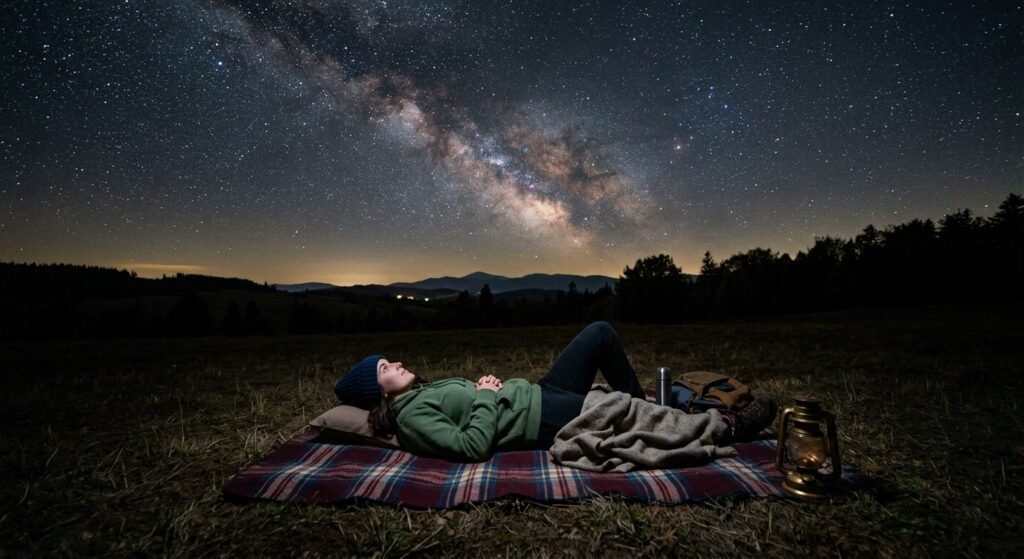
Imagine you’ve just finished a long, slightly frustrating day. Maybe you had a minor disagreement with a coworker, or perhaps you’ve spent the last hour staring at a mounting pile of laundry that you simply don’t have the energy to fold. You step outside onto your back porch or walk down to the driveway to throw away the trash, expecting nothing more than a chilly breeze. But then, for some reason, you look up.
Above you, scattered across a deep, dark canvas, are thousands of tiny, glittering points of light. They’ve been there all day, of course, hidden behind the bright blue curtain of the sun, but in this quiet moment, they demand nothing from you. They don’t care about your unanswered emails. They don’t know about the project you’re worried about failing, or the awkward thing you said during lunch. They just exist, quiet and distant, as they have for millions of years.
And suddenly, without even realizing it, you take a deep breath. The tight knot in your chest starts to loosen just a little bit. It’s a strange sensation because, by any logical measure, looking at the cosmos should make us feel insignificant and perhaps even frightened. We’re standing on a tiny rock spinning through a vast void of nothingness. Yet, instead of feeling panicked, you feel a soft wave of peace wash over you.
The Relief of Standing Underneath the Sky
Most of our days are spent trying to make ourselves feel larger. We work hard to build reputations, secure our finances, voice our opinions, and ensure our presence is noticed by the people around us. We carry the constant pressure of being the main character in our own stories, managing every detail and worrying about how every choice will ripple outward. It’s an exhausting way to live, even when things are going well.
When you look at the stars, that pressure is momentarily lifted. You aren’t the center of everything anymore, and honestly, it’s a wonderfully liberating feeling. You’re just one small spectator watching a grand, ancient show. The realization isn’t that your life doesn’t matter, but rather that the things stressing you out aren’t nearly as monumental as they felt five minutes ago.
What Happens When We Experience Wonder
People who study how we process the world have a specific name for this feeling: awe. For years, specialists in behavioral science have tried to understand why standing in front of something vast, like a mountain range, a roaring ocean, or a starry sky, has such a profound effect on our mental state. They’ve found that awe does something unique to our minds that almost no other emotion can replicate.
Research suggests that experiencing awe actually shrinks our sense of self. In studies where participants were asked to look up at towering trees or gaze at beautiful, expansive views, they consistently reported feeling smaller, but in a way that made them feel more connected to the world around them. Their personal anxieties seemed to quiet down. When we feel small, our egos take a backseat, and we’re able to see ourselves as part of a much larger, beautiful picture.
Think about the last time you saw something that truly took your breath away. Maybe it was a sunset that turned the entire sky pink and gold, or the silence of a forest after a fresh snowfall. In those moments, you weren’t thinking about your social status, your bank account, or your to-do list. You were simply present.
That’s the real magic of wonder. It acts as a natural pause button for our overactive minds. It gently whispers that the world is huge, that life is a mystery, and that we don’t have to have everything figured out right this second. It allows us to step off the treadmill of daily demands and just exist, marveling at the fact that we get to experience any of this at all.
We Aren’t Meant to Carry the Whole World
It’s easy to get trapped in the belief that we are responsible for keeping our entire world spinning. We stay up late worrying about our families, our careers, our friendships, and our futures. We treat every minor setback like a crisis and every mistake like a permanent stain on our character. We load ourselves down with expectations, trying to be the perfect parent, the perfect partner, the perfect employee, and the perfect friend.
But standing under a canopy of stars offers a quiet correction to that mindset. It reminds us that we are part of something that has been turning for a very long time, long before we arrived and long after we’re gone. The universe doesn’t need us to manage it. It just asks us to participate in it for a little while.
When we accept our smallness, we also accept our freedom. We realize that we don’t need to be perfect to be worthy of belonging. We don’t have to carry the burden of the entire world on our shoulders because we were never meant to hold it in the first place.
The Comfort of Knowing You’re Not the Center
Perhaps the greatest gift of stargazing is the perspective it leaves behind when you finally walk back inside and close the door. The laundry is still unfolded, and the emails are still waiting. But the way you see those tasks has changed. They are no longer giant obstacles defining your worth; they’re just tiny pieces of a very brief, very precious journey.
Next time the world feels too loud and your responsibilities feel too demanding, step outside for a few minutes. Find a patch of grass, look up at the dark sky, and let yourself feel small. You might find that the quietest kind of happiness comes not from standing tall above everything else, but from realizing you are just a tiny, beautiful part of a very big universe. And honestly, that’s more than enough.