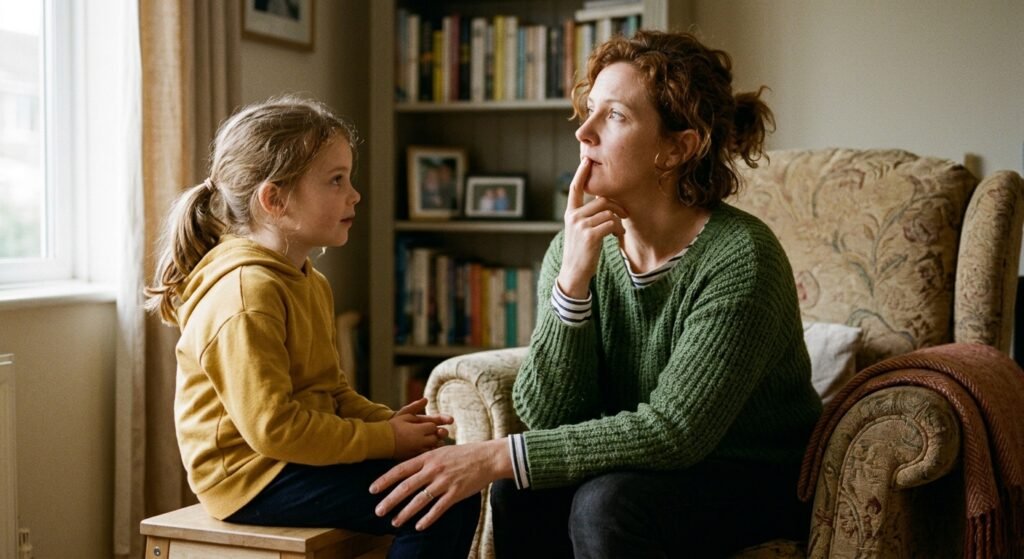
It usually happens on an ordinary Tuesday when your mind is occupied with three different things at once. You’re holding a dish towel, or standing in the hallway with your keys in hand, and somebody spills juice across the rug or forgets to close the back door. Before your rational brain can formulate a deliberate response, a sentence leaps right out of your mouth. It’s spoken with a very specific pitch and emphasis that doesn’t feel entirely yours.
You freeze for a second, feeling a sudden wave of recognition. The phrase hangs in the air, crisp and unmistakably familiar. It’s the exact phrase your mother used whenever the house got too loud, or the precise warning your father delivered when money felt tight. You spent years convinced you’d never sound like that, yet here you are, standing in your own home, delivering a script that was written decades ago.
The Echoes We Never Planned to Keep
When we’re younger, we make quiet promises to ourselves about how we’ll run our lives when we’re finally in charge. We notice the quirks, the impatience, and the repetitive refrains of the adults who raised us, and we secretly vow to craft something completely fresh. We assume our choices will be entirely our own, built from scratch through our own wisdom and modern sensibilities.
That’s why the first time a parental echo slips out, it feels so startling. It isn’t just that you used a specific phrase about turning off lights or putting on a jacket. It’s that for a fleeting moment, you realize the boundary between who raised you and who you’ve become isn’t quite as thick as you thought. The nervous system remembers things long before the mind decides to analyze them.
Why the Past Speaks for Us Under Pressure
Experts who study family dynamics often talk about how early environment shapes our default responses. In moments of surprise, tiredness, or mild overwhelm, our brain doesn’t have the time to compose a brand new speech. Instead, it reaches into the deepest drawer of its memory library and pulls out the phrase that was repeated most often during our formative years.
Research in observational learning shows that we absorb far more through quiet observation than through intentional instruction. Long before you knew how to pay a bill or manage a household, you were quietly noticing how adults reacted when dinner burned or when plans fell apart. Those reactions became the mental blueprint for what adulthood sounds like when life gets busy.
Seeing the Person Behind the Parent
There is an unexpected tenderness that comes after the initial surprise wears off. As children, we tend to view our parents as entirely complete, almost mythical figures who possess endless authority and absolute certainty. We didn’t see their internal fatigue, their financial worries, or the endless list of responsibilities they were trying to balance while making sure everyone had clean socks.
When you hear yourself repeat their words, you suddenly catch a glimpse of what it felt like to stand in their shoes. You realize that when your father complained about shutting the front door, he wasn’t just being difficult. He was likely tired from a long day at work and worried about the electric bill. When your mother repeated herself three times in the kitchen, she wasn’t trying to control the room. She was simply trying to keep a household running on very little rest.
Carrying the Story Forward
It’s easy to laugh off those moments or feel a small flash of embarrassment when you catch yourself repeating history. But those lingering phrases are also small threads connecting your present life to the generations that walked before you. They are reminders that we aren’t starting entirely from scratch, no matter how independent we try to be.
Maybe hearing yourself sound like your parents isn’t a sign that you’ve lost your individuality. Maybe it’s just the moment you realize that the adults who raised you weren’t operating from a master plan after all. They were simply trying their best in the middle of ordinary, chaotic days, using whatever words they had, just like you are right now.