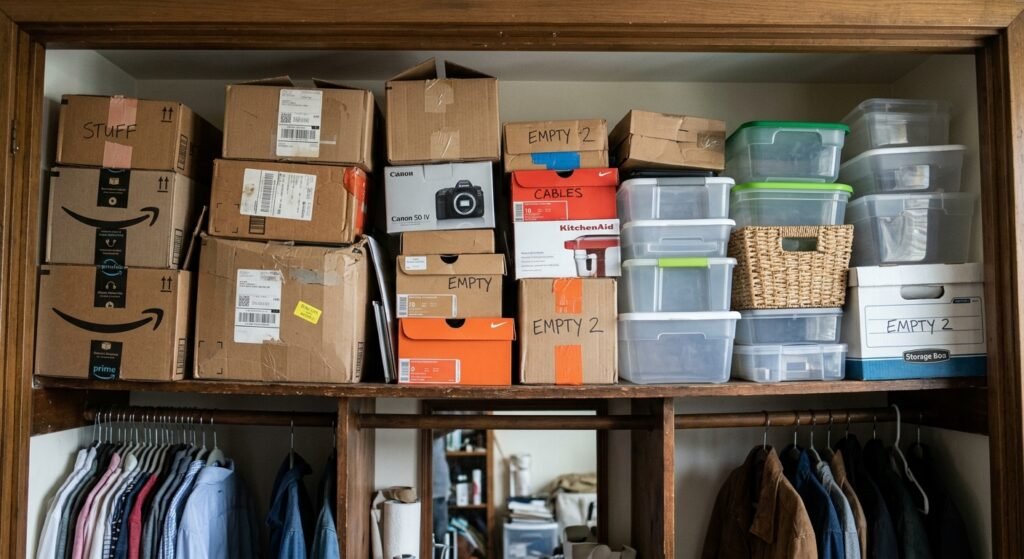
Can we talk about this for a second?
A cardboard box arrives on your porch. You open it up, pull out whatever you bought, and set your new toaster or blender on the kitchen counter. You are done with the purchasing process. But then you look down at the box sitting on the floor, perfectly intact, with its neat corners and sturdy folds, and a very specific thought enters your head.
That is a really good box.
It isn’t just any box. It’s crisp. It has potential. It feels like the kind of cardboard that was built with purpose. Before you even realize what’s happening, you find yourself folding the top flaps inward, carrying it toward the hall closet, and sliding it into the small gap between the vacuum cleaner and the wall. You tell yourself you’re keeping it just in case, though if anyone asked you to explain what that case actually is, you wouldn’t have a clear answer.
The Stories We Tell Ourselves
For some reason this suddenly feels completely reasonable. You convince yourself that tossing a quality box into the recycling bin is practically wasteful. What if you need to ship something next month? What if you decide to move across town in a few years? What if you sell that toaster online eventually and the buyer specifically demands the original packaging?
At some point it stops being about the box and starts being about who you plan to be. Saving cardboard is an act of pure optimism. It is a quiet vote of confidence in your future self. You are imagining a future version of your life that is remarkably organized, constantly mailing thoughtful packages to distant friends, or packing up an entire house with effortless efficiency.
Then there are the tech boxes. Electronics occupy a completely different category in the cardboard hierarchy. When you buy a smartphone, a tablet, or a nice pair of headphones, the box doesn’t even feel like packaging. It feels like an award. The thick finish, the smooth suction of the lid sliding off, the tiny perfectly sized compartments inside… throwing that away feels almost wrong. So into the closet it goes, joining four generations of previous phone boxes, three mystery charging cables, and the original container for a blender you gave away years ago.
The Art of Nesting
Five minutes later, you find yourself staring at a closet that is slowly being reclaimed by empty packaging. But instead of throwing anything away, you decide to solve the problem with logical strategy. You start nesting. You put the medium box inside the large box, and then you stash three smaller headphone boxes inside the medium box. You stand back, look at your creation, and feel a deep sense of accomplishment. You haven’t removed any clutter, but you’ve managed to organize it into a secret cardboard structure.
We all know how this ends. A couple of years pass. You open that closet to search for extra light bulbs, and a small avalanche of hollow cardboard tumbles out onto your feet. You pick up a box, stare at it, and realize you don’t even own the appliance that came inside it anymore. You donated the air fryer two years ago, yet its cardboard home has been living rent free in your hallway the entire time.
A Defense of Cardboard Optimism
Somehow this always happens. We hold on to these practical shapes because they represent potential. A fresh cardboard box is a clean slate, a blank canvas of utility. It promises that whenever life gets messy, you’ll have the exact right container ready to put things back together.
There is something remarkably endearing about this tiny delusion. It shows that beneath our busy daily lives, we are all quietly planning for a future where everything fits neatly into place. We aren’t being hoarders, we’re just being hopeful planners who appreciate good craftsmanship.
So the next time you open a package and spend two full minutes admiring the thickness of the cardboard before sliding it behind the guest room door, don’t feel bad about it. Keep the box. You probably won’t use it. You’ll probably move it to another shelf next spring. But for today, enjoy the quiet comfort of knowing that if you ever need to mail an oddly shaped teapot, you are completely prepared.