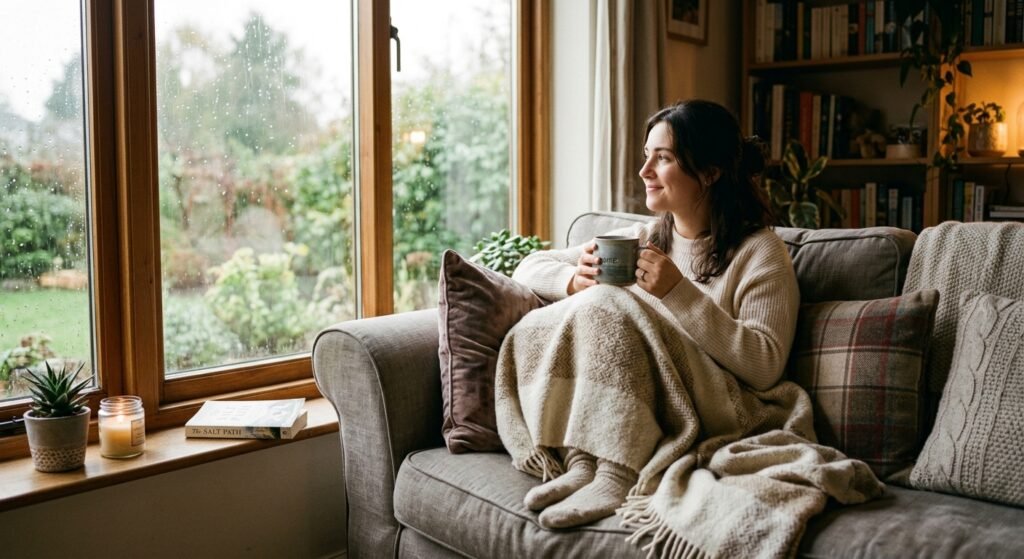

Think about the moment you finally get home after a long, exhausting day. You drop your keys on the counter, kick off your shoes, and take a deep breath. Maybe you put on a pair of soft sweatpants, make a warm drink, or sink into a favorite spot on the couch. We usually look at these small rituals and call them a search for comfort. We think we’re just resting our bodies or escaping the cold. But if you listen closely to the sigh that escapes you in those quiet moments, you might hear something else entirely.
It’s the sound of a system finally letting go. It’s the quiet relief of knowing that, at least for the next few hours, nothing is expected of you, nothing is coming to surprise you, and no one is watching. That feeling isn’t actually about the softness of the blanket or the warmth of the mug in your hands. It’s about security. It’s about the realization that you are, at long last, completely safe.
The Search for Quiet Sanctuaries
We live in a world that constantly asks us to be on our guard. Every notification on your phone is a tiny demand for your attention. Every interaction at work requires a certain level of performance. Even walking down a busy street asks us to process a million different inputs all at once. Without realizing it, we spend our days in a state of quiet vigilance, watching for changes, managing impressions, and adapting to surprises.
That’s why our homes and our habits become so vital to us. When you find yourself watching the same sitcom for the fifth time, you aren’t just being lazy. You’re giving your mind a rest because you already know exactly how the story ends. There’ll be no scary surprises, no sudden plot twists, and no emotional demands. It’s a small, predictable world where you’re in control, and that predictability is deeply soothing to a tired mind.
We often judge ourselves for these habits, wondering why we don’t have the energy for new adventures or why we’d rather stay inside on a Friday night. But when we look beneath the surface, we see that our craving for comfort is actually a beautifully wise response to a noisy world. It’s our way of rebuilding the boundaries that life quietly erodes during the day.
Why Safety Lies at the Heart of Well-Being
For a long time, researchers who study happiness focused on things like excitement, achievement, and positive emotions. They wanted to know what makes people feel thrilled or deeply satisfied with their achievements. But more recently, the focus has broadened to include something much simpler and far more foundational: the feeling of safety.
One of the most famous theories about what people need suggests that our most basic requirements must be met before we can even begin to think about personal growth or creative pursuits. Right above our physical survival needs, like food and water, sits the need for safety. When we feel threatened, even in subtle ways like job insecurity or social instability, our brains prioritize survival over everything else. We can’t experience true joy or connection when we feel like we’re standing on unstable ground.
This is why safety isn’t just the absence of danger. It’s a positive presence in its own right. It’s the emotional buffer that allows us to play, to rest, and to be vulnerable. When we feel secure, our brains release chemicals that help our bodies heal and digest. True comfort is actually a biological signal that tells us it’s finally okay to stop running.
The Beauty of the Unremarkable
Once you realize that comfort is just another name for safety, the way you look at your life begins to transform. You stop seeing your desire for routine as a weakness and start seeing it as a strength. The messy pile of books on your nightstand, the worn-out mug with the chipped handle, the specific way you arrange your pillows, these aren’t just random details. They are the physical coordinates of your sanctuary.
They tell your nervous system that you’ve returned to a place where you’re completely understood and completely accepted. In a world where we’re constantly asked to fit into boxes and meet expectations, having a space where you can simply exist without explanation is the ultimate luxury. It’s the one place where you don’t have to prove your worth to anyone.
This is also why we feel such deep nostalgia for certain spaces from our past. The memory of a childhood bedroom or a grandparent’s kitchen isn’t just about the physical layout of the room. It’s about the feeling of being protected by people who loved us. We miss the safety of a world that felt small enough to comprehend and gentle enough to trust.
Protecting Your Peace
There’s a quiet power in recognizing when you need to retreat and rebuild your walls. Sometimes, the most courageous thing you can do is admit that you’ve reached your limit and need to rest. It’s not about hiding from the world forever; it’s about giving yourself the foundation you need to eventually step back out into it with confidence.
When we prioritize our safety, we aren’t shrinking our lives. We’re actually deep-watering our roots so we can grow taller. Happiness isn’t a state of constant, exhausting expansion. Often, it’s found in the quiet intervals between the adventures, in the moments when we feel completely settled in our own skin.
So the next time you find yourself turning down an invitation to stay home in your favorite chair, don’t apologize for it. Don’t feel like you’re missing out on life. Instead, take a moment to appreciate the sanctuary you’ve built for yourself. You aren’t just staying comfortable. You’re remembering what it feels like to be safe, and that might just be the sweetest form of happiness there is.